
LA County Property Tax: Find Your Bill, Pay Safely & Avoid Penalties
Los Angeles County uses different offices and bill types for property valuation, secured tax collection, supplemental assessments, unsecured personal property, exemptions and assessment appeals. The safest first step is not the payment button—it is identifying the property and the exact bill you are dealing with.
This guide shows how to use the 10-digit Assessor’s Identification Number (AIN), check the 2026–27 secured-tax calendar, compare eCheck and card costs, verify mortgage escrow, understand supplemental bills, review exemptions and preserve an appeal deadline before completing the final action on an official LA County website.
Quick Answer: The Safest LA County Property Tax Workflow
For a normal LA County home or other secured real property, search the parcel by AIN or property address, open the current annual or supplemental bill, check payment history, verify the installment and delinquency date, confirm whether a mortgage servicer has already paid, then use the Treasurer and Tax Collector’s official payment route.
If the amount looks wrong because of assessed value, an exemption or property characteristics, switch to the Assessor or Assessment Appeals Board instead of treating the problem as a payment error.
Do not pay from a similar street address, owner name or old PDF alone. Match the AIN, property, fiscal year, Year/Sequence, bill type and installment first.
Start Here: Match Your Situation to the Correct Route
Find the AIN or use property-address search, then open the current bill or duplicate-bill tools.
Use the bill-search steps →Confirm AIN, bill type, installment, balance, payment history, escrow and current payment fee first.
Review payment options →Check the annual bill, supplemental assessment, ownership update, Homeowners’ Exemption and escrow responsibility.
Use the new-owner checklist →Check the assessment type and deadline before contacting the Assessment Appeals Board.
Review appeal dates →Use the roll year, unsecured bill number and PIN—not the normal secured-property AIN workflow alone.
Go to unsecured taxes →Check the live balance before paying because penalty, cost and redemption amounts can change.
Review late-tax steps →LA County has four main property-tax actors: the Assessor, Auditor-Controller, Treasurer and Tax Collector, and Assessment Appeals Board. Pick the task first so you do not ask the payment office to fix a valuation problem.
Which Los Angeles County Office Handles What?
Handles property appraisal, assessed value, property characteristics, ownership-related assessment records, the Homeowners’ Exemption and many other assessment exemptions.
Use it for: value, property record, exemption or ownership-related assessment questions.
Handles secured and unsecured tax bills, payments, balances, payment history, delinquency, installment plans, penalty requests and tax-defaulted collections.
Use it for: payment, receipt, balance or delinquent-tax issues.
Performs tax calculations and accounting functions and adds certain direct assessments to the secured tax roll at the request of local agencies.
Use it for: tax-rate or direct-assessment accounting questions when directed by the bill.
Hears formal appeals involving assessed value and other eligible assessment disputes.
Use it for: formal regular, supplemental, adjusted, escape or calamity assessment appeals.
If your complaint is “the value is wrong,” do not start with the payment processor. If the complaint is “my payment is missing,” do not start with the Assessor.
How to Find Your LA County Property Tax Bill
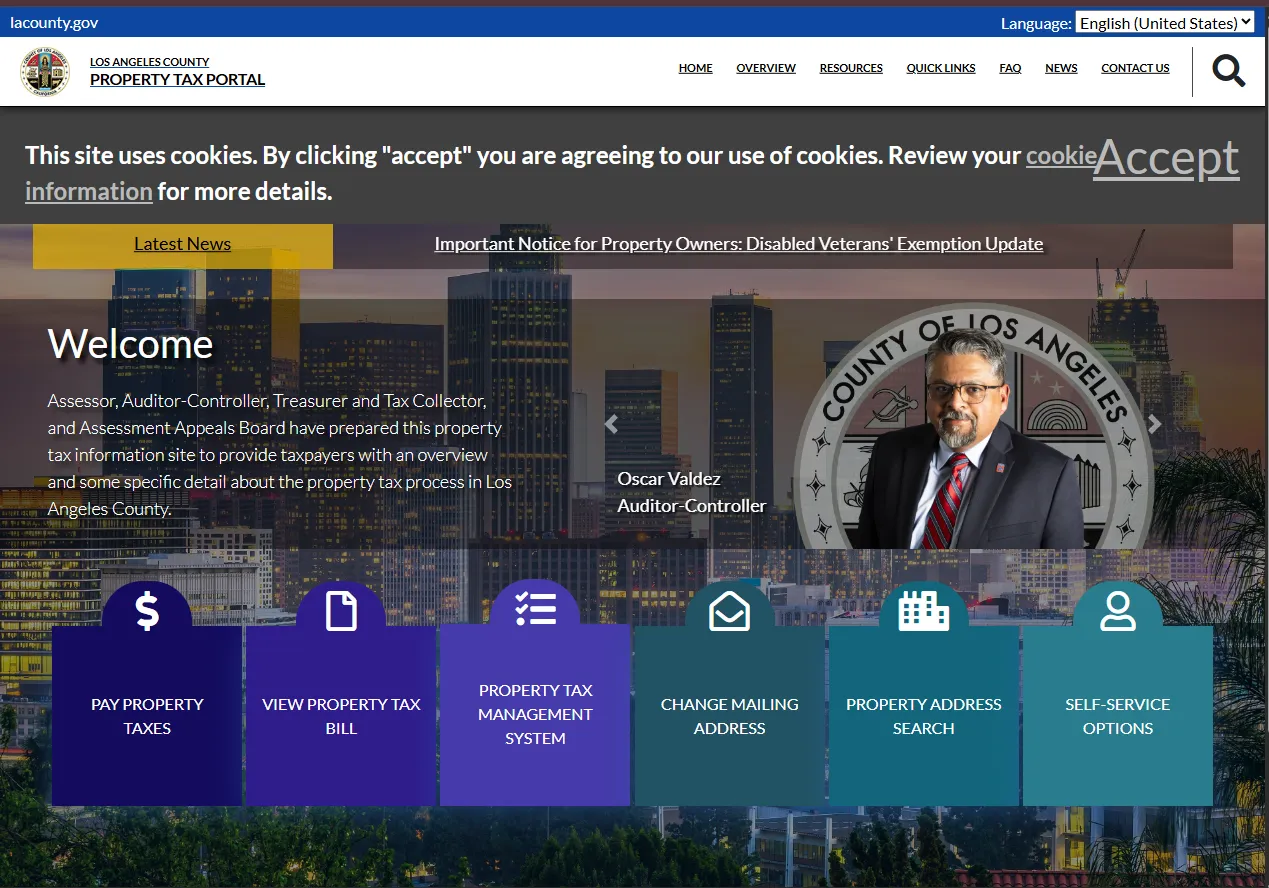
The central Los Angeles County Property Tax Portal connects taxpayers to property-address search, current tax bills, payment information, payment history and self-service tools.
- Open the Property Tax Portal.
- Use the property-address search if you do not know the AIN.
- Confirm the 10-digit AIN and property.
- Open the current bill and identify its type.
- Review payment history before paying.
If an owner-name search is confusing because the property is held by a trust, LLC or prior owner, use the property address and AIN instead.
How to Pay LA County Property Tax Safely
For secured real property, the Los Angeles County Treasurer and Tax Collector currently offers eCheck, credit/debit card, telephone, mail and in-person payment methods. Fees and limits depend on the method.
LA County currently states there is no cost for eCheck payments. You need the AIN and an ACH-enabled U.S. bank account.
Current eCheck transaction limit: $2,500,000.
The current third-party service fee is 2.22% of the payment amount, with a $1.49 minimum per transaction.
Online transaction limit currently includes a maximum of $99,999.99 including the fee.
Call the official payment system at 888-473-0835. Prepare the AIN, Year and Sequence before calling.
The same card service-fee rules apply.
Include the correct payment stub and write the AIN on the check or money order. Mail early enough to preserve a valid USPS postmark.
Do not mail cash.
Secured tax service is available at 225 N. Hill Street, First Floor Lobby, Los Angeles, subject to current county hours and holiday closures.
LA County currently links to Easy Smart Pay, an independent provider, for monthly automated payments. It has its own fee structure and privacy terms.
Review third-party terms before enrolling.
- Confirm the AIN and property address.
- Confirm fiscal year, Year/Sequence and bill type.
- Check the correct installment.
- Review the live balance and payment history.
- Check whether escrow already paid.
- Review the fee displayed for your chosen method.
- Save the confirmation number after payment.
Bank bill-pay warning: LA County discourages relying on online banking or bill-payment services for mailed property-tax payments because bank-generated envelopes may not receive a USPS postmark. Without a qualifying postmark, late-payment treatment may depend on when the Tax Collector receives the payment.
If you have an ACH-enabled checking account, compare eCheck first. It currently avoids the 2.22% card service fee.
LA County Property Tax Due Dates for the 2026–27 Cycle
Annual secured property taxes use two installments. The due date and the delinquency date are not the same thing.
Annual secured bills are prepared and mailed in October and by law no later than November 1.
The first installment becomes due. It is not yet delinquent on this date.
Payment must be timely received or qualify under the USPS postmark rule to avoid the 10% penalty.
The second secured installment becomes due.
LA County states weekend/holiday delinquency dates move to the next business day. Confirm the effective deadline on the 2026–27 bill.
Current-year secured taxes still unpaid at fiscal-year end can become tax-defaulted July 1.
Unpaid secured taxes can enter the redemption process with additional charges.
Supplemental bills have dates printed on the individual bill. Do not substitute annual secured dates.
- Open your current bill.
- Confirm whether it is annual secured, supplemental, adjusted or unsecured.
- Read the installment’s delinquency date.
- If mailing, review the USPS postmark rules.
- If already late, search the current balance before paying.
The first installment being “due November 1” does not mean a 10% penalty starts November 2. The penalty is tied to the December delinquency deadline.
How to Read the LA County Annual Secured Property Tax Bill
The 10-digit Assessor’s Identification Number identifies the real-property parcel.
Use this with the AIN to distinguish the tax year and bill sequence, especially when supplemental bills exist.
The Assessor’s valuation used in the property-tax calculation.
Shows qualifying exemptions deducted from assessed value.
The county bill explanation uses the general 1% levy against net taxable value as a core component.
Charges such as sewer, water, fire or other district items can be added without being based on Assessor valuation.
The total shown for the bill before any later payment, correction or delinquency adjustment.
Annual secured bills contain separate first- and second-installment stubs.
Read this area for delinquent-tax notes or other bill-specific information.
- Open the official Annual Secured Property Tax Bill explanation.
- Match AIN and Year/Sequence.
- Check assessed value and exemptions.
- Review general levy and direct assessments separately.
- Match the payment stub to the installment you intend to pay.
If the total bill increased while assessed value barely changed, inspect direct assessments and voted indebtedness before assuming the Assessor made a valuation error.
Supplemental Property Tax: The Bill New Owners Often Miss
A supplemental secured property tax bill is separate from the regular annual secured bill. California law can require reassessment after a change in ownership or completion of new construction.
LA County explains that a qualifying ownership change or completed new construction between January 1 and May 31 can produce two supplemental assessments: one for the remainder of the current fiscal year and another for the next fiscal year.
The supplemental bill can show full-year supplemental tax, a proration factor and the actual prorated amount due.
Do not automatically apply the annual November/December and February/April schedule. Read the due and delinquency dates on the supplemental bill.
New buyers should ask the mortgage servicer whether supplemental bills are included in escrow rather than assuming the annual escrow arrangement covers them.
- Confirm the bill says Supplemental or Adjusted Supplemental.
- Match the AIN and Year/Sequence.
- Check the ownership-change or new-construction event.
- Read the bill-specific installment and delinquency dates.
- Compare the bill with closing and escrow documents.
- Save each supplemental bill separately from the annual secured bill.
Paying the annual secured bill does not automatically satisfy a separate supplemental bill.
LA County Property Tax Exemptions and Relief
LA County states that a qualifying principal residence may receive a $7,000 reduction in assessed value, roughly equivalent to about $70 of general 1% tax before other bill components.
Eligible disabled veterans and certain surviving spouses may qualify for a larger California property-tax exemption. Current eligibility and exemption amounts should be checked with the Assessor.
Certain qualifying senior, blind or disabled homeowners may be able to review California’s property-tax postponement program. A postponement is not the same as an exemption.
- Confirm that you own the home.
- Confirm it is your principal residence under program rules.
- Check your Assessor record to see whether the exemption is already applied.
- Review the current application instructions.
- File through the Assessor if eligible.
- Later confirm the exemption appears on the assessment or bill.
If the exemption is missing, contact the Assessor rather than the Treasurer and Tax Collector’s card-payment processor.
2026 LA County Assessment Appeals
The Los Angeles County Assessment Appeals Board currently lists the regular 2026 assessment filing period as July 2 through November 30, 2026.
Use the annual filing period for an eligible regular real or personal property assessment dispute.
The filing window is generally within 60 days of the mailing date printed on the supplemental notice or bill, or its postmark date, whichever is later.
Use the mailing or postmark date on the relevant notice or adjusted/escape assessment tax bill.
The Assessment Appeals Board lists a six-month filing window after mailing of a proposed calamity reassessment notice.
Current filing fee: LA County Assessment Appeals Board currently lists a $46 non-refundable application fee. A hardship fee-waiver process is available. Verify the fee immediately before filing.
- Identify the assessment type.
- Record the notice mailing or postmark date.
- Confirm the applicable filing window.
- Gather comparable sales, photos, appraisal evidence or property-record corrections.
- Review the current application fee or fee-waiver process.
- Save filing confirmation and hearing notices.
An appeal does not automatically stop tax deadlines. Keep the assessment dispute and payment obligation on separate checklists so an appeal does not create an avoidable delinquency penalty.
LA County Unsecured Property Tax Is a Different System
Unsecured property tax may apply to certain business personal property, boats, aircraft and other property that is not secured by real estate in the same way as an annual secured bill.
Prepare the Roll Year, Bill Number and PIN shown on the unsecured bill. The bill number can change from year to year.
Annual unsecured personal property taxes are generally due upon receipt and become delinquent after 5:00 p.m. Pacific Time on August 31, subject to the county weekend/holiday rule.
eCheck currently carries no payment fee; credit/debit card payments currently use the 2.22% third-party service fee with a $1.49 minimum.
Questions about the assessee, property or assessed value belong with the Assessor even though the Treasurer and Tax Collector collects the bill.
- Confirm the bill is unsecured.
- Find the roll year, bill number and PIN.
- Verify the current amount and delinquency date.
- Review payment fee before submitting.
- Keep confirmation or mailing proof.
Do not try to pay a business personal-property bill using only a secured real-property AIN.
New LA County Homeowner Checklist
Use the deed, property search, closing papers or tax bill.
Confirm whether the current annual secured installments are paid.
Ownership changes can create separate supplemental assessments.
Principal-residence owners should verify whether the $7,000 assessed-value exemption is active.
Ask which annual and supplemental bills the servicer will actually pay.
Make sure Assessor records can deliver later assessment and tax notices correctly.
Open the Assessor’s new-homeowner page and compare its guidance with your closing statement, supplemental assessment notices and lender escrow setup.
LA County New Homeowner GuidanceA seller tax credit on a closing statement is an accounting adjustment between parties. It is not proof that LA County has posted the tax payment.
Mortgage Escrow: Check Before Paying Twice
A mortgage lender can collect property-tax money monthly without the county payment having posted yet. That gap is why owners sometimes accidentally pay a bill that the lender was already preparing to pay.
“Escrow collects for taxes” is not the same as “this exact LA County installment has posted.” Verify both sides.
Mailing LA County Property Tax Without a Postmark Problem
LA County states that a mailed property-tax payment is timely when it is received by the applicable deadline or receives a qualifying USPS postmark by the delinquency date.
For normal mailed secured payments, confirm the mailing address on the current official payment page or bill.
Use the payment stub for the installment being paid.
Place the AIN on the check or money order as directed.
Use an accepted traceable payment method.
Do not assume every postage method receives a same-day USPS postmark.
After expected processing, verify payment history.
Near a deadline? Bank bill-pay envelopes may lack the USPS postmark LA County relies on for late-arriving mailed payments. Consider the official online payment route or another county-approved method instead.
Keep proof of mailing until the official payment-history record shows the correct installment as paid.
Late, Defaulted and Redemption-Stage LA County Property Tax
For annual secured taxes, LA County currently states that a delinquent first installment is subject to a 10% penalty. A delinquent second installment is subject to a 10% penalty plus a $10 cost.
If current secured taxes remain unpaid at June 30, they can become tax-defaulted on July 1. The county currently describes a $15 redemption fee and additional redemption penalties of 1.5% of base tax per month after default.
Do not calculate a redemption payoff from this article. Once a parcel is defaulted, use the current official balance because penalties, fees, installment-plan status and later collection stages can change the amount.
The later the collection stage, the less useful an old tax bill becomes. Use a current county payoff before sending money.
Wildfire, Calamity and Disaster-Related Property Tax Help
Los Angeles County maintains separate guidance for property damaged or destroyed by wildfire or another qualifying calamity. The Assessor recommends eligible owners consider a Misfortune and Calamity reassessment claim.
The county’s disaster FAQ says the Assessor recommends filing Form ADS-820 within 12 months from the date the property was damaged or destroyed.
The county’s current guidance describes a qualifying total loss in current market value of at least $10,000.
Under qualifying rules, filing a Misfortune and Calamity claim can also affect the handling of current secured-tax payments while reassessment is processed.
Owners with impound accounts should still review the reassessment claim, but lender-payment treatment is different. Coordinate with the mortgage servicer.
Freshness note: LA County’s special 2025 wildfire penalty suspension listed in its disaster FAQ ended April 10, 2026. Do not assume that expired blanket extension applies to a 2026–27 bill. Use the current disaster page for any new event or emergency order.
- Open the current wildfire/emergency FAQ.
- Check whether your property and event qualify.
- Review the Misfortune and Calamity claim instructions.
- Confirm how filing affects your exact bill and escrow arrangement.
- Save the claim submission and later adjusted bill.
LA County Property Tax Troubleshooting
Likely cause: wrong parcel, ownership update or address-search mismatch.
Next: reopen Assessor address search and compare the parcel with your deed or bill.
Likely cause: payment is pending or was applied to another installment.
Next: compare LA County payment history with the servicer’s disbursement record.
Likely cause: routing/account error, ACH restriction or bank debit block.
Next: verify bank details and ACH authorization before retrying.
Likely cause: annual plus supplemental or adjusted billing.
Next: compare Year/Sequence and bill type rather than assuming duplicate billing.
Likely cause: reassessment, new construction or disputed market value.
Next: use the Assessor/appeal route and preserve the filing deadline.
Likely cause: local service or district charge, not Assessor valuation.
Next: use the agency information shown with the direct-assessment line.
Likely cause: new ownership, application issue or benefit not yet applied.
Next: review the Assessor exemption record.
Likely cause: bank bill-pay or postage method did not create an accepted USPS postmark.
Next: gather proof and use the TTC public inquiry route.
Likely cause: escrow timing overlap.
Next: save both payment records and contact the county about refund/credit handling.
Identify whether the problem concerns the parcel, assessment, bill, payment, exemption or appeal before contacting an office.
Documents to Keep Before and After Payment
AIN, property search result, bill PDF, Year/Sequence, installment, due date and escrow statement.
Confirmation number, receipt, bank record, check image, card receipt or postmark proof.
Closing statement, deed, lender escrow disclosure and supplemental notices.
Ownership/occupancy proof, filed application and Assessor correspondence.
Assessment notice, comparable sales, photos, appraisal evidence, fee receipt and filing confirmation.
Damage photos, repair estimates, claim form, event date and adjusted assessment/bill correspondence.
Keep proof until the county’s official record reflects the payment, adjustment, exemption, refund or appeal result—not merely until you receive an email confirmation.
LA County Property Tax Terms
- AIN
- Assessor’s Identification Number. A 10-digit real-property identifier made from map book, page and parcel components.
- Annual Secured Bill
- The normal annual property-tax bill secured by real property and generally paid in two installments.
- Supplemental Bill
- A separate bill that can result from change in ownership or completed new construction.
- Unsecured Tax
- A different tax system for certain property not secured by real estate, including some business personal property, boats and aircraft.
- Year / Sequence
- Bill identifiers used with the AIN to distinguish tax year and bill type or sequence.
- Direct Assessment
- A charge placed on the secured roll for a local service or benefit and not based on Assessor valuation.
- Tax Defaulted
- Status reached when secured property taxes remain unpaid after the fiscal year and enter redemption procedures.
- Redemption
- The process for paying tax-defaulted secured taxes and applicable penalties, fees and costs before later enforcement stages.
Related Property Tax Guides on CountyPropertyTaxes.us
Official Los Angeles County Property Tax Resources
Open the official page only after identifying your task. The notes below explain what to prepare and what to save.
LA County Treasurer and Tax Collector Office
225 North Hill Street
First Floor Lobby
Los Angeles, CA 90012
Secured Property Tax: 213-974-2111
Toll-Free: 888-807-2111
LA County currently lists normal service hours as 8:00 a.m. to 5:00 p.m. Pacific Time, Monday through Friday, excluding County holidays. Verify current service instructions before traveling.
Bring the AIN, current bill, tax year, installment, payment confirmation, escrow documentation and photo identification if it is relevant to your issue.
If you only need a balance, duplicate bill or payment history, try the county’s online self-service tools before making the trip.
Verify Office InformationLA County Property Tax FAQs
How do I find my Los Angeles County property tax bill if I do not know my AIN?
Use the official Los Angeles County Property Tax Portal and its property-address search. Confirm the correct parcel, copy the 10-digit AIN, then use that AIN to review the current bill, payment history and balance before paying.
When are 2026–27 Los Angeles County secured property taxes due?
The first installment is due November 1, 2026 and becomes delinquent after December 10, 2026. The second installment is due February 1, 2027. April 10, 2027 falls on a Saturday; LA County states that when a delinquency date falls on a weekend or legal holiday, the deadline moves to the next business day. Verify the effective date shown by the county and your current bill.
How much does LA County charge to pay property tax online?
LA County currently states that eCheck payments have no payment fee. Credit and debit card transactions currently have a third-party service fee of 2.22% of the transaction amount, with a minimum fee of $1.49 per transaction. Review the displayed fee before submitting payment.
Is a supplemental property tax bill a duplicate of the annual bill?
No. A supplemental bill can result from a change in ownership or completed new construction and is separate from the regular annual secured bill. Check its own Year/Sequence, installment amount and delinquency dates.
What is the 2026 LA County property assessment appeal deadline?
The Assessment Appeals Board states that the regular 2026 assessment filing period runs from July 2 through November 30, 2026. Supplemental, adjusted, escape and calamity assessments use separate filing windows, so check the assessment type and mailing date on your notice.
Bottom Line
For Los Angeles County property tax, start with the AIN and exact bill type. Check the live balance, Year/Sequence, installment, delinquency date and payment history before paying. Treat supplemental and unsecured bills separately, check mortgage escrow before making a duplicate payment, use the Assessor for value or exemption issues, and preserve the Assessment Appeals Board deadline when valuation is disputed.
Find Bill Pay Tax 2026–27 Dates Supplemental Bills Appeals Official LinksOfficial-source details materially reviewed: August 27, 2026.