
DuPage County Property Tax: Pay, Search, Due Dates & Relief
DuPage County real estate taxes are collected in arrears, so the 2025 tax bill is payable in 2026. The Treasurer collects the bill, but assessed-value questions normally begin with the Township Assessor or Supervisor of Assessments.
Before paying, find the 10-digit Property Index Number (PIN), confirm the property and installment, review mortgage escrow and exemptions, then use an official Treasurer payment route. If the problem is value rather than payment, use the assessment and Board of Review process instead.
Quick Answer: What Should You Do First?
Start with the official DuPage County Property Tax Information portal. Search by the 10-digit PIN, property address or map, confirm the correct parcel, then open the tax summary, taxes due, payment history or exemptions area.
DuPage issues one annual real estate tax bill with two payment coupons. Match the correct installment to the correct due date before paying.
Do not start with payment. Search first, because an old bill, wrong PIN, escrow payment or delinquent balance can change what you actually owe.
Which DuPage County Office Handles Your Property Tax Task?
Start here for property characteristics, initial assessment questions and many General Homestead Exemption questions.
Handles countywide assessment administration, many exemption programs, forms and Board of Review support.
Handles tax bills, payments, tax status, refunds, returned payments, delinquent taxes and collection procedures.
The County Clerk calculates tax rates from taxing-district levies and also handles certain billing-name and mailing-address changes.
Hears eligible assessment appeals after township assessment rolls are published.
A qualifying property owner may appeal a Board of Review decision to PTAB or pursue the appropriate court route.
“My bill is too high” can mean two different things. If the assessed value is wrong, start with the assessment side. If the value is correct but payment or posting is wrong, start with the Treasurer.
How to Search DuPage County Property Tax Records
The county property portal combines assessment and tax information in one interface, but the individual sections serve different purposes.
Use the Property Index Number printed on the tax bill when you have it.
Search by street address, then confirm the property before opening tax details.
Useful for nearby parcels, similar addresses or uncertain parcel boundaries.
Use this section for the current installment and live amount due.
Check whether a homeowner, lender or prior payer already submitted money.
Check whether expected homestead, senior, disability or veteran relief appears.
- Open the DuPage County Property Tax Information portal.
- Choose PIN, address or map search.
- Confirm the property address and parcel.
- Check the tax year.
- Open Taxes Due and Payment History.
- Review Exemptions Current if the bill seems too high.
- Only then continue to payment.
If you recently bought the property, an owner name may lag behind the deed. The PIN and physical property address are safer matching clues.
How to Pay DuPage County Property Tax
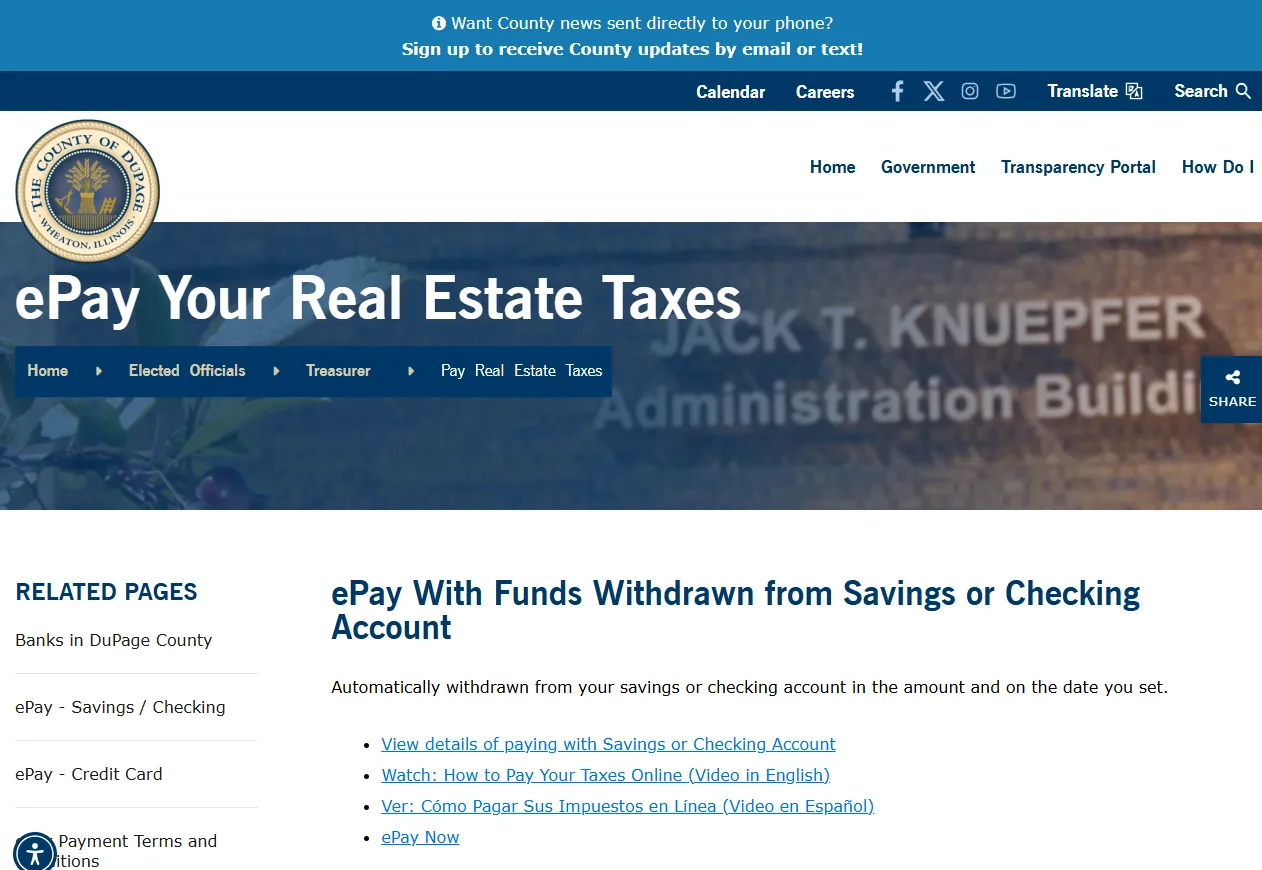
- Open the Treasurer real estate tax payment page.
- Select the payment method you want to use.
- Enter the 10-digit PIN when required.
- Confirm the parcel and full installment amount.
- Review any processor fee before submitting.
- Save the confirmation screen or receipt.
DuPage County Payment Fees and Rules
The current Treasurer credit-card page states that the third-party processor charges 2.10% and DuPage County does not retain the fee.
The in-person page currently lists a 2.10% credit-card fee with a $3 minimum.
The Treasurer currently lists a $3 convenience fee for PIN-based debit-card transactions made in person.
Checks and internet payments returned or rejected can be removed from county records and charged a $25 return-item fee plus applicable late charges.
Online debit warning: The current online credit-card instructions specifically say not to use debit cards for that online payment route. Follow the current Treasurer interface rather than assuming online and in-person card rules are identical.
For a large tax bill, compare the 2.10% card cost with the checking/savings option before choosing convenience over cost.
DuPage County Property Tax Dates for 2026
DuPage County’s 2026 calendar lists April 29 for mailing 2025 real estate tax bills.
Pay or timely submit the first installment by June 1, 2026.
1.5% monthly penalty applies to a late first installment.
The second coupon is due September 1, 2026.
1.5% monthly penalty begins on the unpaid second installment.
The Treasurer says payment must be made by this date to avoid delinquent-tax newspaper publication.
The current calendar says qualifying payments must be received by 4:30 p.m. to avoid a certified delinquent bill.
The Treasurer calendar lists this as the last day for the online system and personal checks.
Cash, cashier’s check or money order becomes the key late-cycle payment route.
Payment must be received before 4:30 p.m. to keep the property from being offered at tax sale.
The annual sale for unpaid 2025 real estate taxes begins at 9 a.m.
DuPage uses the U.S. Postal Service postmark—not a private meter mark—to determine late-payment penalty.
Late-November card cutoff: DuPage’s current official pages are not perfectly consistent: the general calendar lists November 17 as the last day for in-person card payments, while the separate in-person payment page says cards are accepted through the end of business November 18. If paying that late, call or check the live Treasurer page before traveling.
- Open Treasurer Tax Information.
- Confirm you are looking at the 2026 collection calendar for 2025 taxes.
- Match your installment to June 1 or September 1.
- If late, check the current payment method still accepted.
- If close to publication or tax sale, confirm received-time requirements.
- Keep proof of the final payment method.
How to Read the DuPage County Tax Bill
DuPage sends one annual bill with two coupons. The front and back also explain assessment, exemptions, taxing districts and payment details.
The same 10-digit identifier should appear in the property record and payment process.
Used for the first installment due June 1.
Used for the second installment due September 1.
Use these fields when reviewing whether the underlying assessment looks reasonable.
The equalization factor produces the equalized assessed value used in the tax process.
Check General Homestead, Senior, disability, veteran or other applicable benefits.
Schools, municipalities, county, forest preserve, townships, parks, libraries and other districts can affect the combined rate.
Review lender information before making a separate homeowner payment.
Use the current Treasurer record rather than an old copy if payments or penalties may have changed.
A bill can rise even if the County government’s own tax rate barely changes because the total combines many independent taxing districts.
Why a DuPage County Property Tax Bill Changes
Illinois residential property is generally assessed at one-third of fair market value outside Cook County, then equalization, exemptions and local taxing-district rates affect the final bill.
A reassessment, property improvement, sale data or corrected property characteristics can change assessed value.
State or county equalization factors can change equalized assessed value even when the base assessment looks similar.
A missing or expired exemption can increase taxable value.
School, municipal, park, library, fire, township and other district levies can affect the combined tax rate.
When a bill jumps, compare four things side by side: assessed value, equalized value, exemptions and the total tax rate. That identifies the likely source much faster than looking only at the total dollars.
DuPage County Property Tax Exemptions
For qualifying principal residences. DuPage says the Township Assessor automatically grants it in most cases.
For qualifying owners age 65 or older who own, occupy and are liable for taxes on the property.
Protects against some assessment increases but does not freeze the entire tax bill.
DuPage lists an annual $2,000 reduction in assessed value for qualifying owners.
Benefit depends on qualifying service-connected disability and applicable program rules.
Can provide an exemption on qualifying assessment increases from home improvements for up to four years.
- Open the Supervisor of Assessments exemption page.
- Choose the specific exemption rather than assuming all relief is “homestead.”
- Check qualification and tax year.
- Gather age, ownership, residence, disability, veteran or income proof as required.
- File or contact the listed office.
- Check the later property record to confirm the exemption appears.
DuPage County Senior Freeze: 2026 Income-Year Detail
The Senior Freeze is one of the easiest places to use the wrong year’s income limit. The application year and tax-payment year are not the same thing.
For the 2025 application affecting the 2025 tax bill payable in 2026, DuPage uses 2024 household income of $65,000 or less.
For the 2026 application affecting taxes payable in 2027, DuPage lists 2025 household income of $75,000 or less.
DuPage states that the Senior Freeze application deadline is October 1 each year.
The county mails renewal applications to seniors who have an approved freeze on the current bill.
Do not call this a tax freeze. DuPage says it freezes a qualifying assessment base; it does not protect against tax increases caused by higher tax rates.
- Open the current Senior Freeze page.
- Identify whether you are applying for 2025 or 2026.
- Use the matching prior-year household income.
- Confirm age, ownership and occupancy requirements.
- Download the correct application.
- File by October 1 and keep a copy.
Senior Real Estate Tax Deferral
The Illinois Senior Citizens’ Real Estate Tax Deferral is different from the Senior Homestead Exemption and Senior Freeze. It postpones qualifying tax rather than permanently removing it.
The Treasurer lists age 65 by June 1 of the application year.
Current program guidance lists combined annual household income of no more than $75,000.
Applicant must meet the ownership and occupancy requirement.
DuPage says the maximum for the 2025 tax year is $7,500.
The deferred amount works like a state-backed loan and creates a lien.
The Treasurer accepts annual applications through February 27 when the program is offered.
2026 timing: The February 27 application cutoff has already passed for the current 2026 collection season. Do not treat this program as a way to postpone a September 2026 bill after the application window has closed.
- Open the Treasurer’s Senior Deferral page.
- Check whether applications are currently being accepted.
- Review age, household income, ownership, delinquency and insurance rules.
- Read the IL-1017 and IL-1018 instructions.
- Prepare proof of ownership and insurance.
- Return the completed forms by the stated February deadline.
How to Appeal a DuPage County Property Assessment
DuPage County does not use one single countywide calendar date for every assessment appeal. The filing period ends 30 days after publication of the applicable township assessment roll.
- Open the DuPage County assessment appeal page.
- Identify your township.
- Open the current assessment publication/deadline information.
- Count the applicable 30-day appeal period.
- Prepare the correct form and supporting evidence.
- Keep a complete copy of what you file.
Do not wait for the next tax bill to decide whether to appeal. The assessment appeal period happens during the assessment cycle, before the resulting taxes are collected.
Mortgage Escrow and Duplicate-Payment Risk
A mortgage company can pay DuPage County directly from escrow. The paper tax bill may still reach the homeowner, so the bill itself is not proof that the lender failed to pay.
A lender escrow statement and the Treasurer’s posted payment history should agree before you consider the installment complete.
Duplicate Payments, Overpayments and Refunds
DuPage says duplicate payments often occur during refinancing or property sales when a homeowner, title company and mortgage company all send money for the same PIN.
The county says the taxpayer who actually made the duplicate payment must request that refund.
DuPage requests proof showing that the funds were actually debited, such as a bank record or accepted payment receipt.
If you did not make the duplicate payment, contact the mortgage or loan company so it can determine whether it should claim the refund.
The Treasurer says it attempts to contact the payer for instructions and may refund an overpayment to the check maker under its standard process.
- Open Tax Payment History.
- Identify both payments.
- Determine who made each payment.
- Gather bank, escrow and receipt records.
- Follow the Treasurer affidavit/refund procedure.
- Call 630-407-5900 if the correct claimant is unclear.
Late Taxes, Publication and DuPage County Tax Sale
Once a DuPage installment is late, simply mailing the original coupon amount can be wrong because penalties and later collection costs may apply.
Applies to each late installment under the Treasurer’s current instructions.
Pay by the county’s publication-avoidance deadline to reduce later delinquency complications.
Late-cycle payment methods become more restricted after personal checks and online payment close.
Current calendar says certified funds must be received by this time to prevent tax sale.
The annual sale begins for unpaid 2025 real estate taxes.
A valid USPS postmark—not a meter mark—is used for ordinary late-payment penalty timing.
Tax-sale warning: Do not assume that an ordinary postmark rule will protect a payment close to the tax-sale deadline. The Treasurer specifically says the full amount including penalties and costs must be received by the final cutoff to keep the property from being offered at sale.
- Search the current taxes-due screen.
- Identify the unpaid installment.
- Use the current penalty amount.
- Check which payment methods are still allowed today.
- Do not rely on a personal check after the county cutoff.
- If close to tax sale, contact the Treasurer directly.
Mail and In-Person Payment Details
421 N. County Farm Road, Wheaton, IL 60187.
Use for Treasurer payment, refund, delinquency and tax-account questions.
The county’s 2026 page says the drop box is available during the collection period and closes November 2 at 8 a.m.
Keep postal proof when mailing close to an installment deadline.
Mailing rule: Do not assume the Treasurer’s street address is always the correct remittance address for every point in the collection cycle. Use the address printed on the current coupon or current Treasurer instructions.
DuPage County Property Tax Troubleshooting
Likely cause: no bill, wrong address format or new ownership.
Next step: use address or map search in the Property Information portal.
Likely cause: processing delay, rejected bank payment or wrong parcel.
Next step: compare payment confirmation with Tax Payment History.
Likely cause: insufficient funds, rejected account or payment error.
Next step: check the new balance plus the $25 return-item fee and late charges.
Likely cause: assessment or property-record issue.
Next step: contact the Township Assessor and check the Board of Review deadline.
Likely cause: new ownership, application issue or wrong exemption year.
Next step: contact the Township Assessor or Supervisor of Assessments.
Likely cause: servicer timing or escrow error.
Next step: contact the servicer and monitor payment history before the due date.
Match the problem to the right office before calling: assessment → Assessor/Supervisor; payment/refund → Treasurer; tax-rate/billing-name issue → County Clerk; formal value appeal → Board of Review.
Documents Worth Keeping
PIN, current tax bill, correct coupon, tax-year record, taxes-due screen and escrow status.
Email confirmation, bank record, canceled check, branch receipt or USPS proof.
Proof of age, ownership, occupancy, income, disability or veteran status as applicable.
Assessment notice, property characteristics, recent sale information, appraisal and comparable properties.
Both payment records, bank proof, escrow statement and refund affidavit if required.
Current balance, penalty amount, publication notice and tax-sale communications.
DuPage County Property Tax Terms
- PIN
- The 10-digit Property Index Number used to identify a DuPage County parcel.
- Fair Cash Value
- The market-value concept shown on DuPage assessment and tax records.
- Assessed Value
- The property’s assessed land and building value before later equalization and exemption effects.
- Equalized Assessed Value
- The assessed value after application of the applicable equalization factor.
- Tax Code
- The code identifying the combination of taxing districts serving the parcel.
- Board of Review
- The DuPage County board that hears qualifying property-assessment appeals.
Official DuPage County Property Tax Links
Related Property Tax Guides on CountyPropertyTaxes.us
These internal links were selected from currently live site content for tasks that naturally follow a DuPage County tax search.
DuPage County Property Tax FAQs
When are DuPage County property taxes due in 2026?
For 2025 real estate taxes payable in 2026, the first installment is due June 1, 2026 and the second installment is due September 1, 2026.
How do I search DuPage County property tax by address?
Open the official Property Tax Information portal and use Address Search. Confirm the parcel and PIN before opening taxes due, payment history or the payment system.
What is a DuPage County PIN?
PIN means Property Index Number. DuPage County uses a 10-digit PIN to identify real estate parcels in tax, assessment and payment records.
What is the DuPage County online credit-card fee?
The Treasurer’s current online credit-card page lists a 2.10% convenience fee charged by the third-party processor. DuPage County states that it does not retain the fee.
What happens if my DuPage County payment is returned?
The Treasurer says a returned or rejected payment is removed from the account record and can result in a $25 return-item fee plus any applicable late penalties.
What is the DuPage County assessment appeal deadline?
The appeal period ends 30 days after publication of the applicable township assessment roll. Because publication dates differ by township, check the current DuPage appeal page for the exact deadline.
What is the General Homestead Exemption in DuPage County?
The current county exemption page states that qualifying principal residences may receive up to an $8,000 reduction in assessed value.
What is the Senior Homestead Exemption amount?
DuPage County currently lists a maximum $8,000 reduction in equalized assessed value for qualifying seniors age 65 or older who meet ownership and occupancy requirements.
What income limit applies to the Senior Freeze for taxes payable in 2026?
For the 2025 Senior Freeze application affecting the tax bill payable in 2026, DuPage County uses 2024 household income of $65,000 or less. The 2026 application for taxes payable in 2027 uses a different $75,000 limit.
What if my mortgage company pays my DuPage property tax?
Check Tax Payment History and your mortgage escrow record before paying personally. Duplicate payments can require a separate Treasurer refund process.
What happens after October if my taxes are still unpaid?
Payment methods become more restricted, certified funds are required in November, publication and certified-mail costs can apply, and the 2026 tax sale for unpaid 2025 taxes begins November 19.
Does DuPage County use the USPS postmark?
Yes. The Treasurer states that the U.S. Postal Service postmark, not a private meter mark, is used to determine late-payment penalty. Very late tax-sale deadlines can require actual receipt, so read the current late-payment instructions.
Bottom Line
For DuPage County property tax, start with the 10-digit PIN and live property record. Use the Treasurer for bills, payments, refunds and delinquency; use the Township Assessor or Supervisor of Assessments for value and exemptions; and use the Board of Review for a formal assessment appeal. For 2026, keep June 1, September 1 and the late-October/November collection cutoffs separate.
Find Bill Pay Tax 2026 Dates Exemptions Appeal Official LinksMaterially reviewed and updated using current DuPage County 2026 tax, payment, exemption, deferral and appeal guidance: August 27, 2026.