
LA County Property Tax Guide: Find the Bill, Pay Safely & Avoid Penalties
Los Angeles County property taxes can feel simple until the bill type changes, the lender says escrow will pay, a supplemental bill arrives after a home purchase, or the payment deadline is close. This guide gives you a practical order to follow: identify the property with the AIN, read the bill fields, check due dates and payment history, review exemptions or appeals if needed, then use the correct official county page for the final action.
Quick Answer
For most LA County homeowners, the safest process is to search the property by AIN or address, confirm the parcel, open the current bill or payment history, check the installment and delinquency date, confirm whether escrow already paid, then pay only through the Los Angeles County Treasurer and Tax Collector’s official payment route. If the amount looks wrong, check exemptions, supplemental bills, direct assessments and appeal options before assuming the balance is only a payment error.
Start Here: Choose the Situation That Matches Your Tax Problem
LA County property tax tasks use several tools. Pick the closest situation first so you do not waste time on the wrong office or wrong bill type.
| Your Situation | Check First | Best Section |
|---|---|---|
| I cannot find my bill | AIN, property address, bill type, current fiscal year and payment history. | Find the bill online |
| I want to pay online | AIN, installment, balance, eCheck/card choice, escrow status and payment history. | Use the safe payment guide |
| I have a paper or PDF bill | AIN, Year/Sequence, stubs, tax levy, direct assessments and delinquency dates. | Read bill fields |
| I bought a property | Ownership change, supplemental bill, Homeowners’ Exemption and escrow responsibility. | New owner checklist |
| I have business or personal property tax | Unsecured bill number, roll year, PIN and unsecured payment rules. | Unsecured tax section |
| I disagree with the value | Assessment notice, bill type, filing period and supporting evidence. | Appeal section |
How to Find Your LA County Property Tax Bill
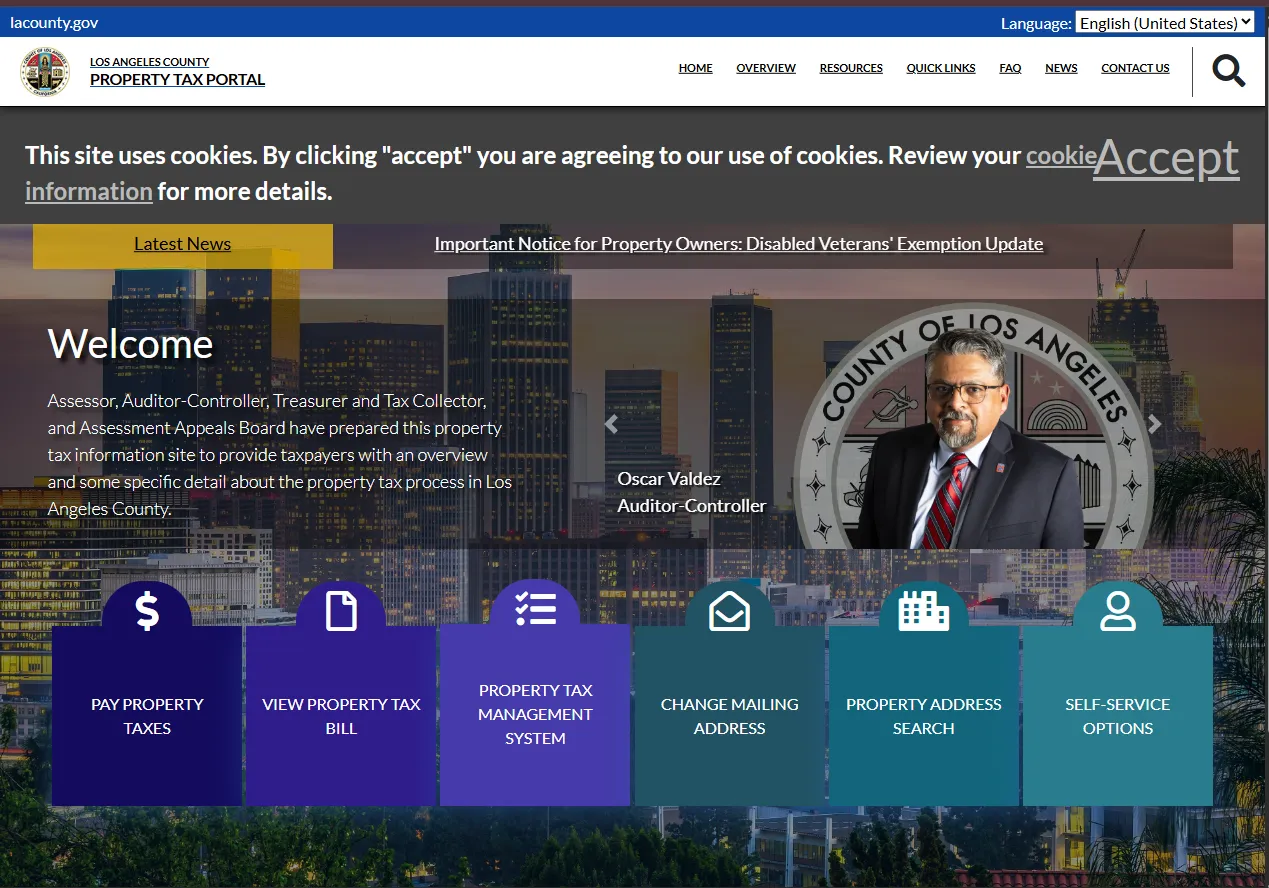
If your bill did not arrive, or you only need to confirm the amount before paying, start with the official portal. LA County’s property tax portal is the central navigation point for the bill, payment, property search, tax history, payment history and property tax information.
- Open the official LA County Property Tax Portal.
- Select the option for viewing a property tax bill, payment history or property tax information.
- Use the Assessor’s Identification Number if you have it.
- If you do not have the AIN, use property address search and confirm the parcel carefully.
- Before paying, open the current bill, balance, installment and payment history.
When online bill lookup helps most
- You did not receive a mailed bill.
- You need a duplicate bill or PDF copy.
- You want to verify whether escrow already paid.
- You need the current balance before the delinquency date.
- You want to confirm whether the bill is annual secured, supplemental, adjusted, substitute or unsecured.
Practical tip: Do not wait until the last day if the bill is missing. Look it up early and save the PDF or screenshot you used, especially when a lender, escrow company, buyer, seller or tax preparer is involved.
AIN Search: The Number LA County Uses to Find Your Parcel
The Assessor’s Identification Number, usually called the AIN, is the key number for a real property parcel in Los Angeles County. It is commonly shown in a 10-digit format that identifies the map book, page and parcel.
AIN search is usually cleaner than address search because it points to the parcel directly.
Address search can help, but always confirm parcel details before payment.
Owner names can change, use trusts, show business entities, or be stale after a sale.
Compare the AIN on the bill, online record, payment screen and escrow documents.
Payment safety rule: Never pay based only on an owner name or a similar address. Confirm the AIN, property address, tax year and installment first.
How to Pay LA County Property Tax
Payment should be the final step. First confirm the AIN, bill type, installment, amount due, payment history and whether a mortgage company is responsible. LA County’s Treasurer and Tax Collector offers online eCheck, card payment, mail, telephone and in-person payment routes.
| Payment Option | Best For | Micro Steps | Official Link |
|---|---|---|---|
| Online eCheck | Owners paying from an ACH-enabled checking account. | Open payment page → enter AIN → verify installment → enter bank details → save confirmation. | Pay secured taxes |
| Credit or debit card | Owners who prefer card payment and accept service fees. | Review fee → confirm amount → submit payment → save receipt and card confirmation. | Review card payment |
| Telephone card payment | Current-year tax payment by phone when you have AIN, Year and Sequence. | Use bill details → call official phone payment number → record confirmation. | Phone payment details |
| Check or money order payment with payment stub. | Include stub → write AIN and Year/Sequence → mail early → keep USPS postmark proof. | Mailing rules | |
| In person | Owners needing direct receipt or office help. | Bring bill/AIN → confirm payment type → keep receipt. | Office contact |
Avoid this common mistake: LA County warns that online banking or bill-pay services are not recommended for property tax payments because those envelopes may not receive a USPS postmark. Without a postmark, penalties can be based on the date the Tax Collector receives the payment.
Payment Troubleshooting Before You Click Submit
Most payment problems are preventable. Use this checklist when the screen does not match your records or when you are close to a delinquency date.
| Problem | What It Usually Means | What to Do |
|---|---|---|
| My lender says escrow pays it | The lender may have collected money but not posted payment yet. | Check payment history and contact the servicer before paying yourself. |
| My eCheck will not process | The account may not be ACH-enabled or may have a debit block. | Ask your bank about ACH debit authorization before retrying. |
| The card fee is higher than expected | Card payment uses a service fee. | Compare eCheck before choosing card payment. |
| The site shows more than one bill | You may be seeing annual, supplemental, adjusted or delinquent items. | Match AIN, Year/Sequence, bill type and installment before paying. |
| Mail payment is near the deadline | Postmark timing matters. | Use official postmark guidance or consider online payment before the deadline. |
LA County Property Tax Due Dates
Annual secured property taxes are split into two installments. The first installment is due November 1 and becomes delinquent after December 10. The second installment is due February 1 and becomes delinquent after April 10. If the delinquency date falls on a weekend or legal holiday, use the official bill and county guidance for the next business-day rule.
- Open the official secured property tax information page.
- Confirm whether your bill is annual secured, supplemental secured, adjusted, substitute or unsecured.
- Check the installment and delinquency date printed on the bill.
- For mail, verify USPS postmark rules before assuming the payment is timely.
- If the date has passed, check the updated balance and penalty before paying.
| Bill / Installment | Due Date | Delinquent After | What to Do |
|---|---|---|---|
| Annual secured first installment | November 1 | December 10 | Pay early or verify escrow before the delinquency date. |
| Annual secured second installment | February 1 | April 10 | Check payment history before paying a second time. |
| Supplemental secured bill | Printed on the supplemental bill | Printed on the supplemental bill | Treat it separately from the annual bill. |
| Unsecured property tax | Different from annual secured taxes | Shown by unsecured rules or bill | Use roll year, bill number and PIN, not real-property AIN. |
How to Read the LA County Annual Secured Property Tax Bill
The official bill explanation is more useful than a normal payment page because it defines the fields people actually see on the bill. Read these areas before paying, mailing a check, calling the county or filing an appeal.
AIN and Year/Sequence
The AIN identifies the parcel. The Year/Sequence area identifies the tax year and bill type. For example, an annual bill and a supplemental bill can have different sequence information, so do not treat every bill as the same type of charge.
General Tax Levy and Net Taxable Value
The official bill guide explains the general tax levy as the general one percent tax rate multiplied by net taxable value. Net taxable value is the value after applicable exemptions are deducted. If your bill seems high, check both value and exemption lines before assuming a payment problem.
Direct Assessments and Special Charges
Direct assessments are additional charges placed on the bill that are not based on Assessor valuation. Examples may include local services or district charges. The bill may list the phone number of the agency connected to those assessments.
Payment Stubs
Annual secured bills have payment stubs. If you mail payment, include the correct stub, write the AIN and Year/Sequence on the check, and keep proof. If you are paying both installments by mail, use the proper stubs as directed by the bill instructions.
- Open the official Annual Secured Property Tax Bill explanation.
- Compare your bill to each field: AIN, Year/Sequence, levy, direct assessments, total due and stubs.
- Check whether the bill is annual, supplemental, adjusted or substitute.
- Use the payment stub and AIN/Year/Sequence if mailing payment.
Official Bill Insert Details Users Often Miss
The LA County Annual Secured Property Tax Bill insert includes practical details that many short articles skip. These details matter when you are paying close to a deadline, paying by mail, using eCheck, using card, or checking exemptions and assistance.
| Bill Insert Detail | Why It Matters | What User Should Do |
|---|---|---|
| Payment due dates | The bill has two stubs and two delinquency deadlines. | Match your payment to the correct stub and deadline. |
| Partial payments | Partial payments may reduce penalties but may not solve the whole balance. | If unable to pay in full, verify current county rules and payment plan options. |
| eCheck | eCheck requires AIN and an ACH-enabled account. | Confirm bank account and ACH/debit-block status before submitting. |
| Credit/debit card | Card transactions include a service fee. | Review fee before choosing card over eCheck. |
| Mail payment | USPS postmark and correct mailing address are critical. | Mail early, include stub, never mail cash and keep proof. |
| Bank bill-pay services | Bank bill-pay envelopes may not receive a USPS postmark. | Avoid relying on bank bill-pay near deadlines. |
| Homeowners’ Exemption note | A missing exemption can make a bill higher than expected. | Check Assessor exemption records if you own and occupy the property. |
- Open or save your bill insert if available.
- Read the payment options and postmark warnings.
- Check whether any exemption, assistance or direct-assessment note applies.
- Use official county pages for final payment and inquiries.
How to Get a Duplicate Bill or PDF Copy
A duplicate bill is useful when the original paper bill is missing, your mortgage company asks for a copy, you need records for a closing, or you want to compare payment history before paying. Do not use an old duplicate as proof of the current balance without checking the live payment page.
- Open the Treasurer or property tax portal bill tool.
- Search by AIN or address.
- Select the correct fiscal year and bill type.
- Save the PDF or duplicate bill for records.
- Before paying, re-check live balance and payment history.
Why Did My LA County Property Tax Bill Change?
A higher or unexpected bill is not always a payment mistake. It may come from a new assessed value, supplemental bill, direct assessment, local levy, missing exemption, prior-year balance, penalty, escrow issue or appeal-related adjustment.
| Possible Cause | Where to Look | Next Step |
|---|---|---|
| New purchase or ownership change | Supplemental notice and Assessor records. | Review the supplemental section and due dates. |
| Assessed value changed | Assessment notice and Assessor property record. | Consider review or appeal if value seems wrong. |
| Homeowners’ Exemption missing | Exemption area of the bill or Assessor record. | Apply or correct if eligible. |
| Direct assessment or PACE charge | Direct assessment lines on the bill. | Contact the agency listed next to the charge. |
| Penalty or cost added | Delinquency date and updated balance. | Check current amount before making payment. |
| Escrow timing problem | Payment history and mortgage statement. | Contact the mortgage servicer if payment has not posted. |
How LA County Property Tax Is Calculated
There is no single final property tax amount for every LA County property. The bill can include the general 1% levy, voted indebtedness, direct assessments, special charges, exemptions, penalties and separate bill types. Two properties with similar market values can have different totals because their assessment history, exemptions, direct assessments and local charges differ.
The official bill guide explains the general tax levy as 1% multiplied by net taxable value.
Exemptions reduce assessed or taxable value when they apply.
Voter-approved taxes can appear on the bill.
Charges such as local district services can appear separately and may require contacting the listed agency.
LA County Property Tax Exemptions
The Homeowners’ Exemption is one of the most common exemptions for owner-occupied homes. LA County Assessor materials describe it as a $7,000 assessed value exemption when the owner occupies the home as a principal residence on January 1. The bill insert also reminds eligible owners to contact the Assessor if the exemption is missing.
- Confirm that you own and occupy the property as your principal residence.
- Open the LA County Assessor Homeowners’ Exemption page.
- Review filing requirements and deadline notes.
- File through the official Assessor process if eligible.
- Check a later bill or Assessor record to confirm the exemption appears.
| Exemption / Relief Topic | Who Should Check | What to Do |
|---|---|---|
| Homeowners’ Exemption | Owner-occupants using the property as principal residence. | Apply with the Assessor and confirm it appears on future records. |
| Disabled Veterans’ Exemption | Qualified disabled veterans or eligible surviving spouses. | Review Assessor requirements and documentation. |
| Property Tax Postponement | Certain eligible senior, blind or disabled homeowners. | Review State Controller program rules and deadlines. |
| Parcel tax exemptions | Owners with school district parcel tax charges who may qualify for local exemption. | Review the specific school district parcel tax exemption information. |
New Homeowner Checklist
New owners have extra risk because the bill may still be in the prior owner’s name, escrow may estimate taxes, supplemental bills can arrive later, and the Homeowners’ Exemption may not be active yet.
- Open the Assessor new homeowner page.
- Review annual bill, supplemental bill and exemption basics.
- Save notices from the Assessor and Treasurer separately.
- Confirm with escrow/lender who pays each bill.
Supplemental Secured Property Tax Bills
A supplemental bill is not the same as your regular annual secured bill. It can appear after a change in ownership or new construction and may have its own due dates. New buyers often confuse a supplemental bill with a duplicate annual bill, but it may be a separate obligation.
- Confirm whether the notice says supplemental, adjusted supplemental or annual secured.
- Check the bill’s own due dates and delinquency dates.
- Compare the supplemental bill with your closing statement and lender escrow records.
- Use the official supplemental property tax page or estimator for more context.
New buyer tip: Do not ignore a supplemental bill because you already paid an annual bill. They are separate bill types and may both need attention.
Unsecured Property Taxes: Business, Personal Property and Other Non-Real-Estate Bills
Unsecured property tax is different from annual secured real property tax. It can apply to certain personal property, business property, boats, aircraft, or other items not secured by real estate in the same way. The unsecured payment page uses roll year, bill number and a PIN from the unsecured bill, not the same AIN workflow as secured real property tax.
- Confirm the bill is unsecured, not annual secured real property tax.
- Find the roll year, bill number and PIN printed on the unsecured bill.
- Use the official unsecured payment page.
- For mail, write the roll year and bill number on the check.
- Keep confirmation or mailing proof.
Important: Unsecured bill numbers can change by year. Match roll year, bill number and PIN before paying.
Assessment Appeals: When You Disagree With Value
If the issue is assessed value, the payment office is not the place to fix the value. Payment deadlines and appeal deadlines are separate. A property owner may still need to manage the bill while pursuing review or appeal.
- Identify the assessment type: regular, supplemental, adjusted, escape or calamity reassessment.
- Review the filing period that applies to that assessment type.
- Gather evidence such as comparable sales, appraisals, photos or property condition details.
- Use the LA County Assessment Appeals Board for filing instructions.
- Do not assume an appeal pauses payment deadlines.
| Assessment Type | Typical Filing Window | User Note |
|---|---|---|
| Regular assessment | July 2 to November 30 each year. | Review annual assessment value and evidence early. |
| Supplemental assessment | Within 60 days of the mailing date printed on the supplemental notice or tax bill, or postmark date, whichever is later. | Do not wait for the annual appeal window. |
| Adjusted / escape / roll change | Within 60 days of the notice or adjusted/escape assessment tax bill mailing/postmark date. | Use the date on your notice or bill. |
| Misfortune / calamity reassessment | Within six months after mailing of proposed reassessment notice. | Relevant after qualifying damage or disaster situations. |
Payment History, Refunds and Duplicate Payments
If you think you paid, your lender paid, or the balance is wrong, check payment history before submitting another payment. Duplicate payments can happen when the owner and escrow company both act, or when an old bill is used after payment has posted.
- Open the official payment history page.
- Search using AIN or required bill details.
- Compare county payment history with your bank, escrow or lender records.
- If something does not match, save proof before submitting an inquiry.
- Avoid submitting repeated duplicate inquiries for the same issue.
Late Payments, Postmarks and Penalty Prevention
LA County property tax penalties often come down to timing and proof. Online payment deadlines, USPS postmarks, accepted delivery services and receiving dates can matter. The safest move is to pay early and keep proof.
| Risk | Why It Happens | How to Reduce It |
|---|---|---|
| Payment mailed too late | The Tax Collector relies on receipt or valid USPS postmark rules. | Mail early, use correct address and keep postmark proof. |
| Bank bill-pay delay | Bank bill-pay envelopes may not get a USPS postmark. | Avoid bank bill-pay near deadlines; use official payment page or verified mailing method. |
| Wrong bill paid | Annual, supplemental and unsecured bills can look similar to users. | Match AIN, Year/Sequence, roll year, bill number and bill type. |
| Escrow duplicate payment | Owner pays before lender payment posts. | Check payment history and call the servicer before paying personally. |
- Check current balance first.
- Review whether the issue is postmark, lost payment, late payment or wrong payment.
- Gather proof before requesting help.
- Use the official inquiry or penalty cancellation route only if your facts match the county’s requirements.
Emergency, Wildfire or Disaster-Related Tax Relief
Some property owners may need special guidance because of wildfires, disaster damage or other emergency conditions. These rules can change and may apply only to specific properties, timeframes or areas. Do not use general due-date advice if your property may qualify for disaster-related relief.
- Open the LA County Treasurer and Tax Collector homepage.
- Look for current wildfire, emergency, penalty cancellation or relief notices.
- Check whether your property and bill type are covered.
- Use the official request form or inquiry route if relief applies.
Documents to Keep Before and After You Pay
Good records make it easier to resolve escrow issues, duplicate payments, appeals, exemptions, penalties, refunds and mailing problems.
AIN, property search result, bill PDF, Year/Sequence, payment stubs, due dates and escrow statement.
Confirmation number, receipt, bank record, check image, postmark proof, card receipt or office receipt.
Ownership proof, occupancy proof, exemption application proof and Assessor correspondence.
Assessment notice, tax bill, comparable sales, photos, appraisals and appeal submission proof.
Useful Official LA County Links
Use these links only after you understand which task you need to complete. This keeps users away from random payment pages, duplicate searches and wrong-office actions.
More Property Tax Help on This Site
These internal guides are included only where they help the user understand the topic before using official county pages.
LA County Treasurer and Tax Collector Office Map
For in-person payment or property tax help, LA County lists the Kenneth Hahn Hall of Administration location. Check current service instructions before visiting, and bring the bill, AIN, payment proof and photo identification if needed for your issue.
Los Angeles County Treasurer and Tax Collector
Kenneth Hahn Hall of Administration
225 North Hill Street, First Floor Lobby
Los Angeles, CA 90012
Phone: 888-807-2111 or 213-974-2111
Editorial Trust and Update Notes
CountyPropertyTaxes.us is an independent informational guide. It is not the Los Angeles County Treasurer and Tax Collector, LA County Assessor, Auditor-Controller, Assessment Appeals Board or any payment processor. This page is designed to help users understand the steps before taking official action.
Update checklist: payment links, eCheck/card fee language, due dates, delinquency rules, postmark guidance, office hours, emergency relief notices, exemption values, supplemental bill guidance, appeal filing windows, PDF bill links and FAQ answers should be reviewed whenever official LA County pages change.
LA County Property Tax FAQs
How do I pay LA County property tax online?
Search the property by AIN or address, confirm the bill type and installment, check payment history, then use the official LA County Treasurer and Tax Collector payment page. eCheck is usually the lowest-cost online route, while card payments can include a service fee.
What is an AIN?
AIN means Assessor’s Identification Number. It is a ten-digit number assigned by the Office of the Assessor to real property in Los Angeles County and is used for bill lookup and payment.
Where can I find my LA County property tax bill?
Use the LA County Property Tax Portal or Treasurer self-service tools to view a bill, duplicate bill, payment history or balance information. Confirm AIN, property address and bill type before paying.
When are LA County secured property taxes due?
The first installment is due November 1 and delinquent after December 10. The second installment is due February 1 and delinquent after April 10. Supplemental and unsecured bills can follow different rules.
What happens if I pay late?
A late annual secured first installment can trigger a 10% penalty. A late second installment can trigger a 10% penalty and a $10 cost. Always check the current balance before paying late.
Can I pay by bank bill-pay?
LA County’s bill insert says online banking or bill-payment services are not recommended because those envelopes may not receive a USPS postmark. This can create penalty problems when payments arrive after the delinquency date.
What is the difference between annual secured and supplemental property tax?
Annual secured property tax is the regular bill tied to real property. Supplemental property tax can appear after a change in ownership or new construction and has its own bill and due dates.
What is unsecured property tax?
Unsecured property tax can apply to certain personal property, business property, boats, aircraft or similar property. It uses roll year, bill number and PIN from the unsecured bill rather than the same secured real-property AIN process.
What is the LA County Homeowners’ Exemption?
The Homeowners’ Exemption may reduce assessed value by $7,000 for eligible owners who occupy the property as their principal residence on January 1. Check the Assessor’s official page for current filing instructions.
Why did my LA County property tax bill change?
The bill may change because of reassessment, a new purchase, supplemental billing, direct assessments, special charges, missing exemptions, penalties, escrow timing or appeal-related adjustments.
What should I check before paying?
Check AIN, property address, bill type, tax year, Year/Sequence, installment, due date, payment history, escrow status, payment method fee and whether the bill is annual secured, supplemental, adjusted or unsecured.
What if my mortgage company pays my taxes?
Check LA County payment history before paying personally. Escrow collection does not always mean the county payment has already posted, and paying personally too early can create duplicate-payment problems.
How do I appeal my assessed value?
Use the LA County Assessment Appeals Board. Regular assessments generally have a July 2 to November 30 filing period, while supplemental and adjusted assessments can have shorter bill-specific deadlines.
Is CountyPropertyTaxes.us an official LA County website?
No. CountyPropertyTaxes.us is an independent informational guide. Final payments, filings, appeals, exemption applications and official records should be completed through Los Angeles County government websites.
Bottom Line
For LA County property tax, start with the AIN or property address, confirm the bill type, read the official bill fields, check due dates and payment history, review exemptions or appeals if needed, then use the correct official county page for payment or filing.
Find BillPay TaxDue DatesRead BillOfficial Links