
New York City Property Tax: Search, Pay & Check 2026/27 Dates
New York City property tax is administered mainly by the NYC Department of Finance (DOF). The same property can have a tax bill, assessment record, payment history, exemption record, Notice of Property Value and recorded documents in different NYC systems, so the safest route depends on what you are trying to do.
Start with the Borough-Block-Lot number (BBL) or property address, confirm the property, open the live bill, check whether a mortgage servicer already paid, then use CityPay only when you are ready to complete the transaction.
Quick Answer: Use the Right NYC System for the Right Job
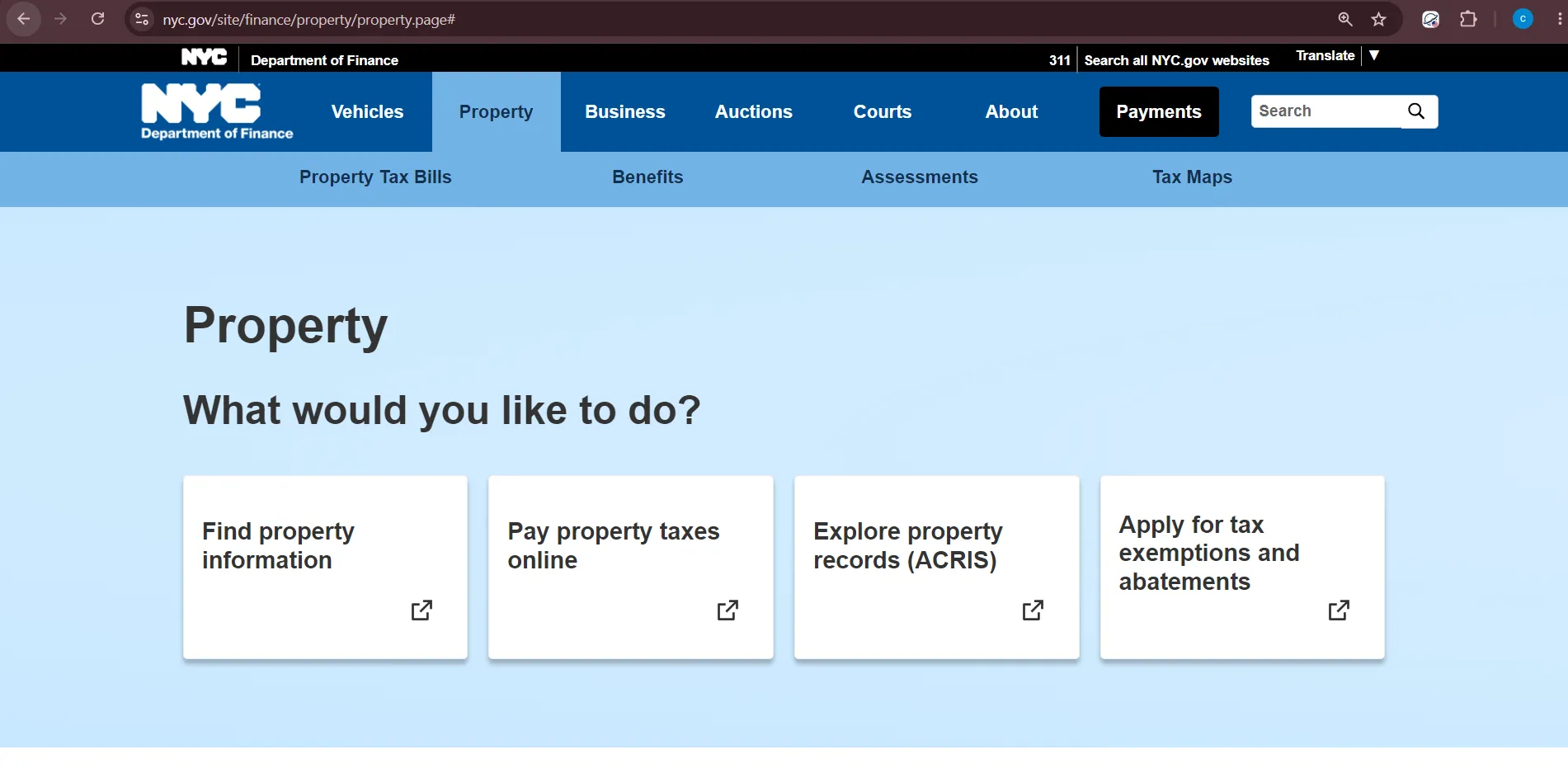
Bill or payment: use NYC Department of Finance property-tax bills and CityPay. Property details and assessment: use the Property Information Portal and DOF assessment pages. Recorded deeds and documents: use ACRIS. Formal assessed-value challenges: use the NYC Tax Commission process.
The Notice of Property Value is not the same thing as a tax bill, and ACRIS is not the payment system. Separating those tools prevents many wrong-page and wrong-action mistakes.
If you are about to send money, stop and confirm the BBL + property address + bill period + current balance + escrow status first.
Current NYC Property Tax Alerts for August 2026
The next regular quarterly property-tax installment is due October 1. Quarterly payers can generally use the interest-free grace period through October 15.
NYC DOF has published FY2027 final property-assessment data. Use the assessment record when checking value or tax class.
Owners who received a DOF surcharge notice and believe the property qualifies for an exemption should review the new deadline immediately.
The standard Tax Commission filing dates for FY2027 were March 2 for Classes 2–4 and March 16 for Class 1.
The normal March exemption filing date became March 16, 2026 because March 15 fell on a weekend.
DOF’s live rate page currently lists the tax-year-2026 rates. Check the live rate page and bill before applying those figures to later periods.
The most time-sensitive item right now is the September 18 surcharge exemption deadline for owners who received the applicable DOF letter.
NYC Property Tax Help by Situation
Use the DOF bill page and search by BBL or property address.
Use CityPay only after confirming the property, bill period, current balance and posted-payment history.
Use address search in CityPay or the Property Information Portal, then save the confirmed BBL.
Review the NOPV and assessment record. A payment screen cannot change an assessment.
Use DOF property-tax benefit pages and check whether the benefit reduces assessed value or the final tax.
Check the posted property-tax payment before sending a second payment yourself.
Many property-tax and abatement actions occur at the building or management level rather than through an individual tax lot bill.
Review DOF credits and refunds before assuming the credit will automatically be mailed to you.
Review the non-primary residence surcharge rules and September 18 exemption deadline immediately.
Payment problem → DOF/CityPay. Assessment problem → DOF assessment/Tax Commission. Recorded deed problem → ACRIS.
How to Search NYC Property Tax by BBL or Address
BBL means Borough-Block-Lot. It is the most useful identifier for matching a New York City property across the tax bill, CityPay, assessment records and many DOF forms.
- Open the Property Information Portal or CityPay.
- Search by BBL if you have it.
- Otherwise search the property address.
- Confirm the borough, block, lot and address.
- Use that verified result for the next task.
For deeds and recorded property documents, use ACRIS. For the live tax bill or payment, return to DOF/CityPay.
What to Check on an NYC Property Tax Bill
Do not treat the amount at the top of an old PDF as the only number that matters. Payment activity, credits, exemptions, abatements, interest and other charges can change the live account.
Confirm both before paying. A similar street or unit can lead you to the wrong account.
Check whether you are looking at the current fiscal-year quarter, semiannual bill or an older statement.
Compare the bill with the live online account before sending money.
This is not necessarily the property’s sale price or market value.
Check whether expected STAR, SCHE, DHE, veteran, clergy or co-op/condo benefits appear where applicable.
Look for servicer payments, overpayments or prior credits before paying personally.
- Open the NYC property-tax bills page.
- Choose the bill/notices search.
- Search the property.
- Open the correct fiscal-year bill.
- Save the PDF only after confirming the property and period.
How to Pay NYC Property Tax with CityPay
Payment should be the last step, not the first. CityPay supports BBL and address search and currently accepts several payment methods.
CityPay currently does not charge a service fee for e-check payment. A returned electronic check can trigger a $20 charge.
CityPay currently adds a nonrefundable 2% service fee.
These payment methods also currently carry the 2% CityPay service fee.
- Search by BBL or address.
- Confirm the correct property.
- Review the live amount due.
- Check posted mortgage or bank payments.
- Select payment method.
- Review any 2% service charge.
- Submit and save confirmation.
Payment safety: CountyPropertyTaxes.us cannot accept NYC property-tax payments or payment credentials. Complete the final transaction only on the official NYC system.
NYC Property Tax Due Dates for FY2027
New York City’s property-tax fiscal year runs from July 1 through June 30. Billing frequency depends on assessed value.
Regular due dates are July 1, October 1, January 1 and April 1.
Quarterly payers are generally entitled to pay interest-free through July 15, October 15, January 15 or April 15.
Regular installments are due July 1 and January 1.
October 1 falls on a Thursday in 2026.
Quarterly accounts can generally pay interest-free through October 15.
NYC states that when a property-tax due date falls on a weekend or federal holiday, payment is due the next business day.
Interest warning: Do not confuse the quarterly grace date with the original due date. If payment misses the applicable grace rule, interest calculations can relate back to the original due date. Always check the live amount after a deadline.
- Open the DOF due-date page.
- Check the property’s assessed value.
- Determine quarterly or semiannual billing.
- Match the current bill period.
- Check weekend or federal-holiday adjustments.
- Use the live bill before paying late.
FY2027 Assessment, NOPV and Property Value
NYC Department of Finance values property annually. The Notice of Property Value (NOPV) explains the assessment for the coming tax year; it is not a bill and does not request payment.
DOF’s estimate of property value under NYC valuation rules.
The value produced after the applicable assessment level and statutory limitations.
Generally the assessed value after applicable exemptions are subtracted.
NYC uses four tax classes, and the class affects the assessment rules and tax rate.
DOF has published final FY2027 assessment data for NYC properties.
A Request for Review or Request to Update is different from a Tax Commission appeal. Use the correct route for the actual problem.
- Open the Property Information Portal or assessment page.
- Confirm BBL and property description.
- Review market, assessed and taxable values.
- Check tax class.
- Compare exemptions and abatements.
- If something is wrong, determine whether you need an update, review or formal appeal.
NYC Property Tax Rates: Read the Tax Year Carefully
New York City does not use one rate for every property. The tax rate depends on tax class.
Freshness note for August 2026: the live DOF rate page currently displays rates for tax year 2026, the fiscal year that ran July 1, 2025 through June 30, 2026. Do not automatically treat those rates as the final FY2027 rates without checking the current DOF page or bill.
Generally includes most one-, two- and three-family homes.
Generally includes co-ops, condos, rentals and other residential properties not in Class 1.
Primarily utility property.
Generally commercial and industrial property not included in another class.
A simplified estimate is taxable value × applicable tax rate, but exemptions, abatements, assessment limitations and other property charges can affect the actual bill.
- Open NYC’s rate page.
- Confirm the tax year displayed.
- Match the property’s tax class.
- Compare the rate with taxable value.
- Use the actual bill for the final amount.
NYC Property Tax Exemptions and Benefits
NYC uses both exemptions and abatements. An exemption generally reduces assessed value before tax is calculated. An abatement generally reduces the tax after calculation.
The Senior Citizen Homeowners’ Exemption can reduce qualifying homeowners’ property tax. Current eligibility includes age, ownership, residence and income requirements.
The Disabled Homeowners’ Exemption provides relief for qualifying owners with disabilities who meet the program rules.
Different exemptions can apply to qualifying veterans, spouses, surviving spouses or Gold Star parents.
Most new applicants interact with New York State for the STAR credit. Some existing NYC recipients still have exemption-related DOF processes.
Available to qualifying clergy members or certain surviving spouses under program rules.
Generally filed by the development’s managing agent or board rather than by an individual owner.
2026/27 deadline status: March 15, 2026 fell on a Sunday, so the NYC finance calendar lists March 16, 2026 as the deadline for several homeowner exemption applications for the 2026/27 tax year. Applications after the applicable deadline may affect a later tax year instead.
- Open NYC Property Tax Benefits.
- Select the program that fits your situation.
- Review ownership, residence, age, income or disability requirements.
- Check whether the normal 2026/27 filing deadline has passed.
- Prepare the required documents.
- Save application and decision notices.
- Later verify the benefit on the property record or bill.
Do not assume STAR, SCHE, DHE, veterans relief and co-op/condo abatement are interchangeable. They have different eligibility rules, administrators and filing processes.
New 2026 NYC Non-Primary Residence Property Surcharge
NYC introduced a new annual surcharge on certain high-value properties that do not serve as a primary residence. It is sometimes called a pied-à-terre surcharge.
If DOF sent you a letter stating that the property may be subject to the surcharge and you believe an exemption applies, review and submit the current exemption application before the extended deadline.
For 2026/27 and 2027/28, the surcharge may apply to qualifying non-primary one-, two- and three-family properties above the applicable $5 million DOF-value threshold.
Certain condominium and cooperative units with DOF values starting at $1 million can fall within the surcharge framework if they are not exempt.
The surcharge generally does not apply when the property is used as a qualifying primary residence by an owner, tenant, certain family members or other qualifying occupants under the DOF rules.
DOF says the majority of properties appearing on the supplemental roll will not actually be subject to the surcharge. The notice letter is the key trigger to review.
- Read the DOF letter carefully.
- Confirm BBL/property information.
- Review the exemption eligibility guide.
- Gather the primary-residence documents requested for your situation.
- Submit before September 18, 2026.
- Save confirmation and copies of evidence.
Do not assume liability from the supplemental roll alone. DOF states that only a subset of listed properties received potential-surcharge letters.
How to Challenge an NYC Property Assessment
A Request for Review and a Tax Commission appeal are not the same process. Filing one does not automatically preserve the deadline for the other.
Used to ask DOF to review market value or certain property information. The deadline varies by tax class.
The independent Tax Commission can review qualifying assessed-value, tax-class and certain exemption claims.
FY2027 standard deadline status: Tax Commission applications had to be received by March 2, 2026 for Tax Classes 2, 3 and 4 and by March 16, 2026 for Tax Class 1. Those standard deadlines have passed.
Some revised DOF notices issued after February 1 can create separate statutory filing windows. For example, certain qualifying notices that increase assessed value or reduce/remove an exemption may allow filing within a limited number of days after the notice. Use the notice itself and current Tax Commission instructions rather than assuming the ordinary March deadline applies.
Special Rules for NYC Co-op and Condo Owners
Co-op and condo property-tax questions often differ from one- to three-family home questions. A co-op owner may not receive an individual property-tax bill because the cooperative building owns the underlying real estate.
Confirm how building property tax, abatements and owner eligibility are reflected in maintenance or building records.
NYC says the development’s managing agent, authorized representative or board handles the co-op/condo abatement application.
The 2026/27 application/renewal deadline was extended into February 2026. Late filings generally affect a later benefit year.
Abatement eligibility can depend on ownership and primary-residence status around the program’s taxable-status date.
Save Tax Benefit Reports, board notices and communications showing whether your unit was included.
ACRIS helps with recorded ownership documents but is not a replacement for the tax or benefit system.
Mortgage Escrow and NYC Property Tax
DOF states that owners whose taxes are paid through a bank or mortgage servicing company may not receive the regular property-tax bill themselves.
Escrow balance ≠ posted property-tax payment. Check both systems before deciding that the bill is unpaid.
NYC Property Tax Credits, Overpayments and Refunds
DOF generally applies property-tax credits to the next bill unless a refund is requested. Current DOF guidance says to allow about eight weeks for a property-tax refund claim to be processed.
An overpayment can create a credit that may be refundable to the person who made the payment.
A successful assessment reduction can create a credit after the original bill was issued.
A later exemption approval can reduce liability and create a credit.
Keep the submitted refund claim and payment evidence while DOF processes the request.
DOF states that property-tax credits must be used or refunded within its applicable six-year period.
For duplicate payments, keep evidence showing who made each transaction and when.
- Open the account and identify the credit.
- Determine why the credit exists.
- Gather proof of payment or assessment/benefit correction.
- Check whether you want the credit applied forward or refunded.
- Submit the official refund request when appropriate.
- Save the claim confirmation.
Late NYC Property Tax and Payment Plans
If a payment is not received or postmarked by the applicable deadline, the account can become late and interest may apply. Do not continue using the original bill amount after a missed deadline.
Interest and other account activity can make an old PDF inaccurate.
DOF offers a standard payment-plan option for many owners who cannot pay the full balance at once.
Eligible owners may qualify for a different payment-plan structure.
DOF also lists a reduced-interest payment-plan option for qualifying circumstances.
A payment agreement does not necessarily freeze the balance at the amount owed when the plan begins.
Use official DOF guidance and qualified legal/tax help when property rights or active legal deadlines are involved.
If You Just Bought an NYC Property
Use the deed, closing statement or official NYC property search.
Do not rely only on the seller’s last bill.
A seller tax credit at closing is not the same thing as an actual payment posted to DOF.
Confirm who will make the next quarterly or semiannual payment.
Prior-owner exemption or abatement treatment may not continue in the same way after a transfer.
Make sure future DOF notices can reach the correct owner or representative.
Keep the BBL, closing statement, current tax bill and escrow disclosure together until the first post-closing tax cycle is complete.
Estate, Trust or Deceased-Owner Property
Death, probate, trust ownership and inheritance can affect mailing records, exemption eligibility, payment responsibility and who has authority to request changes or refunds.
Use the BBL or address to identify current balance and bill history.
Death certificate, letters testamentary, trust documents or other authority records may be relevant.
An exemption tied to the deceased owner may not continue indefinitely.
Paying a property-tax bill does not establish ownership or probate rights.
Get qualified help when needed: contested ownership, foreclosure, estate disputes, tax liens and probate deadlines can require individualized legal or tax advice.
NYC Property Tax Troubleshooting
Likely cause: wrong borough, address formatting or BBL error.
Next action: search by address in CityPay or Property Information Portal and confirm the BBL.
Likely cause: mortgage servicer receives it or mailing information changed.
Next action: download the bill online instead of waiting for paper mail.
Likely cause: normal processing time or bank confirmation.
Next action: keep the CityPay confirmation and allow for posting time before paying again.
Likely cause: assessment change, tax class or property-record issue.
Next action: review NOPV and current appeal/review rules, not the CityPay screen.
Likely cause: filing deadline, renewal, eligibility or processing issue.
Next action: use DOF benefit status/application guidance.
Likely cause: duplicate payment.
Next action: identify both transactions and review DOF credit/refund options.
Do not call every problem a “tax bill error.” Identify whether the issue belongs to billing, payment, assessment, benefit, recorded documents or mortgage escrow.
Documents Worth Keeping
BBL, current bill, bill period, amount due, due date, escrow statement and benefit status.
CityPay confirmation, confirmation email, bank record and updated account history.
NOPV, property description, comparable data, photos and Tax Commission documents.
Application confirmation, decision letters and proof of age, income, disability, veteran status or residence when required.
DOF letter, exemption application, residency documents and confirmation of submission.
Payment evidence, account credit, refund claim and correspondence with DOF.
NYC Property Tax Terms
- BBL
- Borough-Block-Lot, the primary NYC parcel identifier used across many property-tax and property-record systems.
- NOPV
- Notice of Property Value, the annual assessment notice. It is not a tax bill.
- Market Value
- DOF’s estimate of property value under NYC valuation rules.
- Assessed Value
- The value produced after applicable NYC assessment levels and statutory limitations.
- Taxable Value
- The amount generally remaining after applicable exemptions are subtracted from assessed value.
- Abatement
- A benefit that generally reduces the tax after calculation rather than reducing assessed value.
- Tax Commission
- The independent NYC agency that reviews qualifying assessment, tax-class and certain exemption claims.
- ACRIS
- The NYC system used for many recorded real-property documents; it is not the property-tax payment portal.
Official NYC Property Tax Links
New York City Property Tax FAQs
What is the next NYC property tax deadline after August 2026?
For properties billed quarterly, the next regular installment is due October 1, 2026. Quarterly payers with assessed value of $250,000 or less generally have an interest-free grace period through October 15. Properties billed semi-annually have their next regular installment due January 1, 2027, subject to NYC’s next-business-day rule when a due date falls on a federal holiday or weekend.
How do I find my New York City property tax bill if I do not know my BBL?
Use NYC CityPay or the Property Information Portal and search by property address. After locating the property, confirm the borough, block and lot, commonly called the BBL, before downloading a bill or making a payment.
How much does NYC CityPay charge for property tax payments?
NYC currently adds a 2% service fee for credit card, debit card, prepaid or gift card, PayPal and Venmo payments. Electronic check payments do not have a service fee, although a returned electronic check can result in a $20 charge.
Can I still file a normal NYC property assessment appeal for the 2026/27 tax year?
The standard 2026 Tax Commission deadlines were March 2, 2026 for Tax Classes 2, 3 and 4 and March 16, 2026 for Tax Class 1. Those ordinary deadlines have passed. Certain later or revised Department of Finance notices can have separate statutory filing periods, so review the notice and current Tax Commission instructions immediately.
Who needs to check the new NYC non-primary residence property surcharge in 2026?
The new surcharge may apply to certain high-value New York City properties that are not used as a primary residence. For 2026/27 and 2027/28 this can include one-, two- and three-family homes above the applicable DOF value threshold and certain condominium or cooperative units. Owners who received a Department of Finance surcharge letter and believe an exemption applies should follow the current DOF instructions and September 18, 2026 exemption deadline.
Bottom Line
For NYC property tax, start with the BBL or property address, verify the live bill and payment history, determine quarterly or semiannual billing, and use CityPay only after checking escrow and current balance. Use DOF assessment tools and the Tax Commission—not the payment screen—for value or tax-class disputes. If you received a 2026 non-primary residence surcharge letter, review the September 18 deadline now.
Search Property Pay with CityPay Due Dates Benefits 2026 Surcharge Official LinksMaterially reviewed and updated using current NYC Department of Finance, NYC Tax Commission, NYC311 and live CountyPropertyTaxes.us internal-link sources: August 27, 2026.