
Alameda County Property Tax Help: Find Bills, Pay Online & Avoid Penalties
Alameda County property taxes are easier to manage when you first identify the right tax type and parcel. A regular secured bill, supplemental bill, unsecured bill, delinquent bill, escrow payment, or assessment appeal can each require a different next step. This guide explains the process in plain English so you can understand your bill here, then use the official county portal only when it is time to look up, pay, print, file, or appeal.
Quick Answer
To handle Alameda County property taxes safely, start with the official property tax lookup page, choose the right tax type, search by parcel number or property address, confirm the bill year and installment, check payment status, review the delinquency date, then use the official payment route that fits your situation. If the bill looks wrong, check assessment value, exemptions, supplemental activity, tax rate, special assessments, and appeal options before assuming the amount is final.
Alameda County Property Tax Help by Situation
Use this table first if you are not sure whether you need the Treasurer-Tax Collector, Assessor, Auditor-Controller, Clerk, or Assessment Appeals Board.
| Your Situation | What to Check First | Best Next Step |
|---|---|---|
| I need to find my bill | Choose the correct tax type, then search by parcel number or property address. | Find the bill online |
| I want to pay online | Confirm parcel, tax type, bill year, installment, amount and payment status. | Follow safe payment steps |
| I need a duplicate bill or stub | Open the correct tax type and installment before saving or printing. | Read the bill-copy guide |
| I bought or sold property | Look for secured, supplemental, prior-year and escrow activity. | Check supplemental taxes |
| My bill looks too high | Review assessed value, Prop 13 limits, Prop 8 decline-in-value, exemptions and tax rate. | Understand bill changes |
| I may qualify for an exemption | Review Homeowners’ Exemption, Disabled Veterans’ Exemption and Assessor forms. | Check exemptions |
Before You Pay: 7 Checks That Prevent Most Problems
Most Alameda County property tax problems happen because someone pays too quickly or pays the wrong bill type. Use this checklist before entering bank, card, phone, or wire information.
Where to Find Your Alameda County Property Tax Bill
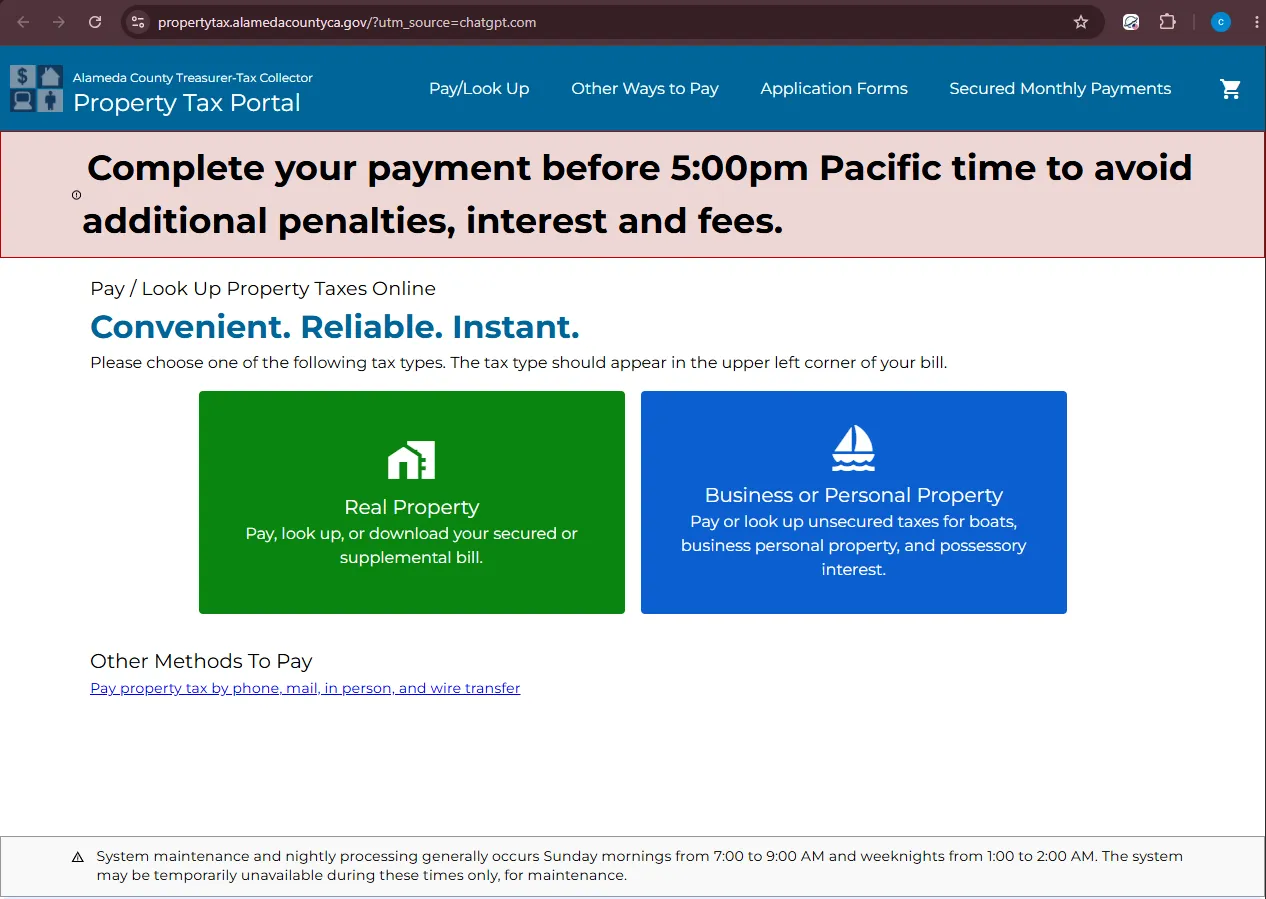
If the paper bill is missing, delayed, or hard to understand, start with the official online lookup. Alameda County’s property tax portal lets users choose the tax type first, then look up or pay real property, supplemental, business/personal property, or prior-year delinquent taxes.
- Open the official Alameda County Property Tax Portal.
- Choose the correct tax type shown on the upper-left area of your bill.
- Select real property for secured or supplemental real estate bills.
- Select business or personal property for unsecured taxes such as boats, business personal property, or possessory interest.
- Search by parcel number, property address, or account information when available.
- Confirm the property, bill year, installment, balance and payment status before paying.
What to confirm before trusting the result
Secured, supplemental, unsecured and prior-year delinquent tax bills are not the same. Pick the correct one before payment.
Similar addresses can cause confusion. Match the parcel number, property address and bill details before submitting money.
Check whether a lender, escrow company or prior payment already posted before making another payment.
Save or print the correct bill only after confirming the tax type, year and installment.
Escrow tip: If your mortgage company pays from escrow, still check the official payment status. Escrow collection does not always mean the county payment has already posted.
How to Search Alameda County Property Tax by Parcel Number or Address
The parcel number is the safest identifier for an Alameda County property tax search. Address search is useful when the parcel number is missing, but you should always confirm the property before paying, downloading a bill, or contacting an office.
- Open the Alameda County property tax search page.
- Use the parcel number from your tax bill, escrow document, closing statement or Assessor record if available.
- Enter the parcel number exactly as the official system asks.
- Use address search if you do not know the parcel number.
- Confirm the correct tax type, bill year and installment before paying or printing.
| Search Method | Best Use | Risk to Avoid |
|---|---|---|
| Parcel number search | Best when you have a tax bill, escrow document, closing statement, payment stub or Assessor record. | Using an old parcel reference or typing the number in a format the system does not accept. |
| Address search | Helpful when you do not know the parcel number. | Selecting a similar address, nearby parcel, unit, or wrong tax type. |
| Tracer/account number | Useful when the tax bill or payment screen asks for a specific bill/account identifier. | Using it for the wrong bill year or tax type. |
| Assessor tools | Helpful for assessed value, parcel lookup, exemptions, ownership-related guidance, and map context. | Confusing assessed value research with Treasurer payment status. |
How to Pay Alameda County Property Tax
Payment should be the final step after you verify the bill. Alameda County encourages online payment to avoid late fees, but it also lists in-person, mail, phone and wire transfer options. Use the method that matches your bill type, timing and documentation needs.
| Payment Option | Best For | Micro Steps | Official Link |
|---|---|---|---|
| Online eCheck | Taxpayers paying from checking or savings after confirming the correct bill. | Search bill → verify amount → choose eCheck → enter bank details → review final screen → save confirmation. | Pay / look up online |
| Credit card | Taxpayers who prefer card payment and accept convenience-fee rules. | Review fee → confirm bill type and amount → pay by card → save receipt and confirmation number. | Review payment screen |
| Taxpayers paying by check with a payment stub. | Use correct stub → make check payable correctly → mail early → keep proof → verify posting online. | Other ways to pay | |
| Phone | Users who want an automated phone payment route. | Call official number → follow prompts → confirm bill → save transaction number. | Phone payment info |
| Wire transfer | Large payments or users specifically instructed to pay by wire. | Review official wire instructions → include parcel/bill details → confirm posting after transfer. | Wire transfer info |
| In person | Users who need office help, payment proof, or account-specific support. | Bring bill/stub → bring ID if needed → confirm accepted payment method → keep receipt. | In-person payment info |
Payment warning: Always read the final official payment screen before submitting. Card, eCheck, phone, wire, returned-check and processing rules can vary, and convenience fees are separate from the tax amount.
Alameda County Property Tax Bill Copy, PDF and Payment Stub
A bill copy is useful for payment, escrow review, closing documents, tax records, refund questions, and appeal records. Before saving or printing a bill, make sure it is the correct tax type and year. Secured, supplemental, unsecured and delinquent bills can represent different obligations.
- Start from the official Alameda County property tax portal.
- Select the correct tax type.
- Search by parcel number, property address, or account information when available.
- Open the bill for the correct year and installment.
- Save the PDF or print the payment stub only after checking payment status.
| Bill Area | Why It Matters | What To Do |
|---|---|---|
| Parcel number | Connects the bill to the correct property. | Match it with the lookup result before paying. |
| Bill type | Secured, supplemental, unsecured and delinquent bills are different. | Select the correct type before submitting payment. |
| Installment | First and second installments have different delinquency dates. | Check the installment before comparing amounts. |
| Payment stub | Helps match mailed payment to the correct bill. | Include it when mailing payment if required. |
| Payment status | Prevents duplicate payment, especially with escrow. | Re-check online before paying from a saved bill. |
Alameda County Property Tax Due Dates, Penalties and Default Risk
Alameda County secured property taxes are generally split into two installments. The first installment is due November 1 and becomes delinquent after 5:00 p.m. on December 10. The second installment is due February 1 of the following year and becomes delinquent after 5:00 p.m. on April 10. If a delinquency date falls on a weekend or legal holiday, check the official FAQ for current handling.
- Open the Treasurer-Tax Collector property tax FAQ.
- Confirm whether your bill is secured, supplemental, unsecured or delinquent.
- Check installment and delinquency date.
- If the delinquency date has passed, review penalties before paying.
- Save proof of payment immediately after submitting.
| Installment / Tax Type | Due Date | Delinquent After | What Happens |
|---|---|---|---|
| Secured first installment | November 1 | 5:00 p.m. December 10 | A 10% penalty attaches after delinquency. |
| Secured second installment | February 1 of the following year | 5:00 p.m. April 10 | A 10% penalty and $10 cost attach after delinquency. |
| Both installments together | Can be paid together | Use first-installment delinquency timing when paying both early | Send total amount due with both payment stubs if paying by mail. |
| Unsecured property tax | Generally due August 31 for taxes on the unsecured roll as of July 31 | 5:00 p.m. or close of business on August 31 | A delinquent penalty can attach after the deadline. |
| Unpaid after June 30 | Delinquent-year review required | June 30 timing can trigger default/redemption consequences | Delinquent penalties, costs, redemption penalties and fees may apply. |
Deadline tip: If mailing a check, mail early and verify posting online. Mailing a check is not the same as seeing the payment posted to the county record.
Secured, Supplemental, Unsecured and Prior-Year Taxes
Alameda County’s property tax portal separates different tax types. This matters because a homeowner can have a regular secured bill and a supplemental bill after purchase, new construction or ownership change. Business personal property, boats and possessory interest may fall under unsecured taxes.
| Tax Type | What It Usually Means | Before You Pay |
|---|---|---|
| Secured property tax | Regular real property tax tied to the property. | Confirm parcel, installment, amount and mortgage escrow status. |
| Supplemental tax | Additional assessment after ownership change or new construction. | Do not confuse it with the regular annual secured bill. |
| Unsecured tax | Taxes for business personal property, boats, possessory interests or taxable property not secured by real estate. | Search under the unsecured/business-personal-property option. |
| Prior-year delinquent tax | Older unpaid tax balance. | Review penalties, costs, payment status and default/redemption risk before paying. |
If You Recently Bought or Sold Alameda County Property
New buyers often see more than one property tax item: a regular secured bill, a supplemental bill, escrow activity, seller credits and mailing-address changes. A supplemental bill is separate from the regular annual secured tax bill and can appear after a change in ownership or new construction.
- Find the parcel number from your closing documents or Assessor record.
- Search secured taxes first, then check supplemental taxes.
- Compare county bills with your closing statement and escrow setup.
- Confirm whether the lender will pay from escrow or whether you must pay directly.
- Check whether Homeowners’ Exemption is already applied or needs action.
- Save the bill, closing statement, escrow disclosure, payment proof and property search screenshot together.
New owner warning: A seller credit at closing does not always mean the county bill has already been paid. Always check official payment status.
Why Your Alameda County Property Tax Bill Changed
There is not one single rate that explains every Alameda County property tax bill. The final amount can depend on assessed value, Proposition 13 factored base-year value, Proposition 8 decline-in-value restoration, voter-approved debt, local tax rates, direct charges, special assessments, exemptions, supplemental assessments and ownership or construction changes.
- Find your parcel number or property address.
- Use tax rate search or Assessor property assessment tools.
- Compare assessed value, tax rate, exemptions and direct charges.
- If the current market value is lower than assessed value, review Prop. 8 decline-in-value options.
- If you still disagree, review Assessment Appeals Board instructions before the filing deadline.
- Pay any current bill on time while an appeal or review is pending.
| Possible Reason | Where to Check | Next Step |
|---|---|---|
| Assessed value changed | Assessor records and assessed value lookup. | Review property value, Prop. 13 rules and appeal timing. |
| Supplemental bill issued | Supplemental property tax search. | Confirm it is separate from the annual secured bill. |
| Exemption missing | Assessor exemption records or claim status. | Contact the Assessor or file the correct form. |
| Special assessment or direct charge | Tax bill line items and tax rate resources. | Identify the agency or charge listed on the bill. |
| Late penalty added | Payment status and delinquency date. | Pay the updated amount and save proof. |
Alameda County Property Tax Exemptions and Relief
Exemptions can reduce assessed value or provide relief for qualifying property owners. The Homeowners’ Exemption is one of the most common California homeowner exemptions, and Alameda County Assessor guidance explains that it reduces taxable value by $7,000, generally saving about $70 to $80 per year.
- Confirm that you own and occupy the property as your principal residence on the January 1 lien date.
- Check whether the exemption already appears in your records.
- If you believe you qualify, contact the Alameda County Assessor’s Homeowners’ Exemption unit.
- Use the claim form or official Assessor instructions for your property.
- If you are near a filing deadline, follow official instructions to protect your filing date.
- Keep a copy of your submission and follow up if the exemption does not appear.
| Exemption or Relief Topic | Who Should Review | Practical Note |
|---|---|---|
| Homeowners’ Exemption | Owner-occupants using the property as their principal residence. | Reduces taxable value by $7,000; contact the Assessor’s Homeowners’ Exemption unit if no exemption appears. |
| Disabled Veterans’ Exemption | Qualifying disabled veterans or unmarried surviving spouses. | Review documentation, disability rating and current Assessor forms before filing. |
| Decline in Market Value / Prop. 8 | Owners who believe current market value is below assessed value. | Request informal review and pay current bills on time while review is pending. |
| Disaster or calamity relief | Owners affected by qualifying fire, flood, disaster or calamity damage. | Assessor guidance says damage must meet eligibility rules and filing deadlines. |
| Transfer/exclusion topics | Owners dealing with Proposition 19, parent-child transfer, spouse transfer or other exclusions. | Rules are specific; use official Assessor forms and instructions. |
No-fee reminder: Alameda County Assessor resources warn that filing for a Homeowners’ Exemption, requesting decline-in-value review, or filing an assessment appeal directly with the official office should not require paying a private company.
Assessment Appeals and Decline-in-Value Review
If the tax bill is high because the assessed value appears wrong, that is an assessment issue, not just a payment issue. Alameda County Assessor guidance explains that a decline-in-value review may be available when current market value is lower than assessed value, and formal appeals may go through the Assessment Appeals Board.
- Look up the property’s assessed value and recent assessment information.
- Compare the value with market evidence or comparable property information.
- Request informal review if appropriate.
- If you still disagree, review Assessment Appeals Board filing instructions.
- Pay property tax bills on time even while an informal review or appeal is pending.
| Review Type | When It Helps | Important Reminder |
|---|---|---|
| Informal decline-in-value review | When current market value appears below assessed value. | Assessor guidance says informal reviews are available July 1 through December 31 each year. |
| Formal assessment appeal | When you disagree with assessed value after review or need formal Board consideration. | Filing period is typically July 2 through September 15, with November 30 for supplemental assessments. |
| Supplemental appeal | When you disagree with a supplemental assessment after ownership change or new construction. | Review official deadlines because supplemental appeal timing can differ. |
| Escape assessment appeal | When you disagree with an escape assessment notice or bill. | Official Assessor material says escape appeals may have a 60-day timing rule. |
Appeal warning: Filing or considering an appeal does not automatically pause your tax bill. Pay timely while the appeal is pending unless official instructions say otherwise.
Refunds, Duplicate Payments and Escrow Problems
Refund or duplicate-payment issues can happen when both a homeowner and mortgage company pay, when a payment posts late, when a supplemental bill is confused with a secured bill, when a credit or refund is created after an assessment change, or when the wrong bill type was paid.
Confirm whether the bill is unpaid, paid, pending, or tied to a different tax type.
Match the county record with your mortgage servicer’s escrow statement before paying again.
Check whether payment was made by eCheck, card, mail, wire, phone, in person, or another route.
Keep confirmations, canceled checks, bank records, PDF bills, parcel numbers and transaction records.
Do not double pay: If your lender usually pays the bill, check official posting status first. Paying personally while escrow payment is pending can create refund paperwork.
Mail, Phone and Treasurer-Tax Collector Office Details
If you do not pay online, use only the official mail address, phone number, or office instructions. Always include the correct payment stub or parcel information when required.
| Contact or Payment Route | Official Detail | Practical Tip |
|---|---|---|
| Mail payment | Alameda County Treasurer-Tax Collector, 1221 Oak Street, Room 131, Oakland, CA 94612. | Use the correct payment stub and verify posting online after mailing. |
| Check payable to | Treasurer Tax Collector, Alameda County. | Make sure the check, stub and bill information match the parcel. |
| Phone payment | Automated phone payment system: 510-272-6800. | Save the transaction number after payment. |
| Treasurer-Tax Collector office | 1221 Oak Street, Room 131, Oakland, CA 94612. | Check office instructions before visiting and bring bill/payment proof. |
| Assessor office | 1221 Oak Street, Room 145, Oakland, CA 94612; phone 510-272-3787. | Use for assessed value, exemptions, Prop. 8 review and assessment questions. |
Common Alameda County Property Tax Mistakes to Avoid
These mistakes cause the most confusion for homeowners, buyers, escrow borrowers, business owners and people dealing with supplemental or delinquent bills.
Secured, supplemental, unsecured and delinquent tax bills are different. Choose the right one first.
A saved bill may not reflect posted payment, penalty, correction, refund or escrow activity.
Escrow collection is not the same as county payment posting. Check official status before the deadline.
A supplemental bill can appear after purchase or new construction and is separate from the annual secured bill.
Informal review and formal appeal timing are separate. Pay the tax bill on time while value questions are handled.
Assessor resources warn that some official exemption/review/appeal actions can be done without private service fees.
Documents to Keep Before and After Payment
Good records help if there is a duplicate payment, escrow dispute, late-posting issue, exemption claim, assessment appeal, supplemental bill question or delinquent-tax problem.
Parcel number, property address, bill type, PDF bill, payment stub, installment, due date and escrow statement.
Confirmation number, receipt, canceled check, bank record, phone transaction number, wire proof or mailed payment evidence.
Ownership proof, occupancy proof, Assessor claim form, disability/veteran documents and filing confirmation.
Assessment notice, value evidence, comparable sales, appeal filing proof and tax bill payment proof.
Related Property Tax Guides on This Site
These internal guides can help users understand general property-tax concepts before using Alameda County official tools.
Official Alameda County Property Tax Links
Use these official sources when you are ready to search, pay, file, appeal, check rates, or confirm a record.
Alameda County Treasurer-Tax Collector Office Map
For in-person help, mail-payment questions, or payment records, use the official office address below. Check current office instructions and accepted payment rules before visiting.
Alameda County Treasurer-Tax Collector
1221 Oak Street, Room 131
Oakland, CA 94612
Phone: 510-272-6800
Editorial Trust and Update Notes
CountyPropertyTaxes.us is an independent informational guide. It is not Alameda County, the Treasurer-Tax Collector, the Assessor, the Auditor-Controller, the Clerk, or the Assessment Appeals Board. This page explains the process so users can understand what to check before taking official action.
Update checklist: payment fee language, due dates, penalty rules, unsecured tax notices, mail address, phone number, exemption rules, appeal filing windows, tax-rate search links, screenshot image, internal links and FAQ answers should be reviewed whenever Alameda County official pages change.
Alameda County Property Tax FAQs
Where do I find my Alameda County property tax bill?
Use the official Alameda County property tax lookup page. Choose the correct tax type, then search by parcel number, property address, or account information when available.
How do I pay Alameda County property tax online?
Open the official property tax lookup page, find the correct bill, confirm the amount and installment, then choose an online payment option such as eCheck or credit card.
Is there a fee to pay Alameda County property tax online?
Payment fees can depend on the method. eCheck and card rules should be reviewed on the official payment screen before submitting payment.
When are Alameda County secured property taxes due?
The first installment is due November 1 and delinquent after 5:00 p.m. December 10. The second installment is due February 1 and delinquent after 5:00 p.m. April 10.
What happens if I miss the first installment deadline?
A 10% penalty attaches after the first installment becomes delinquent. Always check the official record for the current amount before paying late.
What happens if I miss the second installment deadline?
A 10% penalty and $10 cost attach after the second installment becomes delinquent. Additional consequences can apply if taxes remain unpaid.
How do I search by parcel number?
Use the parcel number shown on your tax bill, escrow record, closing document or Assessor record. Confirm the bill type and property before paying.
Can I search Alameda County property tax by address?
Yes. Address search can help if you do not know the parcel number, but always confirm the property and bill details before paying.
What is a supplemental property tax bill?
A supplemental bill can appear after a change in ownership or new construction. It is separate from the regular annual secured property tax bill.
What is the difference between secured and unsecured property tax?
Secured property tax is tied to real property. Unsecured property tax may apply to business personal property, boats, possessory interests, or other taxable property not secured by real estate.
How do I get a PDF or copy of my Alameda County tax bill?
Start from the official lookup page, select the correct tax type, search the bill, then download or print the correct bill copy or payment stub.
How do I apply for the Homeowners’ Exemption?
Review Alameda County Assessor exemption guidance. If you believe you qualify, contact the Homeowners’ Exemption unit or use official Assessor instructions and forms.
What if my Alameda County property tax bill looks too high?
Check assessed value, tax rate, exemptions, direct charges, special assessments, supplemental bill activity and Prop. 8 decline-in-value review options.
Can I appeal my assessed value?
Yes. Review assessed value lookup and Assessment Appeals Board instructions. Pay tax bills on time while an appeal is pending to avoid penalties.
What if my mortgage company pays my taxes?
Still check official payment status before the deadline. Escrow collection does not always mean the county payment has posted.
Where do I mail Alameda County property tax payments?
Mail payments to Alameda County Treasurer-Tax Collector, 1221 Oak Street, Room 131, Oakland, CA 94612, and make checks payable to Treasurer Tax Collector, Alameda County.
What if the property owner died?
Death-related ownership changes can affect assessment, exemptions and mailing. Alameda County Assessor FAQ says the death of a property owner must be reported to the Assessor’s Office within 150 days.
Is CountyPropertyTaxes.us the official Alameda County tax office?
No. This is an independent informational guide. Final payments, filings, appeals and tax records should be completed through official Alameda County systems.
Bottom Line
For Alameda County property taxes, choose the correct tax type first, find the parcel, confirm the bill year and installment, review due dates and payment status, check exemptions or assessment issues if the amount looks wrong, then pay through the correct official county source.
Find My BillHow to PaySearch ParcelCheck ExemptionsOfficial Links