
Florida Property Tax Guide: Find the Right Office, Pay Safely & Understand Your Bill
Florida property taxes are local, even though the state sets many of the rules. That means the right answer depends on what you are trying to do: the county property appraiser handles value records and exemptions, the county tax collector handles bills and payments, and the Value Adjustment Board handles many disputes. This guide explains the process in plain English so you can understand the bill here first, then use the official county or state page only when it is time to search, pay, file, appeal, or check a delinquent balance.
Quick Answer
To handle Florida property tax correctly, first identify the county where the property is located. Use the county property appraiser for property records, assessed value, taxable value, exemptions, classifications and ownership details. Use the county tax collector for the tax bill, payment, discounts, delinquency, deferrals and receipts. Use the county Value Adjustment Board if you disagree with value, classification, portability, deferral or a denied exemption. Before paying, confirm the parcel, tax year, amount due, discount month, escrow status, fee disclosure and deadline.
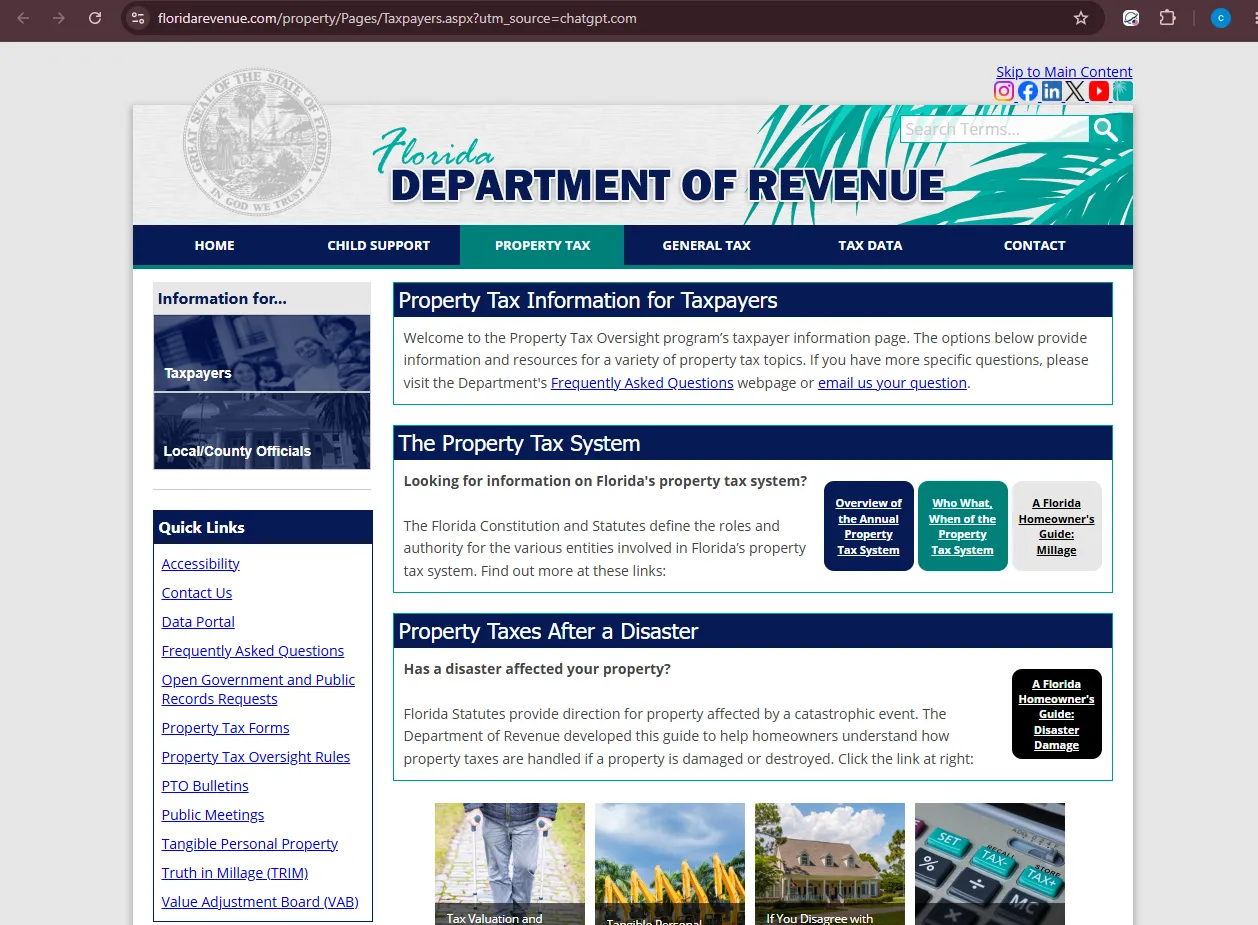
Florida Property Tax Help by Situation
Use this table first if you are not sure which office or page you need. Florida property tax tasks are divided across local offices, and using the wrong office can waste time.
| Your Situation | Correct Starting Point | What to Check | Best Next Step |
|---|---|---|---|
| I want to pay my Florida property tax bill | County Tax Collector | Parcel/account number, tax year, discount, amount due, fee, escrow status and deadline. | Follow the payment guide |
| I want to search property records | County Property Appraiser | Owner record, parcel number, address, just value, assessed value, taxable value and exemptions. | Search property records |
| I need homestead, senior or veteran benefits | County Property Appraiser | Permanent residence status, January 1 eligibility, documents and filing deadline. | Review exemptions |
| My bill looks too high | Property Appraiser first, then VAB if needed | Assessment, taxable value, exemptions, Save Our Homes, millage and non-ad valorem charges. | Understand bill changes |
| I disagree with value or denied exemption | Property Appraiser / Value Adjustment Board | TRIM notice, denial letter, VAB deadline, evidence and petition rules. | Read appeal guide |
Find the Right Florida County Property Tax Office
Florida does not use one statewide property tax payment portal for every parcel. The Florida Department of Revenue provides statewide oversight and taxpayer guidance, but county officials handle the account-specific work. The county where the property sits decides which official website you should use for search, payment, exemptions and appeals.
- Open the Florida Department of Revenue local officials directory.
- Select the county where the property is located.
- Use the Property Appraiser website for value, parcel, ownership, exemptions and classification records.
- Use the Tax Collector website for bills, payments, discounts, deferrals, receipts and delinquent tax questions.
- Use the Value Adjustment Board link if you need to challenge value, classification, portability, deferral or a denied exemption.
Establishes value each year as of January 1 and reviews exemptions, assessment limitations and classifications that may reduce taxable value.
Sends tax bills, collects payments, handles payment options and deferrals, sells tax certificates on delinquent taxes, and processes overpayment refunds.
Hears many challenges involving assessed value, classifications, exemptions, deferrals, portability decisions and ownership/control issues.
Provides statewide oversight, taxpayer guidance, forms, data, rules, local official directories and educational materials.
Before You Pay: Florida Property Tax Safety Checklist
Florida tax bills often show early-payment discounts, non-ad valorem assessments, escrow information and county-specific fees. Check these items before submitting payment so you do not pay the wrong parcel, lose a discount, or duplicate a lender payment.
How to Pay Florida Property Tax
Florida property tax is paid through the county tax collector, not through one statewide payment screen. The exact website, payment vendor, fee, mailing address and payment-status page vary by county, but the safe order is the same statewide: find the correct county tax collector, search the bill, verify the record, review discounts and fees, then pay through the official county route.
- Use the Florida DOR local officials directory or the county website printed on your bill.
- Open the tax collector’s property tax, real estate tax or tax bill payment section.
- Search by parcel number, account number, owner name or address, depending on the county system.
- Confirm the parcel, tax year, amount due, discount, fee, escrow status and payment deadline.
- Pay only after the official county details match your property.
- Save the confirmation and check posted payment status later.
| Payment Method | Best For | Check Before Paying | Practical Tip |
|---|---|---|---|
| Online e-check or bank account | Owners who want electronic payment without mailing a check. | Parcel, tax year, amount due, discount, fee disclosure and confirmation screen. | Some counties may charge no e-check fee while others may vary. Review the county page before submitting. |
| Credit or debit card | Owners who prefer card payment and accept processor fees. | Card fee, total payment, parcel number, account number and receipt. | Card processor fees usually go to a payment processor, not directly to the county tax amount. |
| Owners paying by check or money order. | Correct mailing address, bill stub, parcel/account number, discount month and due date. | Close to the deadline, check whether your county uses received date or postmark rules. | |
| In person | Owners who want counter service or a physical receipt. | Office location, hours, accepted payment types and required bill/account details. | Bring the bill, parcel/account number and ID if your county requires it. |
| Mortgage escrow | Owners whose lender normally pays taxes from escrow. | Posted payment status and mortgage servicer statement. | Do not pay yourself until you confirm the lender has not already paid. |
Duplicate payment warning: If your mortgage company usually pays property taxes, do not rush to pay personally. Search the county tax collector record first and compare it with your escrow statement. Duplicate payments can create refund delays.
How to Search Florida Property Tax Records
Property record search is usually handled by the county property appraiser. This is the record that shows ownership, mailing address, parcel or folio number, legal description, assessed value, taxable value, land/building details, exemptions and classification information. The tax collector may have a separate bill-payment search, so use the right page for the right task.
- Find your county property appraiser website through the Florida DOR local officials directory.
- Search by property address, owner name, parcel ID, folio number or account number, depending on the county system.
- Confirm the property address, owner/mailing details and parcel number.
- Review market/just value, assessed value, taxable value, exemptions and property classification.
- If the record looks wrong, contact the property appraiser before the appeal deadline.
| Record Area | What It Means | Why It Matters |
|---|---|---|
| Parcel / folio / account number | The county identifier for the property. | Use it to match the tax bill, payment page and property appraiser record. |
| Just value or market value | The appraiser’s estimate before assessment limits and exemptions. | This is often the starting point for value questions. |
| Assessed value | Value after assessment limitations such as Save Our Homes may apply. | Assessed value can differ from just value, especially for homestead property. |
| Taxable value | Assessed value minus approved exemptions. | Millage is applied to taxable value to calculate ad valorem tax. |
| Exemption history | Shows benefits such as homestead, senior, disability or veteran exemptions. | Missing exemptions can make the bill higher than expected. |
How to Read a Florida Property Tax Bill
A Florida property tax bill is more than a payment notice. It shows which county is billing you, which parcel is being taxed, which year is due, how discounts are calculated, what non-ad valorem charges may be included, and when taxes become delinquent. Read the bill before paying, especially if escrow, exemptions, a recent sale or a delinquent balance may be involved.
| Bill Area | What It Means | Why It Matters | What to Do |
|---|---|---|---|
| Parcel / account number | The county identifier for your property. | Wrong parcel payments can be difficult to correct. | Match it with the property appraiser record. |
| Tax year | The year being billed. | Prior-year balances may appear separately. | Confirm you are paying the intended year. |
| Gross tax amount | Amount before early-payment discount. | The amount can change depending on the payment month. | Use the current month’s amount from the county site. |
| Discount amount | Reduction for early payment. | November, December, January and February can show different discount levels. | Confirm the current discount before paying. |
| Ad valorem taxes | Taxes based on taxable value and millage. | This part connects to value, exemptions and rates. | Review value and millage if the bill changed. |
| Non-ad valorem assessments | Charges calculated by unit, service or improvement rather than property value. | They can raise the bill even if taxable value did not change much. | Check the county bill detail or taxing authority. |
Best practice: Use the property appraiser record to understand value and exemptions. Use the tax collector bill record to confirm payment amount, discount, status and receipt.
Florida Property Tax Due Dates, Discounts and Delinquency
Florida property tax timing is local, but the statewide pattern is consistent enough to plan around. Assessment date is January 1. New exemption and classification applications are commonly due March 1. Tax bills are commonly sent in November. Early-payment discounts usually apply by month. Unpaid taxes generally become delinquent on April 1, and tax certificates are sold on unpaid items by June 1.
- Open your county tax collector website.
- Find the property tax, real estate tax or tax bill due-date section.
- Confirm the current tax year and discount month.
- Check whether taxes are current, partial, deferred, installment-plan, delinquent or tax-certificate status.
- Pay before the delinquency date if you want to avoid added costs.
- Save your receipt or payment confirmation.
| Time Period | Common Florida Rule or Pattern | User Action |
|---|---|---|
| January 1 | Date of assessment for property value and many eligibility questions. | Confirm ownership, residence and exemption eligibility as of January 1. |
| March 1 | Common deadline for exemption and agricultural or other classification filing. | File homestead or other applicable benefits with the county property appraiser. |
| August | TRIM notice is generally mailed by the property appraiser. | Review proposed taxes, value, exemptions, millage and hearing details. |
| September | Value appeals are tied to the TRIM notice timing. | Check VAB petition deadlines quickly if value, classification or exemption is wrong. |
| November | Tax collectors generally send bills; 4% early-payment discount may apply in November. | Pay early if the discount is worth it and the bill details match. |
| December | 3% discount may apply. | Confirm current amount before paying. |
| January | 2% discount may apply. | Verify updated amount on the county site. |
| February | 1% discount may apply. | Pay before March if you want the last common discount. |
| March 31 | Taxes are commonly due in full by the end of March; homestead deferral applications are due by March 31 for qualifying taxpayers. | Pay, confirm escrow payment, or review deferral options before April 1. |
| April 1 | Unpaid taxes generally become delinquent. | Contact the tax collector and review delinquent payment rules. |
| May 1 | Installment plan applications are due by May 1 for taxpayers who want to prepay property taxes by installment. | Ask your county tax collector about installment plan application rules. |
Florida Property Tax Exemptions: Homestead, Senior, Disability, Veterans and More
Florida exemptions can reduce taxable value, but they are not automatic for every property. The county property appraiser determines eligibility. If you bought a home, moved, became a permanent Florida resident, turned 65, became disabled, are a veteran, are an active duty service member, or are a surviving spouse, review exemptions with your county property appraiser.
- Read Florida DOR exemption guidance to understand statewide categories.
- Find your county property appraiser through the local officials directory.
- Review homestead exemption eligibility and required documents.
- File by the county deadline, commonly March 1 for new homestead applications.
- Check Save Our Homes and portability if you moved from another Florida homestead.
- Keep proof of residence, Florida ID, deed, vehicle registration, voter record, utility records or other county-required documents.
| Benefit | Who Should Review | Why It Matters | Where to Start |
|---|---|---|---|
| Homestead Exemption | Florida homeowners who make the property their permanent residence or the permanent residence of a dependent. | May reduce taxable value by as much as $50,000 and can qualify the home for Save Our Homes protection. | County Property Appraiser |
| Save Our Homes | Homesteaded property owners. | Limits annual increases in assessed value for qualifying homestead property, but it does not freeze the entire tax bill. | County Property Appraiser |
| Portability | Owners moving from one Florida homestead to another. | May allow transfer of all or part of the Save Our Homes assessment difference to a new Florida homestead. | County Property Appraiser |
| Senior exemptions | Older homeowners who may meet age, income and residence rules. | Local senior exemptions vary by county or taxing authority and may require income documentation. | County Property Appraiser |
| Disability benefits | Qualifying disabled persons and disabled first responders. | May reduce taxable value or provide additional relief if documentation is accepted. | County Property Appraiser |
| Veterans, active duty military and surviving spouses | Qualifying veterans, active duty military members and surviving spouses. | Florida provides multiple benefit categories, and documentation rules matter. | County Property Appraiser |
Save Our Homes, Portability and First-Time Florida Homebuyers
Save Our Homes is one of the most important Florida property tax concepts for homeowners. It can limit increases in assessed value for qualifying homestead property, but it does not freeze the tax bill. Your bill can still change because millage rates, non-ad valorem assessments, local budgets, school taxes, or exemptions change.
After buying, review your property appraiser record, mailing address, homestead filing deadline, escrow setup and first tax bill timing.
For homestead property, assessed value increases are generally limited to the lower of 3% or CPI change, unless other rules or changes apply.
If you moved from one Florida homestead to another, portability may transfer part of your assessment difference to the new homestead.
Even with Save Our Homes, your total bill can change because millage and non-ad valorem assessments can change.
- Search your property appraiser record after closing.
- Confirm owner name, mailing address, legal description and parcel number.
- Check whether the prior owner’s exemptions still appear temporarily.
- File homestead by the county deadline if the property is your permanent residence.
- Review portability if you sold or left another Florida homestead.
- Compare the tax bill with your closing statement and escrow disclosure.
Florida Property Tax Rate, Millage and How the Bill Is Calculated
Florida property tax is not one flat statewide rate. Your bill depends on just value, assessed value, assessment limitations, exemptions, taxable value, millage rates and non-ad valorem assessments. Local governments and taxing authorities set millage through the Truth in Millage process, while property appraisers determine value and apply exemptions and limitations.
Simple calculation: Assessed Value = Just Value – Assessment Limits. Taxable Value = Assessed Value – Exemptions. Total ad valorem tax liability = Taxable Value × Millage Rate. Non-ad valorem assessments may be added separately.
- Start with the county property appraiser record.
- Review just value, assessed value and taxable value.
- Check which exemptions and assessment limitations were applied.
- Review millage rates and taxing authorities on the tax bill or TRIM notice.
- Look for non-ad valorem assessments listed separately.
- Compare this year to last year before assuming the bill is wrong.
Why Did My Florida Property Tax Bill Change?
A Florida property tax bill can change even when you did not buy, sell or remodel. The change may come from value, exemptions, Save Our Homes, portability, local millage, non-ad valorem assessments, budget changes, new construction, disaster-related issues or loss of a benefit.
| Possible Cause | Where to Check | What It Means | Next Step |
|---|---|---|---|
| Just value changed | Property appraiser record and TRIM notice. | The appraiser’s market value estimate may have increased or decreased. | Contact the property appraiser and review VAB deadline if you disagree. |
| Assessed value changed | Assessment notice and property appraiser record. | Save Our Homes or other assessment limitations may affect assessed value. | Compare just value, assessed value and taxable value separately. |
| Exemption missing or changed | Exemption section of the appraiser record and tax bill. | Homestead, senior, disability, veteran or other benefits may not be applied. | Contact the county property appraiser before filing deadlines. |
| Millage changed | TRIM notice, tax bill and taxing authority budget hearings. | Local governments, school districts and special districts can affect the rate. | Review millage lines and taxing authorities on the bill. |
| Non-ad valorem assessment changed | Tax bill assessment lines or taxing authority notice. | Charges for services or improvements may be calculated separately from value. | Contact the listed authority if the charge looks wrong. |
| New buyer reset or ownership change | Closing documents and property appraiser record. | A sale can affect assessed value, exemptions, mailing address and future bills. | Review homestead filing and portability rules after closing. |
TRIM Notice: What It Is and Why It Matters
The Notice of Proposed Property Taxes is commonly called the TRIM notice. It is normally mailed before the tax bill and helps you review proposed value, exemptions, taxable value, millage rates, proposed taxes and budget-hearing information. The TRIM notice is also important because some appeal deadlines are tied to when it is mailed.
The TRIM notice is a proposed tax notice, not the payment bill. Do not send payment based only on the TRIM notice.
If just value, classification or exemptions look wrong, contact the property appraiser quickly.
Value petitions are tied to the TRIM notice timing, so do not wait until the November bill to review value issues.
The TRIM notice can show taxing authority hearing details where millage and budgets are discussed.
What If You Disagree With the Value, Classification or Exemption Decision?
If your concern is payment amount after the bill is issued, start with the tax collector. If your concern is value, classification, exemption denial, portability, deferral, or a change in ownership/control decision, start with the property appraiser and Value Adjustment Board process.
- Read the TRIM notice or denial letter carefully.
- Contact the property appraiser if you believe the value, classification or exemption decision is wrong.
- Check the county Value Adjustment Board deadline.
- Gather evidence such as comparable sales, property photos, repair estimates, income documents, exemption documents or portability records.
- File the VAB petition through the county clerk or VAB process if needed.
- Keep payment deadlines separate from appeal deadlines.
Practical rule: An appeal is not the same as payment. If the tax bill is already due, check whether payment is still required while your challenge is pending.
Late, Delinquent, Tax Certificate or Tax Deed Risk
If taxes are unpaid after the deadline, they generally become delinquent on April 1. Florida DOR taxpayer guidance explains that tax certificates are sold on unpaid items by June 1. Tax collectors handle delinquent taxes and sell tax certificates, while clerks of court perform tax deed sales. Treat delinquent or certificate situations as time-sensitive.
- Open your county tax collector website.
- Search the property tax bill or delinquent tax section.
- Confirm tax year, amount, penalties, certificate status and accepted payment methods.
- If a tax certificate or tax deed issue exists, follow official county instructions.
- Save proof because delinquent payment records can matter later.
Urgent note: Delinquent, tax certificate, tax deed, foreclosure, bankruptcy, probate, estate or legal-dispute situations can involve deadlines and legal rights. Use official county sources and qualified professional guidance.
Mortgage Escrow Checklist
If your mortgage company pays property taxes, still check the county payment record. Escrow collection and county payment posting are not always the same thing. This matters most near March 31, before delinquency, or when a new loan servicer takes over.
- Search the county tax collector bill record.
- Compare the bill due date and discount date with your mortgage escrow statement.
- Check whether the lender payment has posted.
- If payment is missing close to the deadline, contact the mortgage servicer and ask for proof.
- Do not pay personally until you know whether the lender payment is pending.
- Keep the escrow statement, county payment screenshot and receipt.
Homestead Tax Deferral, Partial Payment and Installment Plan
Some Florida taxpayers may have options other than one full payment, but the rules are specific and handled locally. The tax collector is the starting point for deferrals, partial payment policies and installment plans.
| Option | Who Should Review | Important Timing | Where to Start |
|---|---|---|---|
| Homestead tax deferral | Homestead owners whose taxes may qualify for deferral under income and lien rules. | Annual deferral application is filed with the county tax collector by March 31 after the assessment year. | County Tax Collector |
| Senior deferral | Permanent Florida residents age 65 or older who may meet income rules. | Review current income limit and county tax collector rules. | County Tax Collector |
| Partial payment | Taxpayers who may need to pay in parts before delinquency. | Partial payment rules depend on the tax collector and must be handled before delinquency. | County Tax Collector |
| Installment plan | Taxpayers who want to prepay property taxes in installments. | Initial application should be filed by May 1 of the assessment year. | County Tax Collector |
Property Taxes After Disaster Damage
Florida property owners affected by catastrophic events may need extra property tax guidance. The Florida Department of Revenue provides taxpayer resources for disaster-damaged property. County property appraisers and tax collectors may also post local disaster, damage-reporting, refund or assessment guidance after hurricanes, floods or other declared events.
- Photograph damage and keep repair, insurance and inspection records.
- Check the Florida DOR disaster damage guidance.
- Contact your county property appraiser about assessment or damage-related procedures.
- Check the county tax collector if a bill, payment, refund or deadline is affected.
- Save all official notices and deadlines.
Common Florida Property Tax Mistakes to Avoid
These mistakes are common for homeowners, new buyers, escrow users, seniors and people trying to pay close to the deadline.
Use the county where the property is located. Florida does not use one statewide payment screen for every tax bill.
The property appraiser handles value and exemptions. The tax collector handles bills and payments.
The amount can change from November through March. Always use the current county bill amount.
If a lender pays from escrow, check posted status before paying personally.
Value and exemption disputes are often tied to TRIM or denial deadlines, not just the final tax bill.
Save Our Homes can limit assessed value increases, but taxes can still change because rates and assessments change.
Documents to Keep
Good records make Florida property tax problems easier to fix. Save documents before and after payment, especially if you have escrow, exemptions, appeals, portability, disaster damage or delinquent taxes.
Tax bill, parcel/account number, property appraiser record, exemption history, payment page and escrow statement.
Confirmation number, receipt, cancelled check, bank record, email confirmation or office receipt.
Florida ID, proof of residence, deed, utility records, disability/veteran documents and senior income records if required.
TRIM notice, assessment notice, photos, comparable sales, repair estimates, denial letter and VAB filing proof.
Related Property Tax Guides on This Site
These internal guides can help you understand general property-tax concepts before you take final action on an official Florida county website.
Official Florida Property Tax Links
Use these official sources when you are ready to search, pay, file, appeal or verify current county-specific rules.
Editorial Trust and Update Notes
CountyPropertyTaxes.us is an independent informational guide. It is not the Florida Department of Revenue, any Florida county property appraiser, any Florida county tax collector, any clerk of court or any Value Adjustment Board. This page is designed to explain the process and reduce confusion before users take account-specific action on official state or county websites.
Update checklist: local official directory links, exemption rules, March 1 filing guidance, discount percentages, delinquency date, tax certificate timing, deferral rules, installment plan deadline, VAB guidance, TRIM notice details, forms, data portal links and county-specific payment warnings should be reviewed whenever Florida DOR or county pages change.
Florida Property Tax FAQs
Where do I pay Florida property tax?
Florida property tax is paid through the county tax collector where the property is located. Use the Florida Department of Revenue local officials directory to find the correct county tax collector website.
How do I search Florida property tax records?
Use the county property appraiser website to search by address, owner name, parcel number, folio number or account number, depending on the county system.
Is there one statewide Florida property tax payment website?
No. Florida property taxes are administered locally. Your county tax collector handles bill payment, while your county property appraiser handles value records and exemptions.
When are Florida property taxes due?
Tax bills are commonly sent in November, discounts may apply by month, taxes are generally due by the end of March, and unpaid taxes generally become delinquent April 1. Always verify the current date with your county tax collector.
What discounts are available for early Florida property tax payment?
Florida DOR guidance describes early-payment discounts of 4% in November, 3% in December, 2% in January and 1% in February. The bill normally calculates the amount for you, but you should verify the current county amount before paying.
What is Florida homestead exemption?
Homestead exemption is a property tax benefit for eligible Florida homeowners who make the property their permanent residence. It may reduce taxable value by as much as $50,000 and can qualify the home for Save Our Homes protection.
What is Save Our Homes?
Save Our Homes is an assessment limitation for qualifying Florida homestead property. It can limit increases in assessed value, but it does not freeze the entire tax bill.
What is portability in Florida property tax?
Portability may allow eligible homestead owners to transfer all or part of the Save Our Homes assessment difference from one Florida homestead to another.
Why did my Florida property tax bill change?
Your bill can change because of just value, assessed value, exemptions, Save Our Homes, taxable value, millage rates, local budgets, non-ad valorem assessments, ownership change, new construction, disaster changes or loss of a benefit.
Who handles Florida property tax exemptions?
The county property appraiser handles exemption applications and determines whether a parcel qualifies. Submit applications and documentation to the property appraiser in the county where the property is located.
Who handles Florida property tax appeals?
The county Value Adjustment Board handles many challenges involving assessed value, classifications, exemptions, deferrals, portability decisions and changes of ownership or control.
What is a TRIM notice?
The TRIM notice is the Notice of Proposed Property Taxes. It helps property owners review proposed value, exemptions, taxable value, millage, proposed taxes and hearing information before the final tax bill.
What if my mortgage company pays my Florida property tax?
Check the tax collector’s payment record before paying yourself. Escrow collection does not always mean the tax payment has already posted.
What happens if Florida property tax is late?
Unpaid taxes generally become delinquent April 1, and additional charges, tax certificate sale or other collection steps may apply. Review delinquent rules with your county tax collector.
Can I pay Florida property taxes in installments?
Florida DOR guidance says taxpayers who want to prepay property taxes on the installment plan should file an application with the tax collector by May 1 of the year the taxes are assessed.
Can Florida homeowners defer property taxes?
Some homestead owners may qualify for deferral under income, age and lien rules. Deferral applications are filed with the county tax collector by March 31 after the assessment year.
Are non-ad valorem assessments the same as property tax?
No. Non-ad valorem assessments are charges calculated on a unit basis or service basis rather than property value. They may appear on the tax bill separately from ad valorem taxes.
Is CountyPropertyTaxes.us an official Florida government site?
No. CountyPropertyTaxes.us is an independent informational guide. Final payments, filings, exemptions, appeals and account-specific records should be completed through official Florida state or county systems.
Bottom Line
For Florida property tax, first find the correct county office. Use the property appraiser for records, value and exemptions; use the tax collector for bills, payment, discounts, delinquency and deferrals; use the Value Adjustment Board for many disputes. Verify everything before paying, especially if a mortgage company may pay from escrow.
Find County OfficeHow to PaySearch PropertyCheck ExemptionsOfficial Links