
Los Angeles County Property Tax Guide: Find Your Bill, Pay Safely & Understand the Charges
Los Angeles County property taxes are easiest to manage when you verify the parcel before taking action. A missing bill, old PDF, wrong AIN, escrow/impound payment, supplemental bill, direct assessment, or missing exemption can change what you should do next. This guide explains the process in plain English so you can understand the bill here, then use the official county portal only when it is time to search, pay, download, file, appeal, or check payment history.
Quick Answer
Start with the official property record. Search by AIN or property address, confirm the parcel, open the current annual secured bill or duplicate bill, check the first or second installment, verify delinquency dates and payment status, review exemptions and direct assessments, then pay only through an official Los Angeles County Treasurer and Tax Collector route. If the bill changed after a sale, new construction, reassessment, or missed exemption, review the supplemental bill and Assessor sections before assuming the amount is wrong.
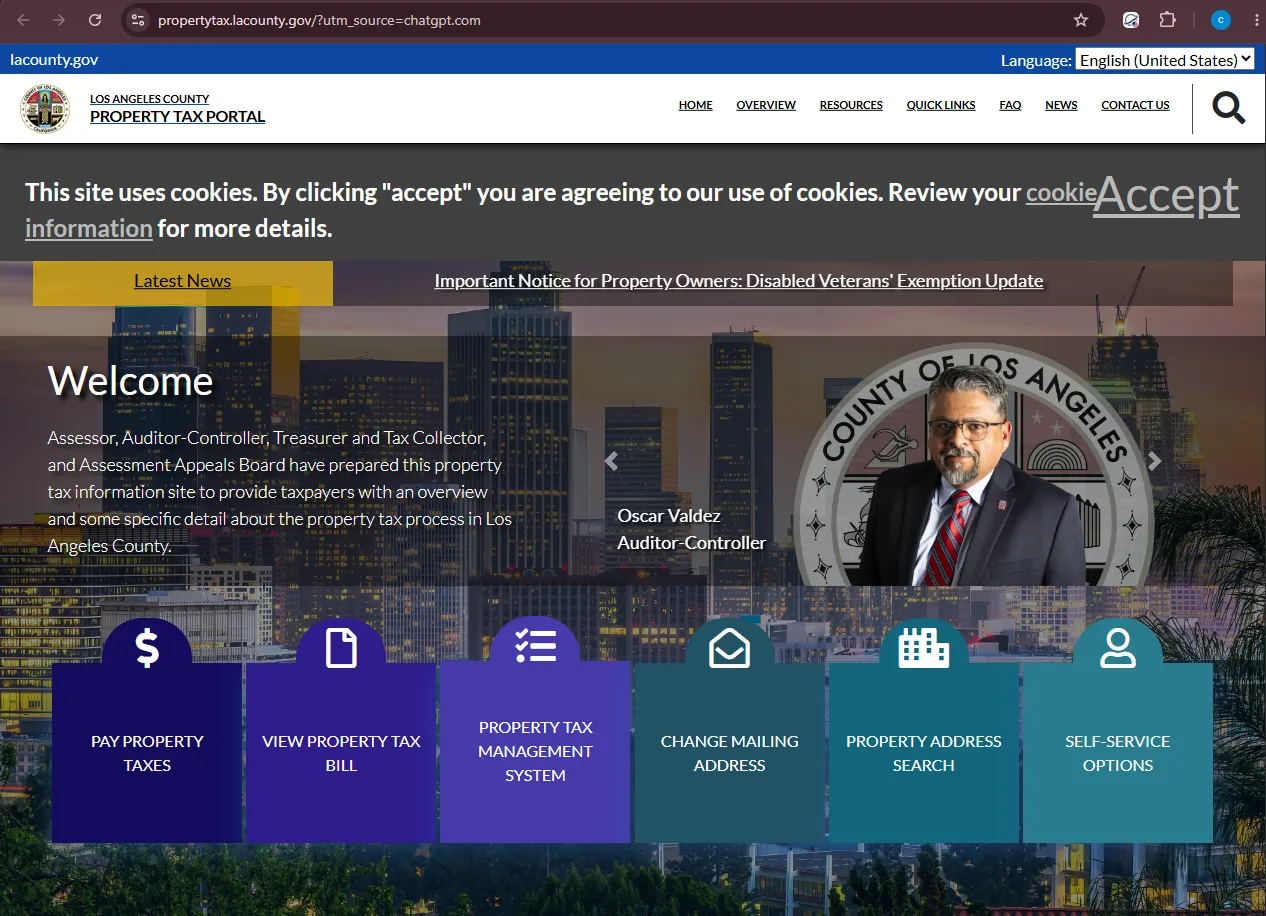
Los Angeles County Property Tax Help by Situation
Use this section to choose the right route. The goal is to understand the issue here first, then use the official portal only for the final account-specific action.
| Your Situation | What to Check First | Best Next Step |
|---|---|---|
| I cannot find my property tax bill | Search by AIN or property address and confirm the correct parcel. | Find the bill online |
| I want to pay Los Angeles County property tax online | Check installment, AIN, amount due, delinquency date, payment status and escrow/impound status. | Pay safely |
| I need a duplicate bill or PDF copy | Confirm the annual secured bill year and installment before printing or mailing payment. | Read the bill guide |
| I bought or built recently | Look for supplemental secured bills and reassessment timing. | Review supplemental bills |
| My bill looks too high | Review assessed value, exemptions, direct assessments, voter-approved debt and tax rate area. | Find why the bill changed |
| I need an exemption or appeal | Check principal residence status, exemption type, assessed value and appeal filing window. | Review exemptions |
Before You Pay: 8 Checks That Prevent Most LA County Tax Problems
Many payment and refund issues happen because taxpayers pay too quickly. Run through these checks first, especially if your lender uses an escrow or impound account.
Where Is My Los Angeles County Property Tax Bill?
Annual secured property tax bills are prepared and mailed in October, but you do not need to wait for paper mail to check the bill, view payment history, request a duplicate bill, or confirm whether a payment posted. The property tax portal is the best first stop because it connects the major offices involved in LA County property tax administration.
- Open the official Los Angeles County Property Tax Portal.
- Select the option to view a bill, pay taxes, review payment history, or use self-service tools.
- Use the AIN if you have it; otherwise use address or Assessor search tools where available.
- Confirm the property address, AIN, tax year and bill type before downloading or paying.
- Save the bill or screenshot only after confirming you are on the correct property record.
- Open the self-service options page.
- Choose the duplicate bill or bill-related option.
- Enter the requested property information.
- Verify year, installment, AIN and property address.
- Use the copy for records or payment only after checking live balance/status.
Payment history can help confirm whether a homeowner, lender, escrow company, or duplicate payment already posted.
Useful when paper mail is missing, your lender needs a copy, or you need a PDF for your records.
Self-service options include homeowner alerts/e-notifications for record activity and property tax management.
New buyers should review annual secured and supplemental tax bill guidance before assuming escrow handled everything.
How to Search Los Angeles County Property Tax by AIN, Address or Property Details
Los Angeles County commonly uses the AIN, or Assessor’s Identification Number, to identify secured property. The AIN is the cleanest identifier for tax bills, payment history and payment instructions. Address search is helpful when the AIN is missing, but you should still confirm the parcel before paying.
- Open the Assessor search or map search tool.
- Enter the AIN if you have it.
- Use address search if the AIN is not available.
- Confirm property location, parcel boundaries and property details.
- Use the confirmed AIN for bills, payments, payment history and exemption checks.
| Search Method | Best Use | Risk to Avoid |
|---|---|---|
| AIN search | Best for paying, viewing bill details, checking payment history, and avoiding wrong-property mistakes. | Using an AIN from an old bill, nearby parcel, or different property. |
| Address search | Useful when the AIN is unknown or when you only have the property location. | Selecting the wrong unit, similar address, vacant land parcel, or map result. |
| Owner-name clue | Helpful only as a supporting clue after sale, estate, trust or business ownership changes. | Paying or filing based only on an owner name match. |
| Map search | Helpful for unusual addresses, land, units, hillsides, commercial parcels or nearby parcels that look similar. | Assuming a map pin is correct without checking the AIN. |
How to Pay Los Angeles County Property Tax Safely
Payment should be the final step. Before you send money, confirm the AIN, bill year, installment, delinquency date, amount due and payment status. This is especially important if your lender collects property taxes in an impound or escrow account.
| Payment Option | What to Know | Micro Steps | Official Link |
|---|---|---|---|
| Online eCheck | The Treasurer and Tax Collector lists no cost for eCheck payments. Your bank account must be ACH-enabled. | Confirm AIN → choose bill/installment → enter bank details → review → save confirmation. | Pay with eCheck |
| Credit or debit card | Card payments include a service fee. Official payment pages list fee details and transaction limits. | Review fee → verify amount → confirm bill year → pay before deadline → save receipt. | Pay with card |
| Telephone payment | Telephone card payment requires details from the secured property tax bill, such as AIN, Year and Sequence. | Have bill ready → call official number → confirm fee → save confirmation. | Telephone payment details |
| Mailed payments should include the payment stub and must be received or USPS-postmarked on time to avoid penalty. | Print bill → include stub → mail early → keep USPS proof. | Mail payment guidance | |
| In person | Counter service can help when you need proof, have a complex payment issue, or need in-person assistance. | Bring bill/AIN → check payment types → keep receipt. | TTC office information |
Avoid duplicate payment: If your mortgage lender pays through escrow or impound, check posted payment status before paying yourself. If both you and the lender pay, you may need refund tracking and extra paperwork.
How to Read the Los Angeles County Property Tax Bill PDF
The annual secured property tax bill is more than a payment notice. It shows the AIN, owner of record, property location, assessed value, exemptions, tax amounts, installment stubs, direct assessments and payment information. Read it carefully before paying, mailing a check, or sending it to your lender.
- Open the Annual Secured Property Tax Bill explanation page.
- Compare the AIN on the bill with the Assessor or portal record.
- Check first and second installment amounts separately.
- Look for exemption, direct assessment, penalty and payment-stub details.
- Save the PDF or printed copy with your payment records.
| Bill Area | Why It Matters | What To Do |
|---|---|---|
| AIN | Main identifier for the secured property tax bill. | Match it with the Assessor or property tax portal result. |
| First installment stub | Separate amount and delinquency date from the second installment. | Pay before the December delinquency deadline if applicable. |
| Second installment stub | Separate amount that becomes delinquent later in the fiscal year. | Pay before the April delinquency deadline if applicable. |
| PIN/EFT/Sequence details | May be needed for phone or electronic payment routes. | Use the numbers exactly as shown on the official bill. |
| Direct assessments | Special charges can increase the total due beyond the basic levy. | Review the listed agency or district if a charge seems unfamiliar. |
| Exemptions | Missing exemptions can make the bill higher than expected. | Check Assessor exemption records if the line looks wrong. |
Printed bill warning: A saved PDF can become outdated if a payment posts, penalty is added, escrow pays later, a correction occurs, or a supplemental bill is issued. Re-check the live record before paying again.
Los Angeles County Property Tax Due Dates and Delinquency Rules
Annual secured property taxes are paid in two installments. The first installment is due November 1 and becomes delinquent after December 10. The second installment is due February 1 and becomes delinquent after April 10. If a deadline falls on a weekend or legal holiday, verify the official next-business-day rule before paying.
- Open the official Annual Secured Property Tax Bill page.
- Confirm whether you are paying the first or second installment.
- Check the delinquency date, not only the due date.
- If mailing, make sure the payment is received or USPS-postmarked on time.
- Save confirmation, receipt or postmark proof if paying close to the deadline.
| Installment | Due Date | Delinquent After | What to Do |
|---|---|---|---|
| First installment | November 1. | December 10. | Pay or make sure USPS postmark is on or before the delinquency date. |
| Second installment | February 1. | April 10. | Check payment status before paying if your lender handles escrow. |
| Late first installment | After the first delinquency date. | Penalty period. | Review official balance because penalty may be added. |
| Late second installment | After the second delinquency date. | Penalty and cost period. | Check official balance before paying because extra cost may be added. |
Los Angeles County Property Tax Rate: Why the Bill Is Not Just One Number
Many homeowners expect one simple LA County property tax rate. In practice, the bill can include assessed value, the general levy, voter-approved debt, tax rate areas, direct assessments, special district charges and exemptions. This is why two nearby properties can have different total bills.
- Find the assessed value on your bill or Assessor record.
- Check whether Homeowners’ Exemption or another exemption is applied.
- Review the tax rate area and voter-approved debt items.
- Look for direct assessments or special district charges.
- If the assessed value looks wrong, review appeal options instead of only calling the Treasurer.
The Assessor establishes the property’s assessed value under California property tax rules.
Approved exemptions can reduce assessed value and may lower the tax bill.
The general property tax levy is commonly described as 1% before voter-approved debt and other items.
Local charges for districts or services can appear on the bill and change the total due.
Why Did My Los Angeles County Property Tax Bill Change?
A higher bill does not always mean one office made a mistake. The change may be caused by reassessment after purchase, new construction, a supplemental bill, missing exemption, voter-approved debt, direct assessments, property tax correction, or lender escrow timing.
| Possible Reason | Where to Check | Next Step |
|---|---|---|
| Change in ownership | Assessor assessed value, base-year value and supplemental bill information. | Compare closing date, reassessment date and supplemental bill period. |
| New construction | Assessor property record and supplemental assessment details. | Confirm completion date and whether a supplemental bill was issued. |
| Missing exemption | Bill exemption line and Assessor exemption status. | File or correct through the official Assessor process if eligible. |
| Direct assessment | Bill charges for districts, bonds or special assessments. | Contact the listed agency if a charge seems wrong. |
| Escrow/impound issue | Payment history and mortgage statement. | Contact your lender if payment is not posted near the deadline. |
Supplemental Property Tax Bills After Buying, Building or Reassessing
Los Angeles County property owners may receive a supplemental secured tax bill after a change in ownership or completion of new construction. This bill is separate from the regular annual secured bill and can surprise new buyers who thought everything was handled through escrow.
- Check whether the bill is annual secured or supplemental secured.
- Confirm the AIN and property address.
- Review the change in ownership or construction date used in the calculation.
- Do not assume your lender will pay it unless your escrow/impound agreement says so.
- Pay by the listed deadline or contact the proper office if the calculation dates look wrong.
New buyer warning: A seller credit at closing and a county tax payment are not the same thing. Review your closing disclosure, tax proration, escrow instructions and official bill status separately.
New Property Owner Checklist
If you recently bought a property in Los Angeles County, your tax situation can include the regular annual secured bill, supplemental bills, escrow/impound setup, ownership records, mailing address updates and exemption filing.
- Open the LA County new property owner page.
- Review annual secured and supplemental secured property tax responsibilities.
- Compare county guidance with your closing and escrow documents.
- Confirm whether your lender will pay current or supplemental bills.
Los Angeles County Property Tax Exemptions
The most common homeowner-related exemption is the Homeowners’ Exemption. If you own and occupy your home as your principal residence on January 1, you may qualify for a $7,000 reduction from assessed value. Other exemptions may apply for disabled veterans, veterans, nonprofit, religious or institutional property uses.
- Open the LA County Assessor Homeowners’ Exemption page.
- Confirm the property is your principal residence.
- Check whether you owned and occupied the home on January 1.
- Submit the claim through the official Assessor process if eligible.
- Keep proof of submission or confirmation with your tax records.
| Exemption Topic | Who Should Review | Practical Note |
|---|---|---|
| Homeowners’ Exemption | Owners who occupy the home as a principal residence. | $7,000 reduction from assessed value if eligible. |
| Disabled Veterans’ Exemption | Eligible disabled veterans or qualifying surviving spouses. | Review official Assessor requirements and documents before filing. |
| Veterans’ Exemption | Veterans meeting official asset and eligibility rules. | Use the official Assessor page to check current requirements. |
| Institutional exemptions | Certain nonprofit, religious, charitable or institutional property uses. | Rules are specialized; use official Assessor forms and guidance. |
| Exemption missing from bill | Owners whose bill does not show an expected exemption. | Check Assessor records before paying or appealing the wrong issue. |
Assessment Appeals and Decline-in-Value Issues
If the problem is assessed value, classification, ownership reassessment, new construction value, or a decline-in-value issue, the Treasurer and Tax Collector is usually not the office that fixes it. Property value disputes generally involve the Assessor first and, if needed, the Assessment Appeals Board.
- Review your assessment notice, property record or supplemental notice.
- Compare the county value with your evidence.
- Check the regular assessment appeal filing period.
- For supplemental assessments, check the deadline printed on the notice or bill.
- Keep payment deadlines separate from appeal deadlines.
Important: An appeal does not automatically remove payment responsibilities. If a bill is due, verify payment rules and appeal rules separately.
Late, Delinquent or Defaulted Property Taxes
If you missed a delinquency date, do not guess the balance from an old bill. Penalties and costs can change what you owe. Search the current balance, confirm the year and installment, then use official payment tools or contact the Treasurer and Tax Collector if you need help.
- Open the property tax portal or Treasurer payment page.
- Search by AIN or property details.
- Confirm whether the amount is current, delinquent or defaulted.
- Review penalties or added costs before paying.
- Save proof after payment.
Urgent note: If taxes are defaulted, in a payment plan, connected to a tax sale, bankruptcy, probate, foreclosure, or legal dispute, do not rely only on an informational guide. Use official help or qualified professional guidance.
Payment History, Refunds and Duplicate Payments
Refund and payment-history questions often come up when a homeowner and lender both pay, an eCheck or card payment is duplicated, a correction is processed, or a refund is created after an appeal or exemption change. LA County self-service tools can help you view recent payment history and request help when history is not displayed online.
- Open the property tax payment history or self-service page.
- Enter the AIN and required bill details.
- Compare posted payments with bank, card, escrow or impound records.
- If an adjustment, returned payment, refund or correction affects the record, submit an official inquiry.
- Save screenshots, receipts and escrow records together.
Often happens when both owner and lender pay, or when a taxpayer repeats payment because the first one seemed missing.
Escrow collection on your mortgage statement does not prove the county received payment.
A returned eCheck or other failed payment may change what appears in payment history.
If an adjustment, refund or correction exists, the online history may require an official inquiry for assistance.
Mortgage Escrow or Impound Account Checklist
If your lender collects property tax money in an escrow or impound account, do not assume the tax is paid until the county record shows payment posted. Lenders and servicers can make payments close to deadlines, and duplicate payments can happen if the homeowner pays separately.
- Search the property by AIN or address.
- Open the current tax bill and payment status.
- Compare installment deadlines with your escrow statement.
- Ask your lender which installment they will pay and when.
- Check posted payment before paying yourself.
- Keep escrow statements and official payment-status screenshots.
Mailing Address, Homeowner Alerts and Missed Notices
A wrong mailing address can cause missed bills, refund notices, supplemental bill surprises, penalty notices or exemption-related mail. Use official self-service tools to review mailing address and alert options when available.
- Open the LA County Property Tax Portal self-service page.
- Choose mailing address, homeowner alert, duplicate bill, payment history or penalty-cancellation tools if relevant.
- Enter the AIN or required property details.
- Save confirmation or screenshots for your records.
Before You Visit the Los Angeles County Treasurer Office
In-person help is most useful when you need payment proof, counter service, a complex payment-history answer, a mailed-payment question, or clarification that cannot be solved online. Bring documents so the visit does not become a second trip.
AIN, property address, current bill or PDF copy, bill year and installment.
Confirmation number, bank record, card receipt, check image, postmark proof or lender escrow statement.
Assessor notice, exemption filing, appeal document, supplemental bill or property record printout.
Photo ID and documents showing your relationship to the property if the issue is owner-specific.
Documents to Keep Before and After Payment
Good records help with escrow issues, payment disputes, duplicate payments, exemption questions, supplemental bills, late-payment penalties and assessment appeals.
AIN, property search result, PDF tax bill, installment stub, escrow statement and exemption status.
Confirmation number, receipt, bank record, card receipt, check image, branch receipt or USPS postmark proof.
Proof of ownership, principal residence status, Assessor claim status and exemption confirmation.
Closing statement, purchase date, construction completion date, supplemental bill and escrow instructions.
Related Property Tax Guides on This Site
These internal guides can help you understand general property-tax concepts before taking action on the Los Angeles County official site.
Official Los Angeles County Property Tax Links
Use these official sources when you are ready to complete a final action such as paying, checking bill status, requesting a duplicate bill, filing an exemption, reviewing appeal rules, or checking tax rate details.
Los Angeles County Treasurer Office Map
For in-person secured property tax help, payment questions, or counter service, check current hours and instructions before visiting.
Los Angeles County Secured Property Tax
Kenneth Hahn Hall of Administration
225 North Hill Street, First Floor Lobby
Los Angeles, CA 90012
Phone: 213-974-2111 or 888-807-2111
Editorial Trust and Update Notes
CountyPropertyTaxes.us is an independent informational guide. It is not the Los Angeles County Treasurer and Tax Collector, Assessor, Auditor-Controller, or Assessment Appeals Board. This page is designed to explain what users should check before taking account-specific action on official Los Angeles County websites.
Update checklist: due dates, delinquency rules, payment methods, eCheck/card fee language, bill-copy tools, self-service tools, exemption rules, supplemental bill links, Assessor search links, tax-rate lookup links, appeal filing windows, office address, screenshot image and FAQ schema should be reviewed whenever official Los Angeles County pages change.
Los Angeles County Property Tax FAQs
How do I find my Los Angeles County property tax bill?
Use the official LA County Property Tax Portal. Search by AIN or property address, confirm the parcel, then open bill, duplicate bill, payment status or self-service options.
How do I pay Los Angeles County property tax online?
Search the property, confirm AIN, installment, amount due, delinquency date and payment status, then use the official Treasurer and Tax Collector payment page.
Is there a free online payment option?
LA County lists no cost for eCheck payments. Credit and debit card payments may include a service fee, so review the official fee screen before submitting payment.
What is an AIN?
AIN means Assessor’s Identification Number. It is the parcel number used to identify secured property in Los Angeles County records and tax bills.
Can I search LA County property tax by address?
Yes, Assessor and property-tax tools may allow address search. If multiple results appear, confirm AIN and parcel details before paying or filing.
When are Los Angeles County property taxes due?
The first installment is due November 1 and delinquent after December 10. The second installment is due February 1 and delinquent after April 10.
What happens if I pay late?
Late payments can trigger penalties and added costs. Always check the official current balance before paying late.
How do I get a duplicate tax bill?
Use the LA County Property Tax Portal self-service options to request or view a duplicate bill, then verify the year and installment before paying.
What is the Homeowners’ Exemption in Los Angeles County?
Eligible owners who occupy their home as a principal residence may apply for a $7,000 reduction from assessed value through the Assessor.
Why did my Los Angeles County property tax bill increase?
Common reasons include reassessment, new construction, supplemental bills, direct assessments, voter-approved debt, missing exemptions, or escrow timing issues.
What is a supplemental property tax bill?
A supplemental bill can be issued after a change in ownership or completion of new construction. It is separate from the regular annual secured bill.
Will my lender pay my supplemental bill?
Not always. Review your escrow or impound agreement and ask the lender directly before assuming a supplemental bill will be paid from escrow.
Who handles property tax payments?
The Los Angeles County Treasurer and Tax Collector handles payment collection, balances, delinquency and related payment services.
Who handles assessed value or exemptions?
The Los Angeles County Assessor handles property valuation, AIN/property search and many exemption matters.
Who handles property tax appeals?
The Assessment Appeals Board handles formal value disputes and appeal filing windows. Payment deadlines and appeal deadlines should be tracked separately.
Is CountyPropertyTaxes.us the official Los Angeles County tax office?
No. This is an independent informational guide. Final payments, filings, appeals and official records should be completed through Los Angeles County official websites.
Bottom Line
Find the bill, confirm the AIN, read the PDF, verify the installment and delinquency date, check exemptions, supplemental bills and escrow status, then pay or file only through the correct official Los Angeles County source.
Find My BillHow to PaySearch PropertyRead Bill PDFOfficial Links