
Tarrant County Property Tax: Search, Pay & Deadlines
Tarrant County property tax is split between two main local systems. The Tarrant County Tax Office handles tax accounts, statements, payments, receipts and collection. Tarrant Appraisal District (TAD) handles appraised value, property records, exemptions and the appraisal protest process.
The safest order is to search the tax account, verify the property and year, review the statement and posted payments, check escrow, then pay through the official county route. If the problem is value or an exemption, stop at the payment step and use TAD instead.
Quick Answer
Use the Tarrant County Tax Office when you need a tax bill, live balance, payment, receipt, installment information, penalty/interest information or collection help.
Use Tarrant Appraisal District when you need appraisal value, property characteristics, ownership or mailing-address record changes, a homestead or other appraisal exemption, or an appraisal protest.
If you are unsure which office to use, ask one question first: “Am I trying to change the property record/value, or am I trying to deal with the tax bill?” Value and exemption issues generally go to TAD; billing and payment issues generally go to the Tax Office.
Tarrant County Tax Office vs Tarrant Appraisal District
Calling the wrong office is one of the easiest ways to lose time. These local offices handle different parts of the same property-tax system.
Use the Tax Office for current tax statements, paid/unpaid status, payment history and collection questions.
Use the Tax Office for online, phone, mail, in-person, drop-box and kiosk payment information and receipts.
Use Tarrant Appraisal District when the market or appraised value looks wrong or property characteristics need review.
TAD handles residence homestead, over-65, disability, veteran and other appraisal-district exemption records.
A formal protest is filed through the Tarrant Appraisal Review Board process. Preserve the deadline shown on the notice.
School districts, cities, the county and other taxing entities adopt rates that can affect the final bill.
The Tax Office cannot simply lower your appraisal because the bill feels high. TAD cannot treat a credit-card payment as posted. Match the problem to the office.
How to Search Your Tarrant County Property Tax Account
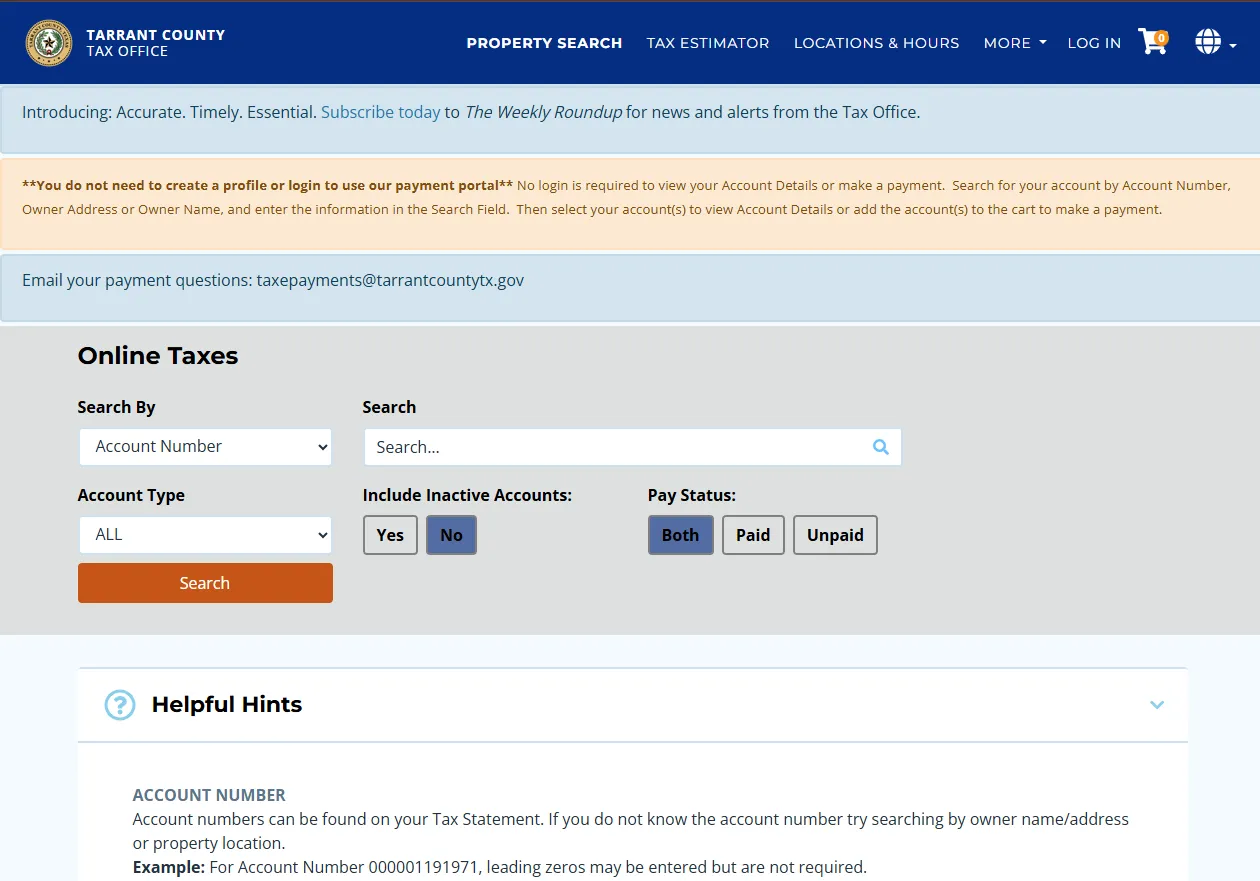
The official Tarrant County portal says you do not need to create a profile or log in to view account details or make a payment.
The current portal supports searches by account number, owner address and owner name. Its search hints also explain how to search by the actual property address.
- Open the official property search.
- Select the search type that matches the information you have.
- Enter the account number, owner information or address.
- Open the matching property.
- Verify the account details before adding anything to the payment cart.
Address-search tip: the official portal says not to enter street type or direction when using property-address search. If “100 Main Street North” fails, try the street number and core street name first.
How to Get a Tarrant County Tax Statement or Receipt
A statement shows the tax account before payment. A receipt shows payment activity after it posts. Both can matter for mortgage escrow, closing records, reimbursement, tax preparation and refund questions.
Search the account, open the correct property and tax year, then use the statement or e-statement tools provided by the Tax Office.
Check that the payment has posted, then save or print the receipt from the official account tools.
Do not wait for a replacement paper bill if the deadline is approaching. Tarrant County says failure to receive a statement does not remove tax, penalty or interest responsibility.
Keep the tax statement together with the mortgage servicer’s escrow statement and the final county receipt.
- Open the county Statements and Receipts page.
- Use the property-account search route.
- Select the correct property and tax year.
- Save the statement before payment if you need a bill copy.
- After payment posts, save the receipt as proof.
How to Pay Tarrant County Property Tax Safely
Payment should come after account verification. The county currently supports online, phone, mail, in-person, drop-box and kiosk routes, but the best choice depends on your timing and payment method.
Search the account, verify details, add the correct account to the cart, review payment method and fee, then save confirmation.
Have the account number ready. Tarrant County says the phone line connects to a third-party payment processor rather than a Tax Office employee taking card details.
Mail early, use a qualifying USPS postmark and keep a copy of the statement and payment proof.
Useful when you want face-to-face help or printed proof. Check current locations and hours before traveling.
County guidance says drop boxes accept checks only. Include the account number and phone number on the check.
The downtown Fort Worth property-tax lobby has a kiosk that can search accounts, verify payments and print statements or receipts.
- Search the official tax account first.
- Confirm owner/property, tax year and balance.
- Check whether escrow already paid.
- Choose an authorized payment route.
- Review the processor fee before submission.
- Save confirmation and verify posting later.
Tarrant County Payment Fees and Posting Details
The Tax Office currently publishes different fees for e-check, debit and credit-card payments. Because processor charges can change, review the official payment screen before final submission.
No additional fee is currently listed for e-check payments.
The county currently lists a 2.15% fee for online or phone credit-card payment.
The current published online or phone debit-card fee is $2.95.
The county currently lists 2.15% for in-person credit with a $2.50 minimum, and $2.50 for in-person debit.
Tarrant County advises allowing 1–3 days for phone payments to appear in the online account.
The county currently lists a $25 service charge for returned checks.
Do not compare payment methods only by convenience. Near a deadline, also compare processor fee, proof of payment, posting time and the risk of a duplicate escrow payment.
Mail Payment, USPS Postmark and Mailing Risk
Tarrant County’s current payment instructions say mailed checks, cashier’s checks and money orders must be postmarked by the applicable deadline to avoid penalty and interest.
A meter date is not the same as the required USPS postmark. The county defines the postmark as the U.S. Postal Service cancellation stamp. It also warns that lost or stolen mail not received by the Tax Office can still create penalty and interest problems.
Rick D. Barnes, Tax Assessor-Collector
PO Box 961018
Fort Worth, TX 76161-0018
Include the correct account information, make the check payable as instructed by the Tax Office and keep a copy of the payment and statement.
Take the envelope to a USPS counter or postal agent and obtain the appropriate same-day postmark instead of relying on a private meter date.
Check the online tax account to confirm the payment was received and posted.
Tarrant County Property Tax Due Dates: 2026–2027
Texas property taxes are generally due on receipt of the bill and normally become delinquent after January 31. However, weekends, holidays, late-mailed bills and special installment plans can change the effective date.
Texas law generally calls for tax bills to be mailed on or around October 1, or as soon thereafter as practicable.
Taxpayers using the half-payment option generally need the first half timely paid by the applicable November deadline.
Texas Tax Code Section 1.06 provides that when the last day falls on a Sunday, timely performance can move to the next business day.
The Texas Comptroller specifically explains that when January 31 falls on Sunday, taxes may be paid on Monday, February 1 and become delinquent Tuesday, February 2.
If the original bill is mailed late, Texas law can postpone delinquency so the taxpayer receives at least the required payment period.
Always verify the delinquency date printed on the official account because special bills and payment plans can follow different timing.
- Open the official Tarrant County Important Dates page.
- Check the current tax year.
- Compare the county date with the delinquency date shown on your own account.
- If a deadline falls on a weekend or holiday, confirm the locally published extension.
- Save proof when paying near the deadline.
January 31 is normally the last statutory payment date, but it is not safe to mechanically write “February 1 is always delinquent.” Weekend and holiday rules can move the effective delinquency date.
Full, Half and Quarterly Payment Options
Tarrant County publishes multiple payment schedules. Eligibility and timing depend on the account and exemption status.
Most taxpayers pay the full annual bill before delinquency.
The Tax Office allows qualifying taxpayers to divide taxes into two equal payments when the first half is timely paid and identified as a half payment.
This option is for qualifying residence homesteads with an over-65 or disability exemption.
County calendar pages confirmed June 30, 2026 for the second half-payment and July 31, 2026 for the fourth quarterly installment. A third-quarter deadline moved to June 1 because May 31 fell on Sunday.
Do not copy the prior year’s installment dates into the next tax year. Weekend and holiday extensions can change the practical deadline. Check the current Tarrant County calendar each year.
Tax Rates, Taxing Entities and Why Two Similar Homes Can Have Different Bills
A Tarrant County tax account can include more than the county itself. School districts, cities and other local taxing entities may each affect the total.
Start with the TAD value record and confirm property facts.
Homestead or other exemptions can affect taxable value differently across taxing entities.
Two nearby properties can fall in different school districts and receive different tax rates.
A Fort Worth property can have a different municipal-tax component from a property outside city limits or in another municipality.
Hospital, college, emergency-service or other local entities can appear depending on location.
The final bill depends on the adopted rates for the entities that apply to the property.
- Open Tarrant County Rates and Exemptions.
- Choose the current adopted-rate information.
- Compare the taxing entities on your account.
- Review entity-specific exemptions.
- Use TAD if an exemption record itself is missing or wrong.
Do not estimate Tarrant County taxes using a single “county rate” from a search result. Use the taxable value and the actual taxing entities assigned to the parcel.
Tarrant County Homestead, Over-65, Disability and Other Exemptions
Tarrant Appraisal District, not the Tax Office payment portal, handles appraisal-district exemption records.
Homeowners should check ownership, principal-residence requirements and the current TAD application instructions.
Qualifying homeowners may have additional exemption and installment-payment rights.
Qualifying residence homesteads may receive additional relief and quarterly-payment options.
Texas provides multiple veteran-related exemption rules depending on disability rating and circumstances.
- Search the TAD property record and confirm the owner/account.
- Open the current residential homestead exemption application.
- Read the eligibility instructions before filling it out.
- Prepare the identity, ownership and residence documents requested by the form.
- File through the official TAD route.
- Save proof and later confirm that the exemption appears on the property record.
Do not assume every exemption needs annual refiling. The TAD residential homestead form explains that an approved exemption generally does not require annual reapplication unless the appraisal district requests it or eligibility changes.
How to Protest a Tarrant County Property Appraisal
A protest is not a complaint that the tax bill feels high. It is a challenge to an appraisal-district action such as value, unequal appraisal, exemption treatment or another protestable issue.
Do not wait for an informal discussion with TAD if the formal protest deadline is approaching. Preserve the formal filing deadline first.
Mortgage Escrow: Check Before Paying Twice
Many Tarrant County homeowners have property taxes paid through a mortgage escrow account. The lender collecting escrow each month does not prove that the Tax Office has already posted the annual payment.
Look for a posted tax payment for the correct year.
Review escrow disbursement activity or the annual escrow analysis.
A pending lender disbursement may not yet appear in the county record.
Do not pay personally until you know the servicer has not paid or will not pay.
Keep the county receipt and mortgage escrow statement together.
If the deadline is close and payment is not posted, contact the servicer and Tax Office promptly.
The useful question is not “Did my lender collect escrow?” It is “Did the Tax Office receive and post the tax payment?”
New Tarrant County Homeowner Checklist
After buying a property, the owner record, tax account, mailing address, exemption record and mortgage escrow setup may update on different timelines.
Check the TAD property record and Tarrant County tax account.
A closing does not always appear immediately in every tax-system screen.
Make sure notices will reach you even if the ownership update is still processing.
Compare the live tax account with the closing statement.
A seller’s exemption does not mean the buyer automatically has the same future benefit.
Know whether you or the mortgage servicer will make the next payment.
Paying the tax does not establish legal ownership. Deed and title records are separate from the tax account.
Late Tarrant County Property Taxes
Once an account becomes delinquent, the live amount can change because Texas law adds penalty and interest. Additional collection costs may apply later in the delinquency process.
Never pay a delinquent account from an old PDF statement. Search the current Tarrant County account and use the live balance or a current payoff amount.
Search the account immediately and confirm the new balance before payment.
Keep USPS proof and confirm whether the Tax Office received the payment. A private meter date is not the county’s required USPS postmark.
Review the current account and official delinquency instructions before assuming the original bill amount is still valid.
If a notice involves foreclosure, sale, bankruptcy, probate or disputed ownership, use official records and qualified professional advice for the specific facts.
Refunds, Overpayments and Duplicate Payments
A refund issue can arise when the homeowner and mortgage servicer both pay, a payment is entered twice, an exemption or appraisal correction changes the bill, or another account adjustment creates an overpayment.
Do not assume a credit automatically turns into a mailed refund. Confirm the local process and who is legally entitled to claim it.
Tarrant County Property Tax Troubleshooting
Try the Tax Office account number, owner name or simplified property address. If you need appraisal data instead, search TAD.
Use the online account and e-statement route. Missing mail does not automatically remove tax liability.
Check confirmation and bank activity. Phone payments can take 1–3 days to post.
Compare the county account with the servicer’s tax disbursement before paying again.
Use TAD and preserve the protest deadline. Do not ask the payment processor to change value.
Review the TAD exemption record and current application status.
Keep USPS postmark proof and verify county receipt/posting.
Gather both payments and contact the Tax Office about the proper refund or credit process.
The delinquent balance may include penalty and interest. Use the current online balance.
Value or exemption → TAD. Bill, payment or receipt → Tax Office. This single distinction solves many Tarrant County property-tax routing mistakes.
Tarrant County Property Tax Terms
- Tax Account Number
- The identifier used by the Tax Office to locate a property-tax account and statement.
- Appraised Value
- The property value determined through the Tarrant Appraisal District appraisal process.
- Taxable Value
- The amount of value remaining for a taxing entity after applicable exemptions and assessment rules.
- Taxing Entity
- A county, city, school district or other local unit that imposes a property-tax rate on qualifying property.
- Half Payment
- An installment method that splits an eligible tax bill into two payments when the first payment is timely made.
- Quarter Payment
- An installment option for qualifying residence homesteads with an over-65 or disability exemption.
- Appraisal Protest
- A formal challenge to certain appraisal-district actions through the Tarrant Appraisal Review Board process.
- Delinquent Tax
- A tax balance that has passed the applicable delinquency date and can accrue penalty, interest and later collection costs.
Official Tarrant County Property Tax Links
Use these sources only after deciding which task you need to complete. Search and verify the property before entering payment information.
Tarrant County Property Tax FAQs
How do I search Tarrant County property taxes?
Use the official Tarrant County Tax Office property search portal. No login is required. Search by account number, owner name, mailing address or property address, then verify the account, property and tax year before paying.
Do I need an account or login to pay Tarrant County property taxes online?
No. The current Tarrant County portal says you do not need to create a profile or log in to view account details or make a payment.
When are Tarrant County property taxes due?
Texas taxes are normally payable by January 31, but weekends, holidays, late-mailed bills and special payment plans can change the effective date. For example, January 31, 2027 falls on a Sunday, and Texas Comptroller guidance explains that when January 31 falls on Sunday the payment can be timely on Monday with delinquency beginning Tuesday. Always verify the Tarrant County calendar and your own bill.
What payment fees does Tarrant County currently list?
The Tax Office currently lists no additional fee for e-check, 2.15% for online or phone credit-card payments, and $2.95 for online or phone debit-card payments. In-person card fees differ. Verify the total immediately before submitting payment.
Can I pay Tarrant County property tax by phone?
Yes. The Tax Office currently directs phone payments to a third-party payment processor at 817-884-1110. Have your account number ready and allow time for posting; the county says phone payments can take 1–3 days to appear online.
What is the Tarrant County property tax mailing address?
The current Tax Office payment page lists Rick D. Barnes, Tax Assessor-Collector, PO Box 961018, Fort Worth, TX 76161-0018 for mailed tax payments. Verify the address on the official page before sending a deadline-sensitive payment.
Does a private postage meter date count as the Tarrant County postmark?
No. Tarrant County states that the applicable postmark is the U.S. Postal Service cancellation stamp and that a metered postage stamp with a date is not the postmark.
Who handles Tarrant County homestead exemptions?
Tarrant Appraisal District handles homestead and other appraisal-district exemption records. The Tarrant County Tax Office handles billing and collection.
When is the Tarrant property-value protest deadline?
The current Tarrant Notice of Protest states May 15 of the current tax year or the deadline printed on the Property Value Notice from TAD, whichever is later. Use the actual notice for your account.
What if my mortgage company pays my Tarrant County property taxes?
Compare the Tax Office account with your mortgage servicer’s escrow records. Do not pay personally until you confirm the lender has not paid or will not pay.
What if I never received my Tarrant County tax statement?
Search the account online and use the statement or e-statement tools. Tarrant County states that failure to receive the property-tax statement does not waive tax, penalty or interest responsibility.
Can I pay Tarrant County taxes in installments?
Tarrant County offers a half-payment option and qualifying quarterly payments. Quarterly payments are generally available for qualifying residence homesteads with an over-65 or disability exemption. Check current deadlines before choosing an installment method.
What should I do if my Tarrant County payment is not showing?
Check the confirmation and bank record first. Phone payments can take 1–3 days to post, and other payment routes can also need processing time. Avoid sending a duplicate payment until the status is verified.
Is CountyPropertyTaxes.us the official Tarrant County Tax Office?
No. CountyPropertyTaxes.us is an independent informational guide. Final payments, statements, official account records, exemptions and protests must be handled through the Tarrant County Tax Office, Tarrant Appraisal District or another responsible government office.
Bottom Line
For Tarrant County property tax, use the Tax Office for bills, payments and receipts and use TAD for appraisal value, exemptions and protests. Search the account first, verify the property and tax year, check escrow and deadlines, then use the official payment or filing route and save proof.
Search Account Pay Safely Check Dates Exemptions Protest Official LinksMaterially reviewed and updated using current Tarrant County, TAD and Texas Comptroller sources: August 27, 2026.