
Gwinnett County Property Tax Guide: Pay, Search, Due Dates & Exemptions
Gwinnett County property tax is easier to handle when you start with the right record instead of jumping straight to payment. A missing bill, escrow account, new home purchase, wrong mailing address, pending appeal, or missed homestead exemption can change what you should do next. This guide explains the practical steps first, then sends you to the official Gwinnett County Tax Commissioner or Board of Assessors page only when you are ready to search, pay, apply, appeal, or verify a property-specific balance.
Quick Answer
Search the official Gwinnett County property tax record, confirm the parcel and owner details, open the current tax bill, check whether a mortgage company or escrow account may pay it, review payment fees, then pay only through the Gwinnett County Tax Commissioner’s official payment options. If the bill looks too high, do not start with the payment office; review the assessment notice, millage rate, homestead exemption status, and appeal window.
Gwinnett County Property Tax Help by Situation
Use this section if you arrived from search and want the right path fast. Gwinnett property tax tasks split between the Tax Commissioner, Board of Assessors, Georgia statewide property tax rules, and sometimes city tax offices.
| Your Situation | What to Check First | Best Next Step |
|---|---|---|
| I want to pay my Gwinnett County property tax | Confirm parcel, tax year, amount due, payment status, escrow status and card/e-check fee rules. | Review payment options |
| I cannot find my tax bill | Search by property information and confirm the parcel before using any payment page. | Find your bill online |
| I have a mortgage escrow account | The county does not send bills to mortgage companies; your tax information is made available, but you remain responsible for payment. | Check escrow steps |
| I need a homestead exemption | Confirm January 1 ownership and primary residence status, then review Gwinnett exemption rules. | Review exemption steps |
| I disagree with property value | Look at the Annual Notice of Assessment and the 45-day appeal window. | Appeal assessment |
| My taxes are late | Review interest, penalty, Fi.Fa., tax lien, levy and tax sale risk. | Handle delinquent tax |
Before You Pay: 7 Checks That Prevent Most Gwinnett Tax Problems
The biggest payment mistakes happen when a property owner pays before confirming the bill and parcel. Use these checks before entering a bank account or card number.
How to Find Your Gwinnett County Property Tax Bill
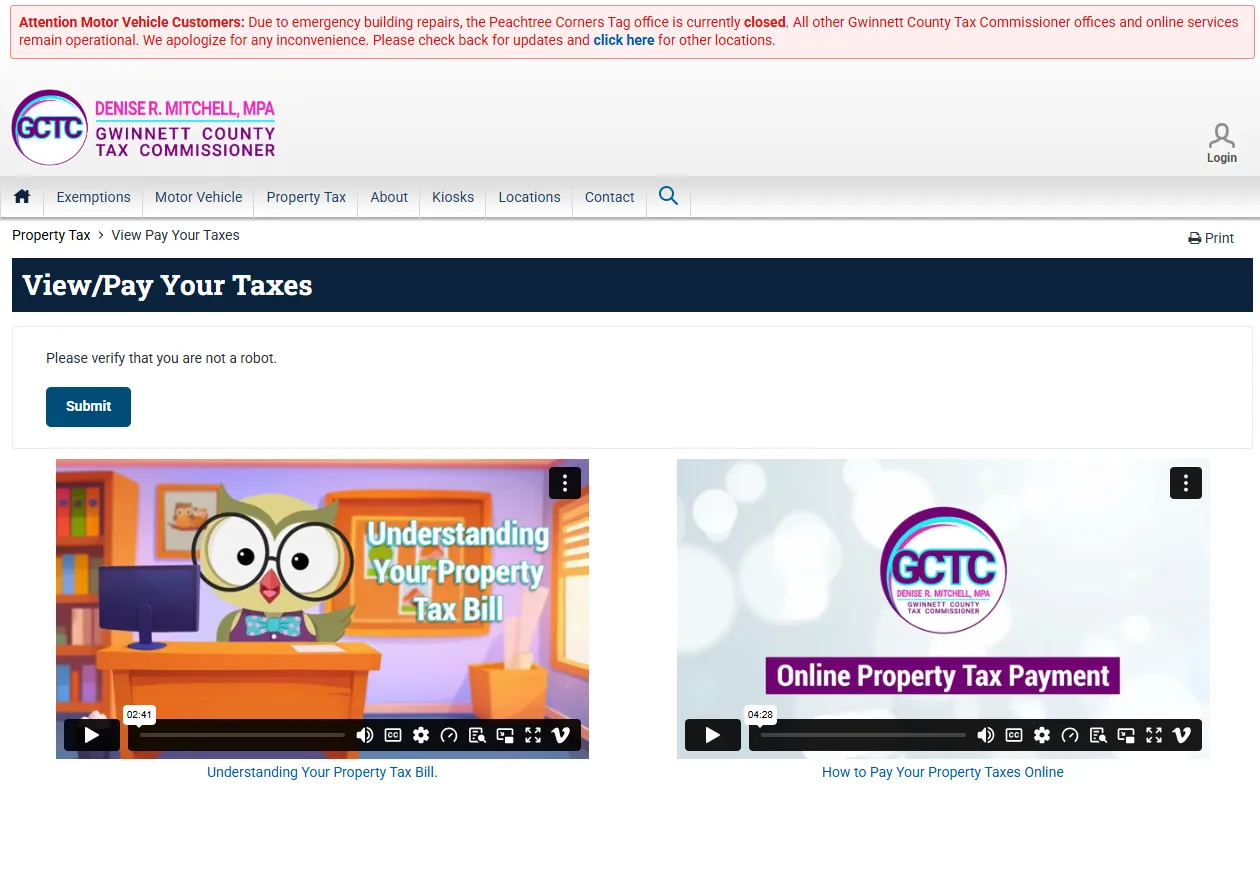
The official Tax Commissioner page is the best starting point for viewing or paying a Gwinnett County property tax bill. Use it when the paper bill has not arrived, when you want to confirm payment status, or when you need to pay online.
- Open the official Gwinnett County Tax Commissioner View/Pay page.
- Complete any security check shown on the page.
- Search for the correct property record.
- Confirm the property address, parcel details, owner information and tax year.
- Review the amount due and payment status before choosing a payment method.
What to check after you find the bill
Verify that the address and parcel belong to the property you intend to pay.
Make sure you are reading the current bill, not a prior-year or delinquent record.
Check whether a payment has already been made by you, your bank, or your mortgage company.
If you recently bought or sold property, confirm the mailing address and ownership information.
Gwinnett County Property Search: Tax Commissioner vs Board of Assessors
Property owners often use “property tax search” to mean two different things. If you want to pay or check a bill, start with the Tax Commissioner. If you want to review valuation, assessment notice, property record data, or appeal information, start with the Board of Assessors.
| Task | Use This Office | Why It Matters | Official Link |
|---|---|---|---|
| View or pay tax bill | Tax Commissioner | The Tax Commissioner bills, collects and distributes ad valorem property taxes and processes homestead exemptions. | View/Pay taxes |
| Check assessment or value | Board of Assessors | The Assessors identify, appraise and maintain taxable property information and annual assessment notices. | Assessors’ Office |
| File an appeal | Board of Assessors / appeal tools | Assessment appeals follow a 45-day window from the date shown on the annual assessment notice. | Property appeals |
| Apply for homestead | Tax Commissioner | Gwinnett has one application for exemptions, with eligibility based on ownership, occupancy and exemption type. | Homestead exemptions |
How to Pay Gwinnett County Property Tax
Gwinnett accepts several property tax payment methods. The best option depends on whether you want to avoid convenience fees, need proof quickly, are mailing a payment stub, or have a delinquent account.
| Payment Option | What to Know | Practical Steps | Official Link |
|---|---|---|---|
| Online check / bank information | Payments can be made online using a check and banking information with no fee. | Search bill → confirm amount → enter banking information → save confirmation. | Payment options |
| Credit card | Credit card payments can be made online or over the counter using Visa, MasterCard, AMEX or Discover, with a 2.30% convenience fee and $1 minimum. | Review fee → confirm amount → pay → keep receipt. | Card payment details |
| Debit card | Visa, MasterCard and Discover debit cards are accepted online and over the counter for a flat fee of $3.50. | Check debit fee → confirm parcel → pay → save confirmation. | Debit card details |
| Mail check or money order to the Tax Commissioner. Do not send cash. Include the payment stub when available. | Write check → include stub or parcel/address → add phone number if no stub → mail early. | Mail payment rules | |
| In person | Cash payments must be made in person. Office payments may use accepted cash, check, money order or card methods. | Bring bill, ID if needed, payment method and proof documents. | Office details |
Returned check warning: Checks are processed quickly, and dishonored checks can trigger service charges, processing fees and collection activity. Confirm funds are available before paying by check or e-check.
Gwinnett County Property Tax Due Dates
Gwinnett County property tax bills are typically mailed in August or September and due in October or November. For 2025, the Tax Commissioner states that property tax bills have been mailed and are due November 15.
- Open the official deadlines and due dates page.
- Confirm the current tax year.
- Check whether the bill is county, city, mobile home, real property, or personal property.
- If the due date has passed, review late interest and penalty before paying.
- If you have escrow, confirm payment status with your mortgage company and the tax record.
| Topic | Gwinnett Detail | What Property Owners Should Do |
|---|---|---|
| Typical bill timing | Bills are typically mailed in August/September and due in October/November. | Do not wait for paper mail if the due date is close; search online. |
| 2025 due date | The 2025 property tax bills are due November 15. | Confirm your parcel and pay before the due date. |
| Mobile home taxes | Mobile home taxes have a due date of April 1. | Separate mobile home deadlines from regular real property bills. |
| Escrow reminder | Tax information is made available to mortgage companies, but the owner remains responsible. | Verify payment status before assuming the lender paid. |
Late Payment Interest, Penalty and Fee Rules
If a Gwinnett property tax balance remains after the due date, late charges can grow over time. Understanding the difference between monthly interest, penalty, tax lien and tax sale risk helps you act before the problem becomes more serious.
| Late Charge / Action | Official Rule | Practical Meaning |
|---|---|---|
| Interest | Interest accrues at 0.81% per calendar month or any part of a month, listed as 9.75% annually. | The balance can grow each month after the due date. |
| Penalty | A 5% penalty is added after 120 days on the remaining balance, with another 5% after each 120 days, up to 20%. | Waiting too long can add meaningful cost beyond interest. |
| Fi.Fa. / tax lien | If unpaid, a Fi.Fa. may be issued against the property and owner of record. | A lien can affect credit, closing and future property actions. |
| Levy and tax sale | A delinquent property can move toward levy and sale if the balance is not resolved. | Treat delinquent notices as urgent and verify the official account. |
Gwinnett County Homestead Exemptions
Homestead exemptions reduce property taxes on owner-occupied homes. Gwinnett has state and local exemptions, and the savings vary by exemption type, including regular, senior and disabled exemptions. There is one application for Gwinnett exemptions, but eligibility depends on your ownership, occupancy, address records and exemption category.
- Confirm you own and occupy the property as your primary residence as of January 1 of the application year.
- Confirm you do not already claim homestead on another property.
- Make sure your driver’s license and vehicles reflect the Gwinnett County address when required.
- Apply by the appeal deadline on your Notice of Assessment if you want the exemption to apply for the current year.
- Once approved, the exemption generally renews unless circumstances change or you become ineligible.
| Exemption Rule | What It Means | Common Mistake |
|---|---|---|
| Primary residence | You must own and occupy the property as your primary residence as of January 1. | Applying for a home you moved into after January 1 and expecting current-year approval. |
| Only one homestead | You can have homestead on only one property; married couples can have only one between them. | Keeping an old exemption after moving or changing ownership. |
| Address records | Vehicles and driver’s license should reflect the Gwinnett County address when required. | Applying before address records are consistent. |
| Renewal | Approved exemptions generally renew automatically unless eligibility changes. | Reapplying unnecessarily after refinancing; refinancing does not affect the exemption. |
| Change in ownership/name/deed | You may need to apply again if ownership, name, deed, or exemption type changes. | Assuming an exemption follows the property after a title change. |
Assessment Notice, Millage Rate and Why the Bill Changed
A higher property tax bill does not always mean the Tax Commissioner changed your value. The Tax Commissioner collects the bill, while assessment values and appeal-related questions go through the Board of Assessors. Your bill can change because of appraised value, exemptions, millage rates, district levies, city taxes, prior-year corrections or delinquent charges.
Start with the Board of Assessors and review your Annual Notice of Assessment.
Review homestead, senior, disabled or other exemption status if the bill looks too high.
Taxing authorities set millage rates, and the final bill reflects those rates.
Interest, penalties, fees or lien costs can increase an unpaid balance.
Gwinnett County Property Tax Appeals
If your issue is the assessed value, property classification, or data shown on the annual assessment notice, start with the Board of Assessors. Georgia’s appeal period is tied to the date shown on the assessment notice, and Gwinnett’s appeal page explains online filing and letter-based appeal options.
- Open and read your Annual Notice of Assessment.
- Find the date shown on the notice.
- Count the 45-day appeal window from that notice date.
- Use Gwinnett’s online appeal tools by the deadline, or submit a written disagreement identifying the property by parcel number or address.
- Keep payment deadlines separate from appeal deadlines.
Important: An assessment appeal does not automatically mean your tax bill can be ignored. Check payment instructions and deadlines separately while the appeal is pending.
If You Just Bought or Sold Gwinnett County Property
Property tax confusion is common after a closing. The bill may relate to a prior tax year, the seller may have given a tax credit at closing, the mailing address may still need updating, and a prior owner’s exemption may not apply to the new owner.
- Search for the property tax bill after closing.
- Compare the bill with the closing statement and escrow disclosure.
- Do not assume a seller credit means the county bill was already paid.
- Confirm the mailing address and owner information are updated.
- Review homestead exemption eligibility for your own primary residence.
- If your lender escrows taxes, confirm whether the lender will pay the next bill.
Mortgage Escrow: Do Not Assume the Lender Paid
Gwinnett’s official due-date guidance says tax bills are not sent to mortgage companies. Property tax information is made available to mortgage companies, but the property owner is ultimately responsible for making sure taxes are paid.
- Search your Gwinnett County property tax bill online.
- Check whether payment has already posted.
- Compare the due date with your mortgage escrow statement.
- If payment has not posted near the due date, contact your mortgage company directly.
- Do not pay personally until you understand whether the escrow payment is pending.
- Save the official tax record and mortgage payment proof.
Refunds, Overpayments and Unclaimed Money
Refund issues can happen after duplicate payment, escrow confusion, appealed assessments, prior-year corrections, overpayment, or unclaimed checks. Gwinnett also maintains refund-related pages including unclaimed refunds and tax sale excess funds.
Happens when the owner pays and the mortgage company also pays.
Refund checks and notices can be missed if the mailing address is outdated.
A final value change may affect taxes and possible refund processing.
Separate official procedures may apply if a tax sale created excess funds.
- Search your property and payment history first.
- Compare any refund claim to the correct parcel and tax year.
- Review unclaimed refunds if you believe money was owed but not received.
- Review tax sale excess funds separately if the property was involved in tax sale.
Delinquent Taxes, Tax Liens and Tax Sales
Delinquent tax should be handled quickly. Once a balance remains unpaid, interest and penalty can be added, and an account may move toward Fi.Fa., tax lien, levy and tax sale steps.
- Search the property tax account and identify the unpaid year.
- Review interest, penalty and fee charges.
- Check whether a Fi.Fa. or tax lien has been issued.
- If the property is selected for sale, review tax sale instructions and seek legal advice if needed.
- Keep payment proof and official communications.
Tax sale warning: Gwinnett’s tax sale information states that legal advice cannot be provided by Tax Commissioner staff. If your property involves lien, levy, redemption, tax sale, bankruptcy, foreclosure, estate ownership, or legal deadlines, get official and qualified professional help.
Gwinnett County Property Tax Office Contact and Mailing Details
Use the contact details below for property tax questions, mailed payments, in-person payment questions, homestead help, and account-specific assistance.
| Contact Item | Official Detail | Best Use |
|---|---|---|
| Property Tax Phone | 770-822-8800 | Bill, payment, exemption or account questions. |
| tax@gwinnettcounty.com | Property tax assistance and written support. | |
| Regular Mail | Gwinnett County Tax Commissioner, PO Box 372, Lawrenceville, GA 30046-0372 | Mailed check or money order payments with stub. |
| Overnight Mail / Office | Gwinnett County Justice & Administration Center, Tax Commissioner’s Office, 75 Langley Drive, Lawrenceville, GA 30046 | Overnight mail, office visits and document delivery. |
| Office Hours | Monday–Friday, 8 a.m.–5 p.m., except holidays | In-person support planning. |
Before You Visit the Tax Commissioner’s Office
Bring enough information to avoid a second trip. This is especially important for payment disputes, escrow issues, returned checks, refund questions, delinquent tax, homestead records and ownership changes.
Parcel ID, property address, tax bill, tax year and any payment stub.
Confirmation number, bank record, canceled check image, money order receipt or escrow statement.
Driver’s license, vehicle registration address, ownership/occupancy proof, and exemption documents if relevant.
Probate, estate, trust, deed, foreclosure or representative documents if ownership is complicated.
Common Gwinnett County Property Tax Mistakes to Avoid
These are the most common errors that lead to duplicate payment, late fees, missed exemptions or wrong-office frustration.
Mortgage companies can access tax information, but owners remain responsible for making sure payment is made.
Gwinnett says not to send cash by mail. Use check or money order for mailed payments.
Assessment appeals must be filed within 45 days of the notice date.
Homestead is tied to eligibility, ownership and occupancy rules. Title or name changes may require action.
Payment and collection questions go to the Tax Commissioner; value and assessment questions go to the Assessors.
Late accounts can lead to interest, penalties, liens, levy and tax sale risk.
Related Property Tax Guides on This Site
These internal guides can help you understand general property-tax concepts before taking action on the Gwinnett official site.
Official Gwinnett County Property Tax Links
Use these official sources only when you are ready to complete final actions such as payment, application, appeal, account verification, delinquent balance review or refund search.
Gwinnett County Tax Commissioner Office Map
For in-person property tax help, mailed-payment questions, homestead issues, returned payment questions or account-specific assistance, use the Tax Commissioner office details below.
Gwinnett County Justice & Administration Center
Tax Commissioner’s Office
75 Langley Drive
Lawrenceville, GA 30046
Property Tax Phone: 770-822-8800
Editorial Trust and Update Notes
CountyPropertyTaxes.us is an independent informational guide. It is not the Gwinnett County Tax Commissioner, Gwinnett County Board of Assessors, Gwinnett County Government or Georgia Department of Revenue. This guide explains the process and helps users avoid common mistakes before taking final action on official websites.
Update checklist: due date, payment fees, accepted payment methods, mailing address, office hours, homestead rules, assessment appeal deadlines, delinquent interest and penalty rules, tax sale procedures, refund links, screenshot and official URLs should be reviewed whenever Gwinnett official pages change.
Gwinnett County Property Tax FAQs
How do I pay Gwinnett County property tax online?
Open the official Gwinnett County Tax Commissioner View/Pay page, search your property, confirm the bill and payment status, choose a payment method, review any fee, and save the confirmation.
When are Gwinnett County property taxes due?
Gwinnett property tax bills are typically mailed in August or September and due in October or November. The 2025 property tax bills are due November 15.
Can I pay Gwinnett property tax with no fee?
Online payments using check and banking information are listed with no fee. Credit card and debit card payments include convenience fees.
What are the Gwinnett property tax card fees?
Credit card payments have a 2.30% convenience fee with a $1 minimum. Visa, MasterCard and Discover debit card payments have a flat $3.50 fee.
Where do I mail Gwinnett County property tax payments?
Mail payments to Gwinnett County Tax Commissioner, Department of Property Tax, PO Box 372, Lawrenceville, GA 30046-0372. Use check or money order and do not send cash.
What if I do not have a payment stub?
If you mail a payment without a stub, reference your parcel ID or property address on the check or money order and include a phone number.
Does Gwinnett send tax bills to mortgage companies?
No. Property tax information is made available to mortgage companies, but owners are ultimately responsible for making sure taxes are paid.
How do I apply for a Gwinnett homestead exemption?
Use Gwinnett’s homestead exemption application process. You generally must own and occupy the property as your primary residence as of January 1 and meet the rules for the exemption type.
Do I need to reapply for homestead every year?
Once approved, a Gwinnett homestead exemption generally renews automatically unless circumstances change or you become ineligible. You may need to apply again after ownership, name, deed or exemption-type changes.
How long do I have to appeal a Gwinnett assessment?
Georgia assessment appeals are filed within 45 days of the date shown on the annual assessment notice. Gwinnett offers online appeal tools and accepts qualifying written appeals.
What happens if Gwinnett property taxes are late?
Interest accrues monthly on unpaid balances, penalties can be added after 120 days, and unpaid accounts can progress toward Fi.Fa., tax lien, levy and tax sale steps.
Who handles Gwinnett property value questions?
The Board of Assessors handles assessment and value questions. The Tax Commissioner handles tax billing, collection, payment options, homestead processing and related property tax services.
Can I get a refund for overpaid Gwinnett property taxes?
Possibly. Refund issues can involve duplicate payment, escrow confusion, appealed assessments, unclaimed refunds, tax sale excess funds or corrected accounts.
What if I just bought a home in Gwinnett County?
Search the tax bill, compare it with your closing statement, confirm escrow setup, update mailing information if needed, and review homestead exemption eligibility.
Is CountyPropertyTaxes.us the official Gwinnett County tax office?
No. CountyPropertyTaxes.us is an independent informational guide. Final payments, exemption applications, appeals and account-specific verification should be completed through official Gwinnett or Georgia government websites.
Bottom Line
Search the official Gwinnett property record, confirm the correct bill, review due date and fees, check escrow and exemptions, then use the official Tax Commissioner or Board of Assessors page for final action.
Find My BillHow to PayDue DatesExemptionsOfficial Links