
Santa Clara County Property Tax: Search, Pay & Due Dates
Santa Clara County property tax involves several offices. The Assessor determines assessed value and exemptions, the Controller-Treasurer calculates taxes from the assessment roll and tax rates, and the Department of Tax and Collections (DTAC) issues and collects property tax bills.
Before paying, identify the parcel by Assessor’s Parcel Number (APN) or address, confirm whether the bill is annual secured, supplemental or another type, check the installment and delinquency date, review escrow and posted payments, then use the official county payment system.
Quick Answer: What Should You Check Before Paying?
Open the Santa Clara County secured property tax record, search by APN or address, and verify the property, fiscal year, bill type, installment, current amount due, delinquency date and payment status.
If a mortgage servicer handles your taxes, check whether its payment has already posted. If you recently bought the property or completed new construction, also look for a separate supplemental assessment and tax bill.
Do not treat the Assessor’s value record as the final payment record. Use DTAC’s live bill and payment status before sending money.
Santa Clara County Property Tax Offices: Who Handles What?
The biggest time saver is knowing which office can actually fix the problem.
Handles property appraisal, assessed value, parcel characteristics, ownership-related assessment records, exemptions and many value questions.
Calculates property taxes using assessed values, applicable tax rates and other tax-roll information.
Issues bills, accepts payments, tracks balances, handles secured/unsecured tax collection, refunds and many delinquency questions.
Provides the formal county process for qualifying disputes over assessed value when the issue is not resolved with the Assessor.
If the bill includes a parcel tax or direct assessment that looks wrong, the agency listed for that charge may be the right contact.
Administers the Property Tax Postponement program for qualifying homeowners who meet the state requirements.
If your complaint is “the property’s value is wrong,” contact the Assessor or appeal body. If the value is correct but the payment or balance is wrong, use DTAC.
How to Search Santa Clara County Property Tax by APN or Address
The APN is the most useful parcel identifier for Santa Clara County real property. You can often find it on a prior tax bill, deed, escrow statement, assessment notice or Assessor record.
- Open Santa Clara County secured property tax information.
- Prepare the APN or exact property address.
- Search and confirm the correct parcel.
- Review the bill, installment and current payment status.
- Do not enter payment details until the record matches.
Use the Assessor search when you need assessed value, property characteristics or assessment information rather than a live DTAC tax balance.
Assessor Property SearchHow to Read a Santa Clara County Property Tax Bill
A tax bill can be correct mathematically but still surprise a homeowner because of a supplemental assessment, direct charge, missing exemption or new assessed value.
Match the Assessor’s Parcel Number with the property you intend to pay.
Make sure you are reading the correct fiscal year and not a prior-year or supplemental statement.
Shows the geographic tax-rate area associated with the parcel’s combination of taxing agencies.
Comes from the Assessor and is a key input in the ad valorem tax calculation.
Check whether an expected Homeowners’ or other qualifying exemption appears.
Parcel taxes and direct assessments may appear separately and are not necessarily based only on Assessor value.
First and second installments have different due and delinquency dates.
Check whether escrow, a prior transaction or a partial payment has already reduced the balance.
This is the date to watch when avoiding the normal secured-tax penalty.
If the disputed item is a direct charge or parcel tax, contact the agency tied to that line item instead of asking the Assessor to change it.
How to Pay Santa Clara County Property Tax
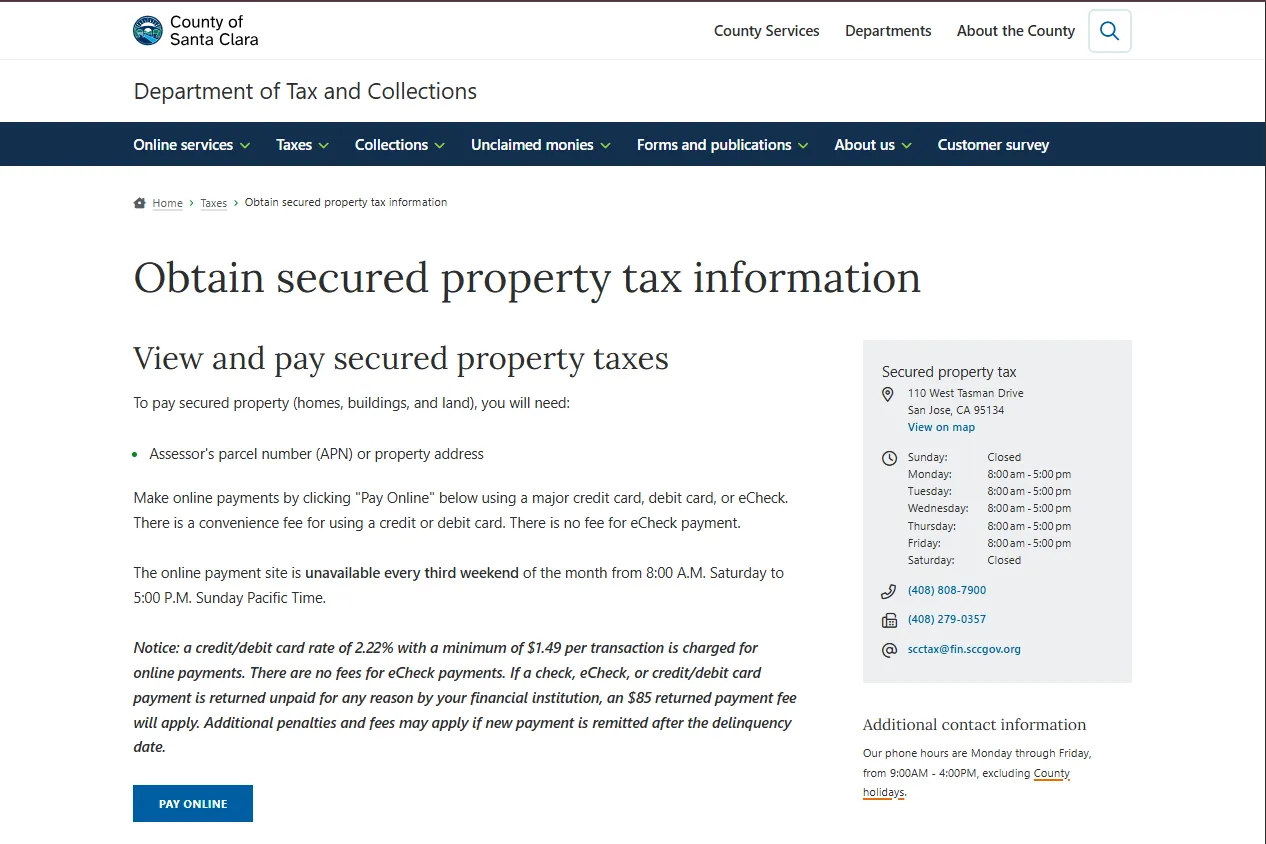
Santa Clara County currently accepts online property tax payments by eCheck and major credit/debit cards. The county’s secured-tax page currently lists eCheck as no-fee and card payments at a 2.22% convenience fee with a $1.49 minimum per transaction.
Currently listed by the county with no convenience fee. Verify routing/account details carefully before submitting.
Current county guidance lists a 2.22% convenience fee with a $1.49 minimum per transaction.
Include the payment coupon when available and follow the official USPS-postmark instructions.
Useful when you need direct bill-specific help or want a counter receipt.
Santa Clara County currently allows partial payments on current secured property tax under specific rules.
DTAC says mailed payments with coupons typically take about 2–5 business days to process after receipt.
Returned-payment warning: the county currently lists an $85 returned-payment fee for an unpaid check, eCheck or card payment. If the replacement arrives after delinquency, additional penalties may apply.
- Search by APN or property address.
- Verify the fiscal year and installment.
- Check payments already posted.
- Choose eCheck or card.
- Review any fee shown before final submission.
- Save the confirmation number and later verify posting.
Santa Clara County Property Tax Due Dates
Annual secured property tax is payable in two installments. The due date and the delinquency date are not the same thing.
Lien date. The Assessor determines the property’s taxable value for the assessment cycle.
Annual secured bills are generally mailed during October and no later than the statutory billing period.
First secured installment is due.
Last normal day to pay the first installment without the secured-tax delinquency penalty.
Second secured installment is due.
Last normal day to pay the second installment without the secured-tax delinquency penalty.
Important year-end date before unpaid current secured taxes move into additional default/redemption treatment.
If December 10 or April 10 falls on a weekend or County holiday, the delinquency deadline moves to the next business day.
Follow the county’s online payment cutoff and Pacific Time instructions when paying on the last day.
Do not wait for a mailed bill. Failure to receive a property tax bill generally does not excuse a late-payment penalty. Search the account online when a bill is missing.
Put both December 10 and April 10 on your calendar even if your lender normally pays through escrow.
Mail Payments: Santa Clara County Postmark Rules
Mail timing is one of the most avoidable causes of property-tax penalties. Santa Clara County relies on an official U.S. Postal Service postmark for mailed tax-payment timing.
Bank bill-pay warning: DTAC specifically warns that home-banking envelopes may not receive a USPS postmark. A payment initiated before the deadline can still be treated as late if the county receives it afterward without qualifying postmark proof.
Santa Clara County Partial Property Tax Payments
Santa Clara County currently allows partial payments on current secured property tax, but partial payment does not extend the delinquency deadline.
The first installment must be fully paid before money can be applied to the second installment.
The county states that a separate contract is not required simply to make partial current-tax payments.
If part of an installment remains unpaid after the delinquency date, the normal penalty applies to the unpaid balance.
Current secured installments must ultimately be paid before the fiscal-year-end default rules apply.
- Open the county payment system.
- Find the parcel and current bill.
- Review payments already made.
- Use the option that allows entry of an amount below the balance due.
- Keep track of the remaining balance and delinquency date.
A partial payment reduces what remains due; it does not create a new due date.
Supplemental Property Tax: New Buyers and New Construction
A supplemental tax bill is separate from the regular annual secured bill. California supplemental assessments can follow certain changes in ownership or completed new construction and place the new assessed value into effect before the next regular roll.
A purchase or other reassessable transfer can establish a new base-year value.
Completed new construction can produce a supplemental assessment for the added value.
The supplemental assessment is generally prorated for the applicable portion of the fiscal year.
Receiving a supplemental bill does not replace the normal annual secured property tax bill.
Do not assume your mortgage company receives or automatically pays every supplemental bill.
Purchase timing and reassessment periods can sometimes result in more than one supplemental bill.
- Find the change-of-ownership date on your closing documents.
- Review the Assessor’s supplemental assessment notice.
- Match the APN and new assessed value.
- Open the separate supplemental tax bill.
- Read the bill-specific delinquency dates.
- Ask your lender whether it will pay the supplemental bill.
- Keep the annual and supplemental bills as separate records.
Bill-date rule: supplemental-bill delinquency timing can differ depending on when the bill is mailed. Read the dates printed on the supplemental bill instead of assuming the annual December 10 / April 10 schedule always controls.
Santa Clara County Property Tax Rate and Proposition 13
California’s Proposition 13 generally limits the basic ad valorem property tax rate to 1% of taxable assessed value, plus amounts needed for voter-approved indebtedness. That is why the final Santa Clara County bill can be more than a simple 1% calculation.
For many properties, the taxable base follows Proposition 13 rules until a qualifying change in ownership or new construction triggers reassessment.
Factored base-year value generally increases by the California inflation factor, limited to 2% in a year.
Debt-service rates can make the ad valorem total higher than the basic 1% amount.
Parcel taxes, sewer, school or other direct charges may appear separately from the Assessor-based ad valorem calculation.
Two similar Santa Clara County homes can have very different assessed values because their base-year values may have been established at different purchase dates.
Why Did My Santa Clara County Property Tax Bill Change?
A reassessable ownership change can create a new base-year value and supplemental assessment.
Completed new construction may increase assessed value and produce supplemental tax.
Check whether the Homeowners’ or other expected exemption appears on the assessment and bill.
Tax-rate-area charges can move independently of your base assessment.
A school parcel tax, sewer charge or other agency assessment can change the total.
Penalty, cost or returned-payment charges can increase what is owed.
Compare the new bill with the prior year line by line. Determine whether the difference comes from value, rate, exemption, direct charge or payment status before contacting an office.
Santa Clara County Property Tax Exemptions and Relief
The Homeowners’ Exemption is the most common owner-occupant benefit. Santa Clara County’s current Assessor materials state that qualifying owners who occupy the home as their principal residence may receive up to a $7,000 reduction in taxable assessed value.
For qualifying owner-occupants using the property as their principal residence.
Available under California rules to qualifying disabled veterans or certain surviving spouses.
Proposition 8 may allow a temporary reduction when market value falls below the factored base-year value.
Property damaged by qualifying misfortune or calamity may have a separate reassessment route.
Certain qualifying transfers can be excluded from reassessment when the statutory requirements and filing rules are met.
California’s state program can defer current-year taxes for qualifying seniors, blind homeowners or homeowners with disabilities.
- Confirm you own and occupy the property as your principal residence.
- Find the APN.
- Check whether the exemption already appears.
- Review the Assessor’s current claim form and deadline instructions.
- Keep a copy of the filed claim.
2026–27 state postponement update: California’s Property Tax Postponement program currently lists an annual household income limit of $57,002, generally requires at least 40% equity, and opens filing October 1, 2026 through February 10, 2027. Postponed taxes are deferred, not forgiven, and are secured by a lien.
How to Appeal a Santa Clara County Property Assessment
A high bill and a high assessed value are not the same problem. If you believe the Assessor’s value is wrong, review the Assessor’s dispute process and preserve the formal Assessment Appeals deadline.
- Open the Assessor’s dispute page.
- Identify regular, supplemental or escape assessment.
- Check the filing deadline before gathering extensive evidence.
- Use the official Assessment Appeals application process if needed.
- Save the filing confirmation and case number.
Do not let informal conversations cause you to miss the Assessment Appeals filing window.
Refunds, Duplicate Payments and Unclaimed Property Tax
Property-tax refunds can result from duplicate payments, overpayments, reduced assessments, uncashed refund checks or other adjustments.
A homeowner and mortgage servicer can both pay when account status is not checked first.
A corrected or reduced assessment can change tax liability and produce a refund.
A refund can become unclaimed when the mailing address is outdated.
County-issued refunds can remain unclaimed when checks are not deposited.
- Open the county unclaimed property tax page.
- Search the current list or online claim system.
- Match the payee and APN when available.
- Prepare government-issued identification.
- Prepare property ownership evidence.
- Save the submitted claim confirmation.
The county states that listed unclaimed property-tax funds remaining unclaimed for more than two years can be transferred to the County’s general fund under the cited state law, so do not ignore a valid refund listing.
Late Payment and Penalty Cancellation
For normal secured installments, Santa Clara County states that late payment can trigger a 10% penalty plus a $20 cost on the delinquent installment or unpaid balance.
After June 30: unpaid current secured property taxes can move to the tax-defaulted file. County guidance states that a $30 redemption fee is added and redemption penalties accrue at 1.5% per month until paid.
A penalty cancellation is not discretionary customer service. DTAC may only cancel penalties when the reason fits authority provided by California law.
An error by the Tax Collector, Auditor or Assessor may support cancellation under applicable law.
Documented circumstances such as specific unexpected hospitalization, certain natural disasters or qualifying emergencies may be considered.
DTAC states that non-receipt of a property tax bill is not itself grounds for penalty cancellation.
Without an accepted USPS postmark, an early bank-bill-pay initiation does not necessarily establish timely payment.
DTAC states that financial circumstances alone are not a statutory basis for cancellation.
DTAC requires the balance and penalty to be paid before it reviews the cancellation request; approved penalties are refunded.
- Read DTAC’s qualifying legal grounds.
- Pay the amount required for review.
- Enter the APN, bill and contact information.
- Explain the qualifying reason precisely.
- Attach supporting documentation.
- Keep the submission confirmation.
Mortgage Escrow Checklist
A mortgage escrow account means your servicer may collect money from you for taxes. It does not prove the tax authority already received the payment.
Use the APN or address in the official tax system.
Check first or second installment separately.
Look for lender or servicer payment before paying yourself.
Compare scheduled and completed disbursements.
Do not assume annual escrow procedures cover supplemental tax.
Keep county status and servicer documentation if a dispute develops.
If the deadline is close and the county still shows unpaid tax, contact the mortgage servicer immediately. Do not wait until after delinquency to investigate.
Santa Clara County New-Owner Checklist
Match the deed, closing statement and Assessor record.
Make sure Assessor and tax correspondence will reach you.
See whether current installments are already paid.
A new purchase can trigger reassessment and separate billing.
A new owner must file their own qualifying claim even if the prior owner received the exemption.
Ask the servicer exactly which tax bills it will pay.
Buying the property does not reset every tax process into one bill. Annual secured tax, supplemental tax, escrow and exemption filing can all move on separate timelines.
Santa Clara County DTAC Office and Contact Information
Use the Department of Tax and Collections for bill-specific payment questions, mailed payments, refunds, delinquent secured tax and other collection issues. Check current hours before visiting.
Santa Clara County Department of Tax and Collections
110 West Tasman Drive
San Jose, CA 95134
(408) 808-7900
County guidance lists phone assistance Monday–Friday, 9:00 AM–4:00 PM, excluding County holidays.
Current DTAC property-tax pages list office hours of 8:00 AM–5:00 PM Monday–Friday, excluding County holidays.
APN, tax bill, fiscal year, installment, payment proof, escrow statement and any relevant county correspondence.
If your problem is assessed value or exemption eligibility, visiting DTAC may not solve it. The Assessor’s West Tasman office handles assessment-side questions.
Santa Clara County Property Tax Terms
- APN
- Assessor’s Parcel Number, the main parcel identifier used across Assessor and property-tax records.
- Secured Tax
- Tax secured by real property such as land and buildings.
- Supplemental Assessment
- A prorated reassessment after certain changes in ownership or completed new construction.
- Tax Rate Area
- The geographic combination of taxing agencies and rates applying to a parcel.
- Homeowners’ Exemption
- A qualifying principal-residence exemption that can reduce assessed value by up to $7,000.
- Redemption
- The process for paying property tax after current secured tax becomes tax-defaulted.
Official Santa Clara County Property Tax Links
Santa Clara County Property Tax FAQs
How do I search for my Santa Clara County property tax bill?
Use Santa Clara County’s official secured property tax system and search by Assessor’s Parcel Number (APN) or property address. Confirm the property, tax year, bill type, installment and current balance before paying.
What are the Santa Clara County secured property tax due dates?
The first secured installment is due November 1 and normally becomes delinquent after December 10. The second installment is due February 1 and normally becomes delinquent after April 10. If a delinquency date falls on a weekend or County holiday, the deadline moves to the next business day.
How much does Santa Clara County charge to pay property tax online?
The county currently lists no fee for eCheck. Credit and debit card payments currently carry a 2.22% convenience fee with a minimum fee of $1.49 per transaction. Always review the fee shown by the official system before submitting payment.
Will my mortgage lender automatically pay a Santa Clara County supplemental tax bill?
Do not assume it will. Supplemental bills are separate from the regular annual secured bill, and lenders may not automatically receive or pay them. Check with the servicer and verify the county account before the supplemental bill becomes delinquent.
How do I appeal a Santa Clara County property assessment?
Start with the Assessor’s assessed-value dispute guidance. Regular assessment appeals generally use the county’s July 2–September 15 filing period, while supplemental and escape assessments generally have shorter notice-based deadlines. Filing an appeal does not automatically stop the tax-payment requirement.
Bottom Line
For Santa Clara County property tax, start with the APN or property address, identify the exact bill type, check the current installment and delinquency date, verify escrow and prior payments, then use DTAC’s official system for payment. Use the Assessor for value and exemption issues, and protect the formal appeal deadline if assessed value is disputed.
Find My Bill Pay Tax Due Dates Supplemental Tax Exemptions Official LinksMaterially reviewed and updated: August 27, 2026.