
California Property Tax Guide: Find the Right County, Pay Safely & Read Your Bill
California property tax is not paid through one statewide website. Your actual bill, search tool, payment page, penalty amount, exemption claim and appeal deadline usually depend on the county where the property is located. This guide gives you the practical order: find the correct county office, search the parcel, read the secured or supplemental bill, verify the installment deadline, check exemptions or postponement help, and then use the official county tax collector for the final payment.
Quick Answer
To handle California property tax safely, first identify the county where the property is located. Use the county assessor for value, ownership, parcel details and exemptions. Use the county tax collector for bills, payments, penalties, refunds and delinquent-tax questions. For statewide rules and county contacts, use California Board of Equalization pages and the California State Controller’s Property Tax Postponement program when applicable.
Start Here: What Are You Trying to Do?
California property tax tasks are split between county offices. Use this table before paying, filing an exemption, calling a county office or trying to appeal a value.
| Your Situation | Best Starting Point | Why | Next Step |
|---|---|---|---|
| I need to pay my property tax | County tax collector | California payments are county-based, not one statewide payment portal. | Follow payment guide |
| I need to search a bill or parcel | County assessor or tax collector | Search tools may use parcel number, assessment number, address, bill number or owner information depending on county. | Search records |
| I need the due date | County tax collector plus BOE calendar | Statewide secured-roll dates are common, but payment instructions and deadline handling are local. | Check due dates |
| I want a Homeowners’ Exemption | County assessor | The claim is filed with the county assessor where the property is located. | Review exemptions |
| I bought a home and got another bill | County assessor and tax collector | A supplemental bill can be separate from the regular annual bill. | Understand supplemental bills |
| I think the value is wrong | County assessor or assessment appeals board | Value disputes are handled through assessment review or appeal, not by normal payment. | Review appeal steps |
Find the Right California County Property Tax Office
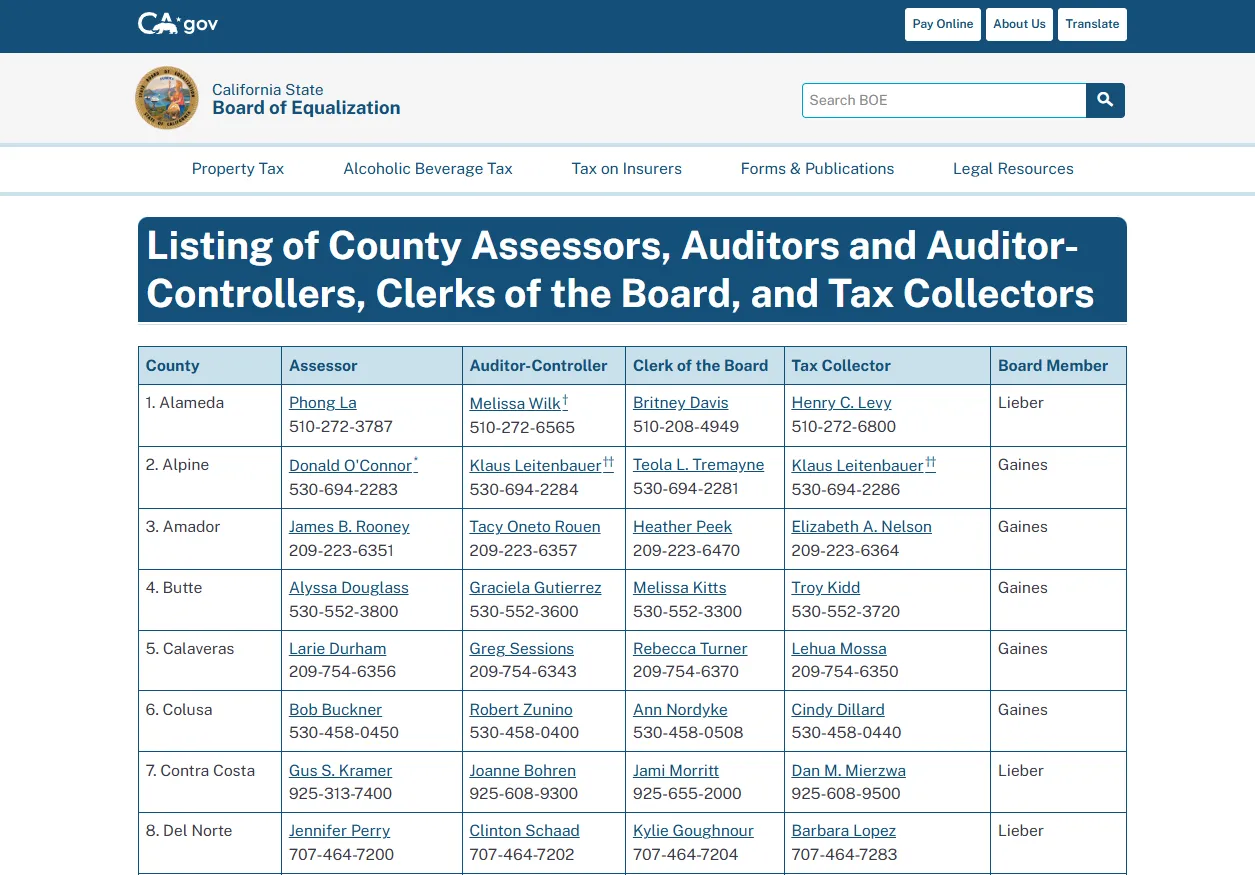
The most important California property tax step is finding the correct county office. A statewide article can explain the rules, but your bill, search portal, payment page, mailing address, refund question, exemption claim and appeal window normally depend on the county where the property is located.
- Open the California BOE county contacts page.
- Find the county where the property is located.
- Use the assessor for property value, ownership records, parcel details and exemptions.
- Use the tax collector for bills, payment options, mailed payments, penalties, refunds and delinquent taxes.
- Use the Clerk of the Board or assessment appeals contact if you need to appeal assessed value.
Practical rule: if you are trying to pay, start with the county tax collector. If you are trying to fix assessed value, ownership details, mailing address or exemptions, start with the county assessor.
How to Pay California Property Tax
California property taxes are usually paid to the county tax collector, not to a single statewide payment portal. Most counties offer online payment, mailed payment, in-person payment and sometimes phone or bank-related options. Always search and verify the bill before paying.
- Open the BOE county contacts page.
- Choose the county where the property is located.
- Open the county tax collector’s official website.
- Search the bill and confirm the installment.
- Pay only after the parcel, amount and payment screen match your records.
| Payment Method | Best For | Before You Pay | User Tip |
|---|---|---|---|
| Online payment | Fast payment through the official county tax collector website. | Verify parcel number, tax year, installment, amount and convenience fee. | Save the confirmation page immediately. |
| Users paying by check with a payment stub or coupon. | Use the county’s official mailing address and include the correct stub if required. | Near the deadline, use mailing proof or a postmark-friendly method. | |
| In person | Users who need a receipt or help with a bill question. | Check county office hours, accepted payment types and required documents. | Bring the bill, parcel number and ID if needed. |
| Mortgage escrow | Homeowners whose lender pays from an impound or escrow account. | Check whether the lender payment has already posted. | Do not double-pay without checking posted payment status. |
| Prior-year or delinquent payment | Older unpaid balances or defaulted taxes. | Contact the county tax collector or use delinquent-tax tools. | Rules may differ from current secured-tax bills. |
How to Search California Property Tax Records
Property tax search tools are county-based. Some counties use parcel number, some use assessment number, some allow address search, and some also provide owner or bill-number search. The safest search method is usually the parcel number because it identifies the property more directly than a name.
- Start with parcel number or assessment number if available.
- If using address, confirm the exact property, city and county.
- Check the tax year and bill type before paying.
- Compare the bill with escrow, deed or closing documents if you recently bought the property.
- Do not pay only because the owner name looks familiar.
Best when you have a prior bill, deed, closing statement, assessment notice or escrow document.
Useful when you do not know the parcel number. Confirm the correct city, property type and mailing details.
Some county tax collectors let you search by bill number, assessment number or tax year.
Use owner name only as a supporting clue. Names can change, be abbreviated or be listed under trusts and companies.
California Property Tax Due Dates
California secured property tax bills commonly follow two installments. The first installment is due November 1 and becomes delinquent if unpaid after December 10. The second installment is due February 1 and becomes delinquent if unpaid after April 10. If a date falls on a weekend or legal holiday, counties may apply the next-business-day rule, but always confirm with the county tax collector before waiting until the last minute.
- Review the statewide BOE property tax calendar.
- Open your county tax collector’s due-date or payment page.
- Confirm the tax year, bill type and installment.
- If the date already passed, check payment status and penalty before paying.
- Save proof if paying close to any deadline.
| Tax Event | Typical Date | What It Means | Action |
|---|---|---|---|
| Annual secured bills mailed or transmitted | On or before November 1 | County tax collectors mail or electronically transmit county tax bills to property owners. | If you do not receive a bill, search online or contact the county tax collector. |
| First installment due | November 1 | The first half of the secured tax bill is due. | Pay before the delinquency deadline to avoid penalty. |
| First installment delinquent | December 10 | Penalty may apply if unpaid after the deadline. | Check posted status before sending a late or duplicate payment. |
| Second installment due | February 1 | The second half of the secured tax bill is due. | Confirm whether escrow or mortgage servicer will pay. |
| Second installment delinquent | April 10 | Penalty may apply if unpaid after the deadline. | Pay before the deadline and save confirmation. |
| Unpaid taxes in default | July 1 | Unpaid secured taxes can move into default status. | Contact the county tax collector if the balance remains unpaid. |
Important: statewide dates are helpful, but payment instructions are local. Always use the county tax collector’s current page for final due dates, payment fees, penalty details and accepted payment methods.
How to Read a California Property Tax Bill
A California property tax bill can include more than one number. Before paying, read the bill carefully so you know whether it is a regular secured bill, supplemental bill, corrected bill, escape assessment, prior-year balance, direct assessment or special assessment item.
| Bill Area | Why It Matters | What to Check |
|---|---|---|
| Parcel or assessment number | Identifies the property in the county system. | Match it with your deed, escrow documents or prior bill. |
| Tax year | Shows the year the bill applies to. | Do not confuse current bills with prior-year or supplemental bills. |
| Installment stubs | Each installment may have a separate payment stub or amount. | Use the correct stub if mailing payment. |
| Assessed value | Helps explain the taxable base before rates and charges. | Compare to assessment notice and prior-year values. |
| Exemptions | Missing exemptions can increase the taxable amount. | Look for Homeowners’ Exemption or applicable veteran/other exemptions. |
| Special assessments or direct charges | These may appear on the bill but may not be reduced by standard exemptions. | Review line items such as bonds, Mello-Roos, assessments or local charges. |
Practical tip: if the bill amount changed suddenly, compare assessed value, exemptions, parcel changes, supplemental events and local charges before assuming the county made a payment mistake.
California Property Tax Rate: Why the Bill Is Not Just One Number
California is known for Proposition 13, but your actual bill can still vary by property and county. A bill may include the general 1% ad valorem tax, voter-approved debt, direct assessments, special taxes, local charges and supplemental taxes. A lower assessed value does not always remove direct charges, and exemptions may not apply to every line item.
- Compare current assessed value with last year’s assessed value.
- Check whether ownership changed, construction was completed or a supplemental bill was issued.
- Review whether a Homeowners’ Exemption or other exemption is missing.
- Look for local bonds, Mello-Roos, direct charges or special assessments.
- If the assessed value looks wrong, review county assessment appeal options.
Assessed value generally follows base-year value rules and annual limits unless a reassessment event occurs.
Two similar homes can have different bills if they are in different districts or have different special assessments.
Some exemptions reduce assessed or taxable value, but not every special charge is reduced.
Buying a property or completing new construction can trigger a separate bill outside the regular annual cycle.
California Property Tax Exemptions and Assistance
California exemptions and assistance programs depend on the owner, property use and county filing rules. Most exemption claims begin with the county assessor. Do not assume an exemption is applied just because you qualify; check your bill and property record.
- Open your county assessor’s website.
- Search the parcel or assessment record.
- Review whether the exemption appears on the bill or record.
- If missing, download the correct county form or use the county filing portal.
- Save the claim confirmation and watch a later bill for correction.
| Program | Who Should Review | What It May Do | Where to Start |
|---|---|---|---|
| Homeowners’ Exemption | Owners who occupy the home as their principal residence on the lien date. | Provides a $7,000 reduction in taxable value for a qualifying owner-occupied home. | BOE Homeowners’ Exemption |
| Disabled Veterans’ Exemption | Qualifying disabled veterans or eligible spouses. | May reduce taxable value if requirements are met. | BOE Disabled Veterans’ Exemption |
| Property Tax Postponement | Eligible seniors, blind homeowners or disabled homeowners with qualifying principal residences. | May defer current-year property taxes, secured by a lien that must eventually be repaid. | State Controller PTP |
| Institutional and other exemptions | Religious, nonprofit, welfare, school, hospital or other qualifying property owners. | May exempt eligible property from ad valorem tax if requirements are met. | BOE Exemptions |
California Supplemental Property Tax Bills
A supplemental bill can surprise new homeowners because it is separate from the regular annual bill. In California, a change in ownership or completed new construction can create a supplemental assessment. That can lead to an extra bill that may not be included in your regular escrow estimate.
- Open the BOE supplemental assessment page.
- Read how change in ownership or new construction can create an additional bill.
- Compare the supplemental bill with your regular secured bill.
- Ask your county tax collector whether the bill is current, supplemental or prior-year.
- Ask your mortgage servicer whether escrow or impound will pay the supplemental bill.
A new purchase can trigger a reassessment and separate supplemental bill.
Completed construction can create a supplemental assessment separate from the regular bill.
Supplemental bills may not always be paid through a lender’s regular impound account.
The bill may cover only part of the fiscal year depending on the event date.
Appealing a California Property Tax Assessment
If your problem is value, not payment, the tax collector usually cannot fix it. Assessment disputes normally start with the county assessor and may involve the county assessment appeals board or Clerk of the Board. Payment deadlines still matter while an appeal is pending, so do not ignore the bill.
- Review the BOE assessment appeals information.
- Find your county Clerk of the Board or assessment appeals office.
- Confirm the filing window and required form.
- Collect value evidence before filing.
- Keep paying attention to tax bill deadlines while the appeal is pending.
| Problem | Likely Office | What to Prepare | Important Reminder |
|---|---|---|---|
| Market value looks too high | County assessor or assessment appeals board | Comparable sales, property facts, photos, assessment notice and parcel data. | Appeal deadlines are county-specific. |
| Property details are wrong | County assessor | Building size, use, condition, ownership records or correction evidence. | Fixing records may take time. |
| Exemption missing | County assessor | Claim form, proof of occupancy, veteran/disability documents or other required records. | This may be a filing/correction issue, not an appeal. |
| Payment posted incorrectly | County tax collector | Receipt, confirmation number, bank record, parcel number and tax year. | This is a payment-status issue, not an assessment appeal. |
Property Tax Postponement for Seniors, Blind or Disabled Homeowners
California’s State Controller administers a Property Tax Postponement program for eligible homeowners who are seniors, blind or have a disability. This is not a tax cancellation. It is a deferment secured by a lien and must eventually be repaid. Always read the current year’s income, equity, occupancy and application rules before applying.
- Open the State Controller’s Property Tax Postponement page.
- Review the current program year timeline.
- Check age, disability/blind status, principal residence, equity and income requirements.
- Download or request the current application instructions.
- Apply only if you understand the lien and repayment rules.
Mortgage Escrow and California Property Taxes
If your lender collects property taxes through escrow or an impound account, still verify county payment status. Escrow collection and county payment posting are not the same thing. This matters when bills are near a deadline, when a supplemental bill arrives or when you refinance.
- Search the county tax collector’s bill page before paying yourself.
- Check whether the lender has posted payment for the correct installment.
- Ask whether supplemental bills are covered by the escrow or impound account.
- Keep escrow statements, county payment status screenshots and receipts.
- If the bill is unpaid near the deadline, contact the mortgage servicer immediately.
Documents to Keep Before and After Paying
Property tax issues are easier to fix when you can prove the parcel, bill, payment and timeline. Save records even when you pay online.
Parcel number, county bill, assessment notice, escrow statement, exemption record and due-date page.
Receipt, confirmation number, bank record, check image, postmark proof or county payment status screenshot.
Proof of occupancy, ownership, veteran/disability documents, claim forms and county filing confirmation.
Assessment notice, comparable sales, photos, appraisals, property facts and appeal application copy.
Helpful Internal Property Tax Guides
Use these related guides to understand general property tax concepts. Use official California or county websites for final payments, filings and account-specific decisions.
Official California Property Tax Links
Use these official sources to move from this guide to the correct government action page.
Editorial Trust and Update Notes
CountyPropertyTaxes.us is an independent informational guide. It is not the State of California, California Board of Equalization, California State Controller, California Tax Service Center or any county assessor or tax collector. This page is written to help users understand the process before taking official action.
Review checklist for future updates: county contact directory, secured-tax due dates, Homeowners’ Exemption amount, Property Tax Postponement rules, supplemental assessment guidance, assessment appeal filing windows, county-specific payment links, internal links and FAQ answers should be reviewed whenever official California sources change.
California Property Tax FAQs
Where do I pay California property tax?
You usually pay California property tax through the county tax collector where the property is located. Use the California BOE county contacts page to find the correct county tax collector.
Can I pay California property tax on one statewide website?
No. California property tax payments are county-administered. Statewide pages explain rules and contacts, but payment is usually completed on a county tax collector website.
How do I search California property tax records?
Start with the county assessor or county tax collector website. Search by parcel number, assessment number, bill number or property address depending on the county system.
What are the California property tax due dates?
For secured property taxes, the first installment is generally due November 1 and delinquent after December 10. The second installment is generally due February 1 and delinquent after April 10. Confirm with your county tax collector.
What happens if December 10 or April 10 falls on a weekend or holiday?
The BOE calendar notes that if a specified date falls on Saturday, Sunday or a legal holiday, the action may be done on the next business day. Still confirm the exact rule with your county tax collector.
What is the California Homeowners’ Exemption?
The California Homeowners’ Exemption provides a $7,000 reduction in taxable value for a qualifying owner-occupied principal residence. Claims are filed with the county assessor.
Who handles property tax exemptions in California?
The county assessor generally handles exemption claims, including the Homeowners’ Exemption and other property-tax savings programs.
What is a supplemental property tax bill in California?
A supplemental bill can be issued after a change in ownership or completed new construction. It is separate from the regular annual property tax bill.
Does my mortgage escrow pay supplemental property taxes?
Not always. Some supplemental bills may not be paid through escrow or an impound account. Ask your mortgage servicer and check the county tax collector’s records.
How do I appeal my California property tax assessment?
Start with your county assessor or county assessment appeals office. BOE provides statewide appeal guidance, but filing is handled locally through the county process.
Do I still need to pay while appealing my assessment?
Yes. An appeal does not automatically remove the obligation to pay taxes by the due date shown on the bill. If a reduction is granted, the county may issue a proportionate refund.
What is the Property Tax Postponement program?
The State Controller’s Property Tax Postponement program may allow eligible seniors, blind homeowners or disabled homeowners to defer current-year property taxes on a principal residence. The deferment is secured by a lien and must eventually be repaid.
Why did my California property tax bill change?
Your bill may change because of reassessment, ownership transfer, new construction, supplemental assessment, missing exemption, local bonds, Mello-Roos, direct charges or special assessments.
Who should I contact for a payment problem?
Contact the county tax collector for payment status, refunds, penalties, mailed payment issues, delinquent taxes and bill payment questions.
Who should I contact for a property value problem?
Contact the county assessor first. If the value dispute cannot be resolved, review the county assessment appeals process.
Is CountyPropertyTaxes.us an official California tax website?
No. This is an independent informational guide. Final payments, exemption claims, appeals and official records should be handled through official state or county government websites.
Bottom Line
For California property tax, the correct county matters first. Find your county office, search the property, confirm the bill and due date, check exemptions or postponement help, understand supplemental bills if you recently bought or built, then pay through the official county tax collector.
Find County OfficeHow to PayDue DatesExemptionsOfficial Links